

A foreigner can set up a company in Vietnam, and in most business lines the company can be 100% foreign-owned. Under Article 19(2) of the Law on Investment 2025 (No. 143/2025/QH15), a foreign investor may now establish the company before obtaining the Investment Registration Certificate (Giấy chứng nhận đăng ký đầu tư, IRC), if it meets the market access conditions. However, a company formed this way must obtain that certificate within 12 months and cannot run its project until then. Pham Do Law Firm explains each step of setting up a business in Vietnam below.
By lawyer Do Thi Thu Hoai, Founder and Lawyer Partner of Pham Do Law Firm. Updated 10 November 2026.
| At a glance | Rule in 2026 |
|---|---|
| Foreign ownership | Up to 100% in most business lines; Appendix I of Decree 96/2026/ND-CP lists the exceptions |
| Certificates | Investment Registration Certificate (IRC) and Enterprise Registration Certificate (ERC), in either order |
| Time set by law | IRC 10 working days from a valid dossier; ERC 3 working days from receipt |
| Company-first route | IRC due within 12 months of establishment |
| Charter capital | Paid within 90 days of the ERC, by transfer into a capital account |
| Legal representative | At least one must reside in Vietnam |
| State fees | No fee for the IRC; VND 25,000 for the ERC until 31 December 2026, free when filed online |
The seven steps in this guide
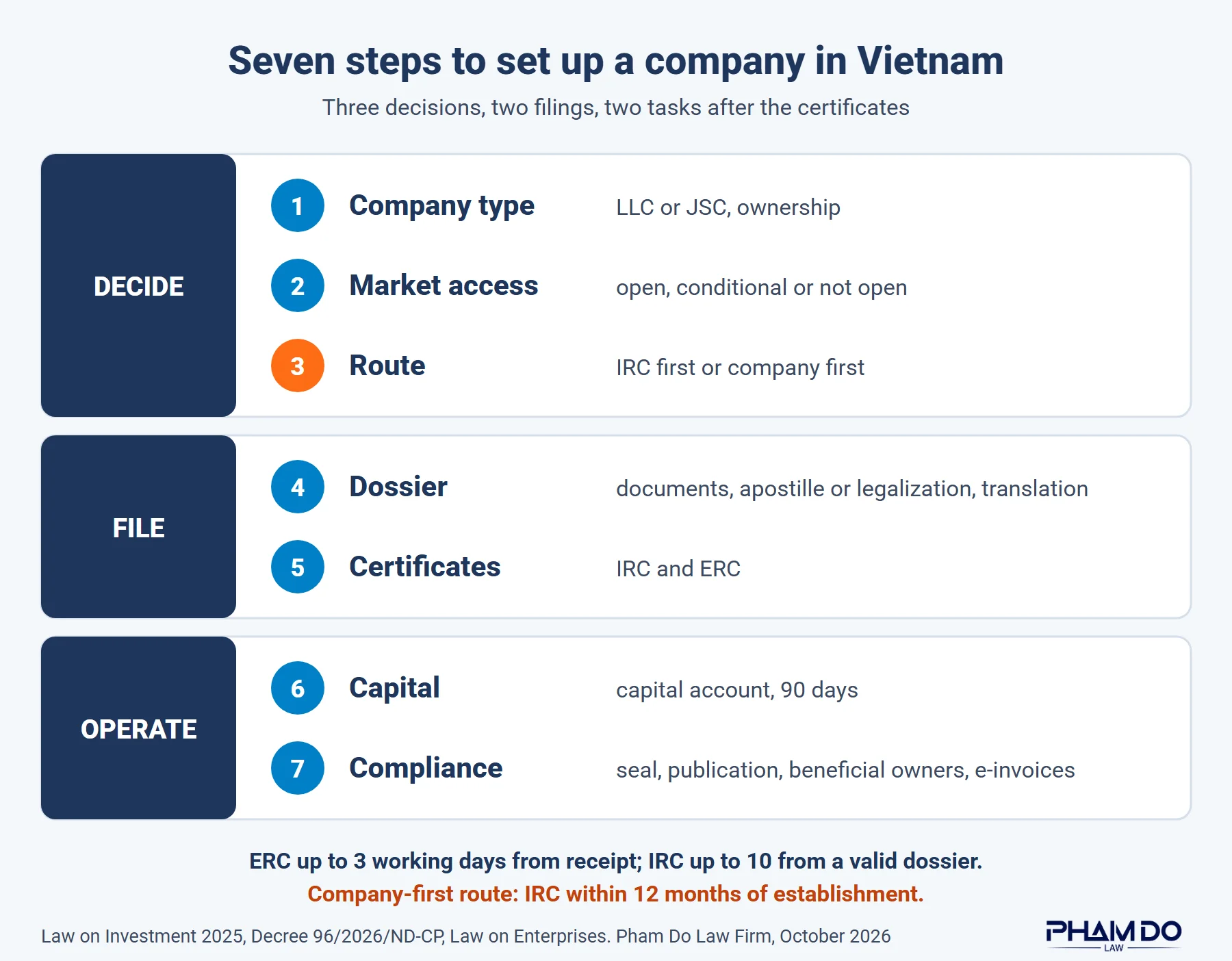
- Decide: company type (see also who can invest and nominee risks)
- Decide: market access and business lines
- Decide: IRC first or company first
- File: documents, address and remote filing
- File: receiving the certificates
- Operate: capital account and 90 days
- Operate: first obligations and taxes
Also in this guide: minimum capital, a visa for the owner, time limits set by law, state fees and frequently asked questions.
Not covered here: representative offices and branches, buying into an existing Vietnamese company, and household businesses. Investment incentives, taking profits out of Vietnam and exit are explained in our guide to foreign direct investment in Vietnam.
Can a foreigner set up a company in Vietnam?

Yes. Organizations and individuals may establish and manage enterprises in Vietnam, except the groups listed in Article 17(2) of the Law on Enterprises, such as state officials and minors (Article 17(1)). Foreign investors are individuals of foreign nationality or organizations established under foreign law, and a company with a foreign member is a foreign-invested company (Article 3(19) and (22) of the Law on Investment 2025).
Household businesses are reserved for Vietnamese citizens (Article 82(2) of Decree 168/2025/ND-CP), so a foreigner uses a company. Buying shares in an existing company is another form of investment, and it needs no IRC (Article 26(2)(c) of the Law on Investment 2025).
Investor, legal representative and director
You can invest personally or through a company you own abroad. Whoever signs for the Vietnamese company is its legal representative (người đại diện theo pháp luật). Under Article 12(3) of the Law on Enterprises, the company must always have at least one legal representative residing in Vietnam, and the last resident representative who leaves the country must authorize another resident in writing.
That person may be a foreigner, including the owner, who then needs a lawful basis to reside in Vietnam. If the only legal representative stays abroad for more than 30 days without authorizing anyone, the owner, the members’ council or the board must appoint another legal representative (Article 12(5)).
“Director” is a management title; the legal representative binds the company in transactions and before courts (Article 12(1)). Each limited liability company or joint stock company may have one or several legal representatives, with their number, titles and powers set in the charter (Article 12(2)).
An owner who will live abroad can therefore remain a legal representative and appoint a second one who resides in Vietnam, with the powers of each set in the charter (Article 12(2) and (3)).
Can a foreigner own 100% of the company?
In most business lines, yes.
Under Article 17(1) of Decree 96/2026/ND-CP, a foreign investor has the same market access as a Vietnamese investor except in the lines listed in Appendix I of that decree. Those lines are either closed to foreign investors or open on conditions, which may include an ownership cap or a required Vietnamese partner.
Nominee and local-name shortcuts, and why they fail
Registering the company in the name of a Vietnamese friend, partner or employee is not a legal shortcut. Under Article 4(1) of Decree 168/2025/ND-CP, as amended by Decree 296/2026/ND-CP, owners, members and shareholders must not stand in for another person when contributing capital. Founders also answer for the accuracy of the registration data.
On the register, the capital belongs to the nominee, not to you. A foreign investor’s own cash capital must arrive by transfer into the company’s capital account (Article 4(4) of Circular 38/2026/TT-NHNN). A hidden owner also contradicts the beneficial owner list the company must declare.
The lawful version of a Vietnamese partner is a real joint venture, with control rights recorded in the charter. See joint ventures and keeping control in our foreign direct investment guide.
If foreign investors, directly or through foreign-majority companies, hold 50% or less of the charter capital, the company follows domestic-investor procedures when it later invests in another company or project (Article 20(1) and (2) of the Law on Investment 2025). Founding that joint venture is still a foreign investor’s project and needs an IRC, unless the foreign investor buys into an existing company (Article 26).
Choose between an LLC and a joint stock company
Most foreign founders choose a limited liability company, while a joint stock company suits a group of at least three shareholders or a plan to issue shares. Representative offices and branches of foreign companies follow a separate route with their own license.
What is an LLC in Vietnam?
In a limited liability company (công ty trách nhiệm hữu hạn, LLC), the owners are liable for its debts only up to the capital they contributed. Such a company has legal personality from the date of its ERC and cannot issue shares unless it converts into a joint stock company (Articles 46 and 74 of the Law on Enterprises).
| Feature | Single-member LLC | Multi-member LLC | Joint stock company (JSC) |
|---|---|---|---|
| Owners | 1 organization or individual | 2 to 50 members | At least 3 shareholders, no maximum |
| Liability | Up to charter capital | Up to capital contributed | Up to capital contributed |
| Issuing shares | No, except to convert into a JSC | No, except to convert into a JSC | Yes |
| Capital deadline | 90 days from the ERC | 90 days from the ERC | 90 days from the ERC, or shorter if the charter says so |
| Legal basis | Articles 74, 75 | Articles 46, 47 | Articles 111, 113 |
Check market access and choose your business lines
Restricted lines and ownership caps
Under Article 8(2) of the Law on Investment 2025, the Government publishes a list of lines with restricted market access for foreign investors, which is Appendix I of Decree 96/2026/ND-CP.
Its section A lists lines not yet open to foreign investors (23 lines when the decree was issued), and section B lists lines open on conditions (62 lines). Those conditions can concern the ownership ratio, the form of investment, the scope of activities, the investor’s capacity or a required partner (Article 8(3)).
Government Resolution 66.18/2026/NQ-CP, in force from 1 July 2026 to 28 February 2027, changes the conditions for some of these lines, such as ship agency and maritime pilotage. Check the portal below for the current conditions.
For example, a company registering advertising (section B, item 6) and logistics (section B, item 43) must meet the conditions of each (Article 17(6) of Decree 96/2026/ND-CP). Where investment treaties set different ownership caps for its lines, the lowest cap applies to the company (Article 17(10)(d)).
| Category | Examples | Appendix I, Decree 96/2026/ND-CP |
|---|---|---|
| Not open to foreign investors | Sending workers abroad under contract; temporary import for re-export; travel services other than inbound international travel; press | Section A, items 6, 14, 23 and 2 |
| Open on conditions | Advertising; education; logistics; real estate business | Section B, items 6, 10, 43 and 19 |
| Open as for Vietnamese investors | Lines not listed in Appendix I, such as management consulting or software development | Not listed; Article 17(1) applies |
Where to check the conditions
Under Article 18 of Decree 96/2026/ND-CP, the Ministry of Finance publishes the market access conditions for each Appendix I line on the National Investment Information Portal (Cổng thông tin quốc gia về đầu tư). Check it on the day you file, because older guides may predate the 2026 decree.
Another list applies to all investors. Until 28 February 2027 that list is Appendix IV of the Law on Investment 2025, in force since 1 July 2026 and narrowed by Government Resolution 66.17/2026/NQ-CP. From 1 March 2027 the list annexed to Law No. 24/2026/QH16 replaces it. Even a line open to foreign investors may still need a sector license under it.
Register business lines wide enough at the start
Register every line you plan to use in the first years, not only the first contract, because of the company-first route: a company set up before its IRC may add other business lines only after that certificate is issued (Article 72(4) of Decree 96/2026/ND-CP).
After the IRC, the company may amend its enterprise registration, including new lines, without a new project, as long as each new line passes the market access check (Article 73(1)). If a new line changes the project objective recorded in the IRC, the investor must also adjust the IRC (Article 33(2) of the Law on Investment 2025).
Sector licenses, trading and import rights
An ERC is not a general business license; Appendix IV lines need their own license before the company operates them. Whether trading and importing need separate licenses depends on the goods, so settle it when choosing the lines.
IRC first or company first?
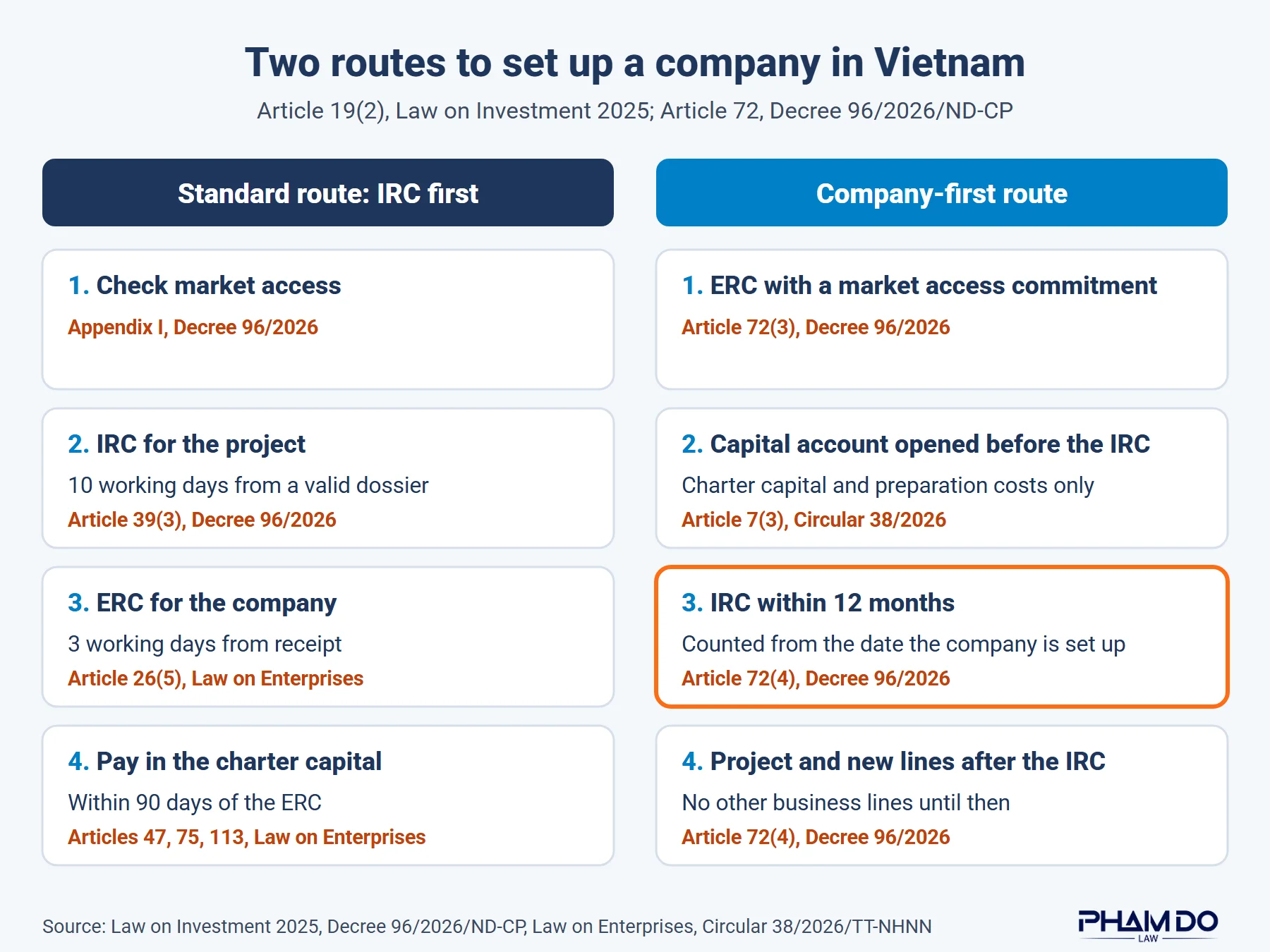
Two routes are lawful; choose one before preparing the documents.
| Your situation | Route | Why |
|---|---|---|
| Service or trading business in an open sector | Company first | The company exists after the ERC while the IRC is prepared |
| Conditional sector | IRC first | The conditions are settled before the company is formed; a company-first company carries the risk alone (Official Letter 5427) |
| You need a company quickly, for example to hire staff | Company first | The ERC comes first, 3 working days from receipt of the dossier |
| Manufacturing in an industrial park or export processing zone, or capital must go into the project from day one | IRC first | A company-first company cannot carry out the project until the IRC (Article 72(4) of Decree 96/2026/ND-CP) |
The standard route: IRC, then ERC
Here the investor first obtains the IRC, because a project of a foreign investor needs one (Article 26(1) of the Law on Investment 2025), and then registers the company.
Which projects need investment policy approval
Most service and trading companies do not. Our guide to foreign direct investment in Vietnam explains the approval track in more detail. Article 24 of the Law on Investment 2025 lists the projects that need investment policy approval (chấp thuận chủ trương đầu tư). They include casinos, foreign investors’ projects in telecommunications with network infrastructure, publishing and press, and projects asking the State for land without an auction or tender. Their IRC follows the approval (Article 38(1)(a) of Decree 96/2026/ND-CP).
The company-first route and the 12-month deadline
Under Article 19(2) of the Law on Investment 2025, a foreign investor may set up the company before the IRC but must meet the market access conditions when establishing it. Its enterprise registration application includes a commitment to meet them (Article 72(3) of Decree 96/2026/ND-CP).
You get: a company with an ERC, an enterprise code that also serves as its tax code, a seal and a capital account limited to charter capital and preparation costs.
You do not get: the right to carry out the project or add other business lines before the IRC (Article 72(4)).
You must: obtain the IRC within 12 months of establishment (Article 72(4)).
Official Letter 5427/BTC-DNTN of the Ministry of Finance (29 April 2026) states that the registration office need not examine the investor’s commitment; the investor bears the legal responsibility. A closed or conditional line therefore surfaces only at the IRC stage.
Decree 96/2026/ND-CP does not state the consequence of passing the 12 months without an IRC. Pham Do Law Firm recommends preparing the IRC dossier together with the company registration.
Documents for the IRC and the ERC
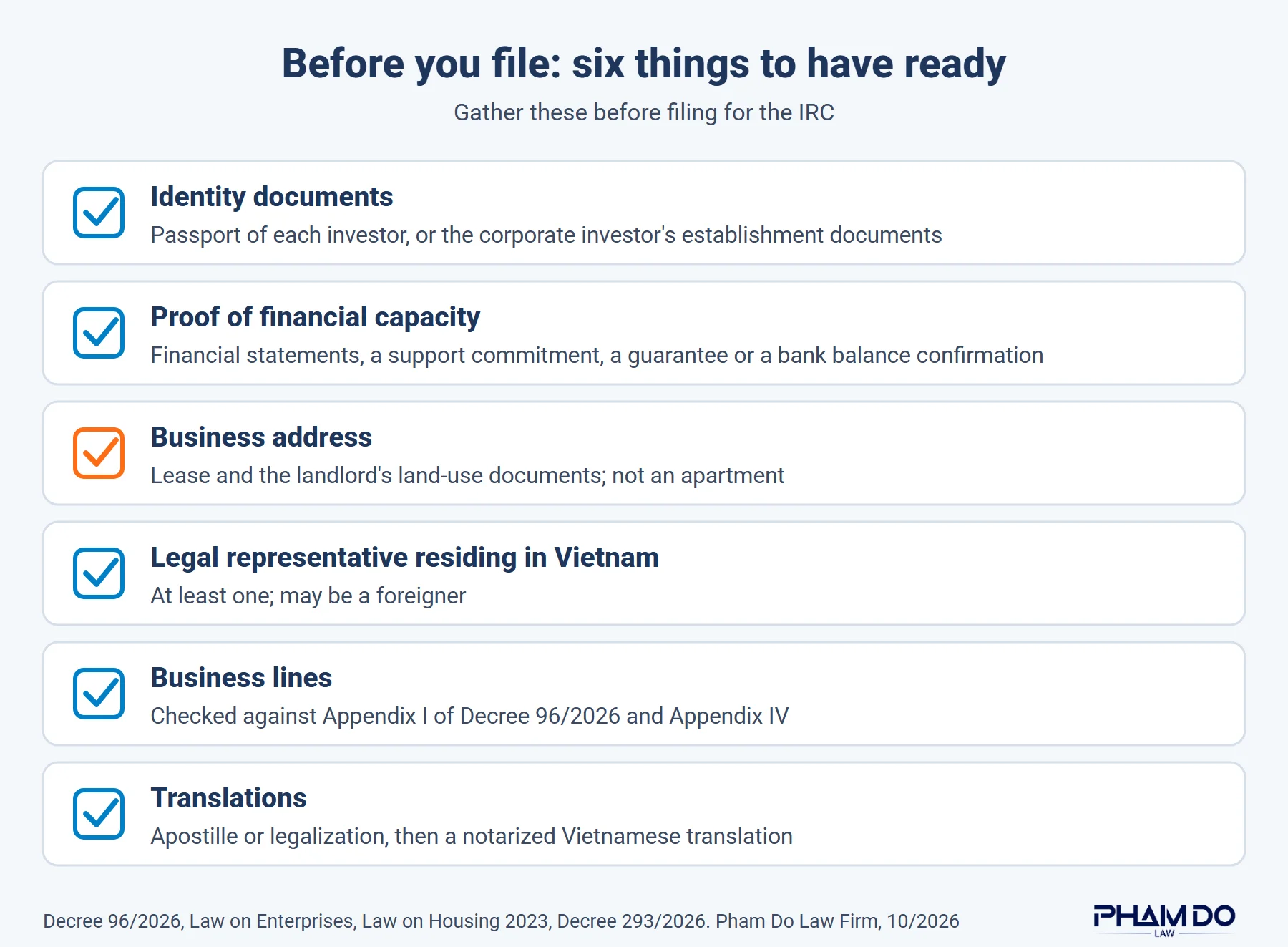
Gather the documents before you file. Most come from the investor, and foreign documents need a Vietnamese translation and often an apostille or legalization.

| Document | For the IRC | For the ERC |
|---|---|---|
| Application | Request to implement the project | Enterprise registration application; under the company-first route it includes the market access commitment |
| Investor’s legal status | Copy of a valid passport (individual) or of the establishment certificate (organization) | Copies of the legal documents of members and of the legal representative; a foreign organization’s documents must be legalized, or apostilled where the Apostille Convention applies between the issuing country and Vietnam |
| Financial capacity | At least one document listed in Article 32(1)(c) | Not required |
| Project proposal | Objectives, scale, capital, location, schedule, labor needs | Not required |
| Location | Copy of the land-use document or another document on the right to use the site | Head office address in the application |
| Company documents | Not required | Charter; list of members or founding shareholders; list of beneficial owners, if any; copy of the IRC under the standard route |
No document outside the legal list may be requested (Article 6(1)(b) of Decree 96/2026/ND-CP). A personal proof of residence for the investor or a bank reference letter about the investor’s character, often listed online, is not part of it.
Choose the company name early. The Vietnamese name consists of the company type followed by a proper name. The registration office may refuse a name that is identical or confusingly similar to a registered one (Articles 37, 38 and 41 of the Law on Enterprises). Search the National Business Registration Portal before you file.
Proof of financial capacity
For the IRC, the investor proves financial capacity (Article 32(1)(c) of Decree 96/2026/ND-CP, which Article 39(1) applies to the IRC dossier). Any one of these will do: financial statements for the last two years, a support commitment from a parent company or a financial institution, a guarantee, or another document proving financial capacity.
Those financial statements do not have to be audited, and the commitments need no validity period (Article 6(7)). For an individual investor, a bank balance confirmation may serve as that other document; Article 32(1)(c) sets no minimum amount.
Foreign documents: translation, legalization and apostille
Every foreign-language document needs a Vietnamese translation (Article 5(2) of Decree 96/2026/ND-CP). From 11 September 2026, under Article 25(2) of Decree 293/2026/ND-CP, a public document from a member state that applies the Apostille Convention with Vietnam, bearing an apostille, no longer needs consular legalization. Its translation must still be notarized or certified in Vietnam (Article 27(1)).
Note: an apostilled document may be refused in Vietnam if it is an administrative document directly related to commercial or customs operations (Article 26(1) of Decree 293/2026/ND-CP), so ask the receiving office before you apostille corporate documents.
The registered address of the company
Under Article 42 of the Law on Enterprises, the head office must be in Vietnam and serve as the company’s contact address, with a telephone number, fax number and email address, if any. For the IRC, the investor also submits a document showing the right to use the project location (Article 32(1)(đ) of Decree 96/2026/ND-CP).
Its province decides which Department of Finance (Sở Tài chính) handles the registration. Using an apartment in an apartment building for a purpose other than housing is prohibited (Article 3(8)(c) of the Law on Housing 2023 (No. 27/2023/QH15)), so a flat is not a safe head office. Vietnamese law does not mention “virtual offices”, so confirm the address before signing a lease or paying a deposit.

Can you set up a company in Vietnam remotely?
Yes, for the filings.
Enterprise registration can be filed in person, by post or online on the National Business Registration Portal (Cổng thông tin quốc gia về đăng ký doanh nghiệp) (Article 26(1) of the Law on Enterprises).
For the IRC, Article 41(1) of Decree 96/2026/ND-CP requires the investor first to declare the project online on the National Investment Information System (Hệ thống thông tin quốc gia về đầu tư). Its dossier must then reach the investment registration authority within 10 working days of that declaration, or the online declaration lapses.
For a project that does not need investment policy approval, the dossier itself may be filed on paper or online on the same system, with or without a digital signature (Article 42(1)).
A law firm can file for you under a power of attorney. Both the person granting the authorization and the authorized person must authenticate electronically, and an investor with no Vietnamese electronic identification account adds a copy of his or her passport instead (Article 12(5) of Decree 168/2025/ND-CP, as amended by Decree 296/2026/ND-CP).
Since 28 September 2026, a foreigner who entered or resides in Vietnam lawfully may obtain a Vietnamese e-ID account, applying with a passport at the provincial police immigration office. A company established in Vietnam may also obtain its own organization e-ID account (Articles 7 and 11 of Decree 69/2024/ND-CP, as amended by Decree 320/2026/ND-CP).

Opening the bank account needs a person in front of the bank, but that person may be the company’s authorized representative rather than the foreign owner. The law does not require the owner to fly in for this step.
Under Article 15(2) of Circular 17/2024/TT-NHNN, as amended by Circular 25/2025/TT-NHNN from 1 December 2025, a bank opening a company account at the counter must meet the company’s lawful representative in person, meaning its legal representative or an authorized representative, and match biometric data. The capital account follows the same procedure (Article 7(7) of Circular 38/2026/TT-NHNN). Online opening also collects that person’s biometrics (Article 16).
Filing the application and receiving the certificates
Outside industrial parks and economic zones, the IRC is issued by the provincial Department of Finance. A project inside an industrial park, export processing zone, high-tech park, concentrated digital technology zone or economic zone goes to the zone management board (Article 27 of the Law on Investment 2025).
For the ERC, the business registration office under the provincial Department of Finance decides, or the high-tech park management board for a company inside a high-tech park (Article 20(1) of Decree 168/2025/ND-CP). Its enterprise code is also the tax code.
Checkpoint: you hold the ERC with its enterprise code, and either the IRC or a filed IRC application.
Capital account and the 90-day contribution deadline
Charter capital must be paid within 90 days from the date of the ERC (Articles 47(2), 75(2) and 113(1) of the Law on Enterprises). Cash contributions of a foreign investor go by bank transfer into the company’s capital account, not in cash and not through a personal or operating account (Article 4(4) of Circular 38/2026/TT-NHNN).
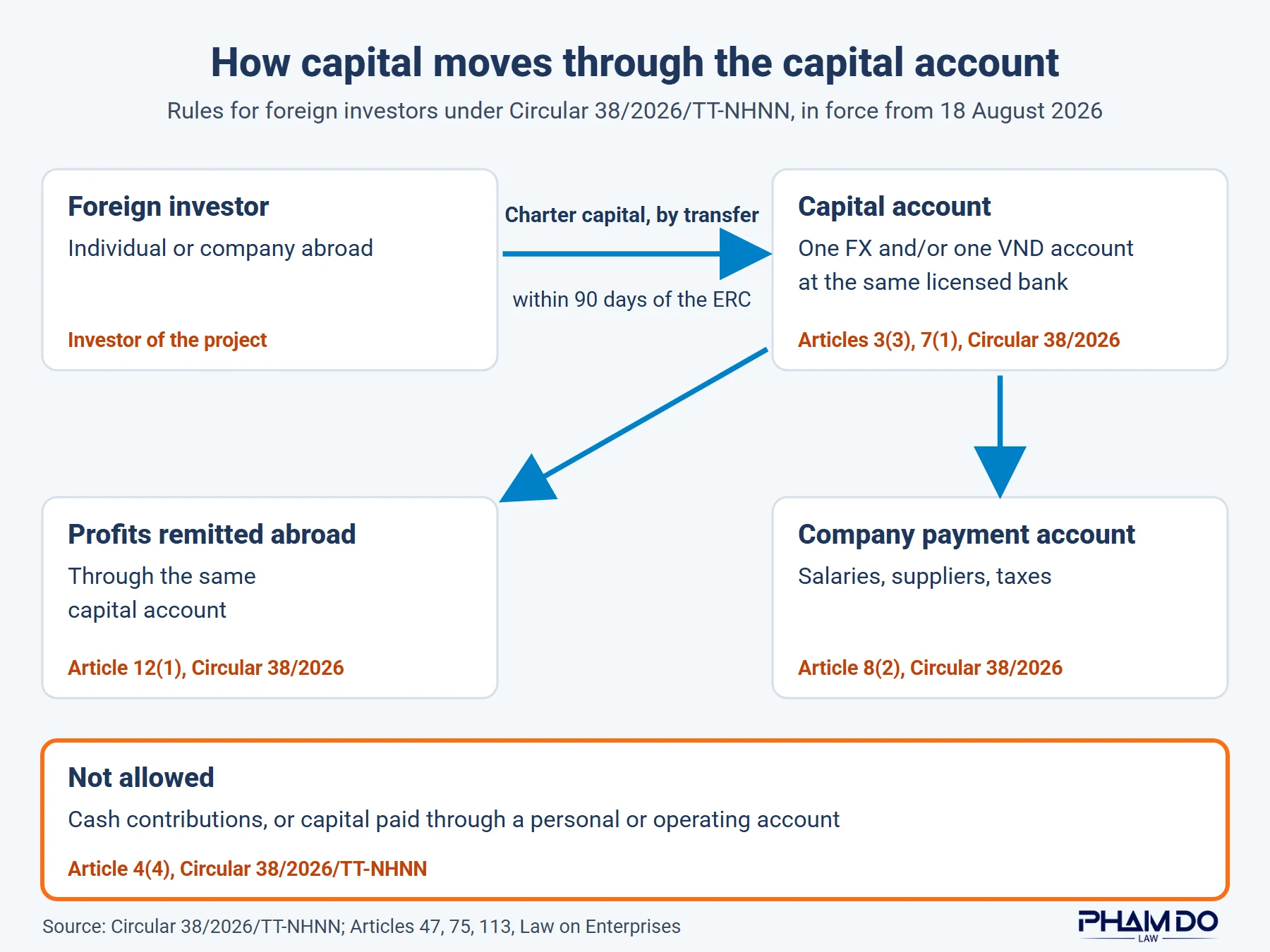
- Company-first route. This account may be opened before the IRC, but serves only to receive charter capital and interest, pay lawful preparation costs and refund the capital if the IRC is refused (Article 7(3)).
- Profits. Profits leave Vietnam through the same capital account (Article 12(1)), and only after the investor has met its financial obligations to the State (Article 11 of the Law on Investment 2025).
- Late payment. Capital not fully paid in 90 days means the company must register the lower charter capital within the next 30 days (Articles 47(4) and 75(3)). An owner of a single-member LLC is liable with all his or her assets for losses caused by late payment (Article 75(4)).
Those 90 days also run from the ERC under the company-first route. Charter capital need not equal the project’s investment capital, which is contributed on the schedule in the IRC (Article 72(5) of Decree 96/2026/ND-CP).
The capital account is for capital movements. The company transfers money from it to its own payment account, in foreign currency or VND, to carry out its investment activities (Articles 8(2)(a) and 9(2)(a) of Circular 38/2026/TT-NHNN). Plan to open both accounts with the bank.
Checkpoint: the capital account is open and the bank has confirmed receipt of the charter capital.
Minimum capital to set up a company in Vietnam
Neither the Law on Enterprises nor the Law on Investment 2025 sets a general minimum charter capital; only some sectors have one. Decree 96/2026/ND-CP sets no formula linking the declared capital to the financial capacity documents filed for the IRC.
A visa or temporary residence card for the owner
Owning a company does not by itself give a right to stay.
Your investor visa category depends on the capital contributed, under Article 8(7a) to (7d) of Law No. 47/2014/QH13 on the entry, exit and residence of foreigners, as last amended by Law No. 118/2025/QH15.
| Category | Capital contributed | Visa up to | Temporary residence card up to |
|---|---|---|---|
| ĐT1 | VND 100 billion or more, or incentive sectors or areas | 5 years | 10 years |
| ĐT2 | VND 50 billion to under 100 billion, or encouraged sectors | 5 years | 5 years |
| ĐT3 | VND 3 billion to under 50 billion | 3 years | 3 years |
| ĐT4 | Under VND 3 billion | 1 year | Not eligible |
This table follows Articles 8, 9, 36 and 38 of that law. An owner who contributes less than VND 3 billion therefore cannot obtain an investor temporary residence card and needs another basis, such as a work permit from the company.
For an investor visa, the applicant must show documents proving the investment under the Law on Investment (Article 10(4)(a) of Law No. 47/2014/QH13). Setting up a company is itself a form of investment (Article 18 of the Law on Investment 2025), and no provision requires the IRC for this purpose. The company-first route is new, however, so confirm with the immigration office which documents it accepts before the IRC is issued.
First obligations of the new company after registration
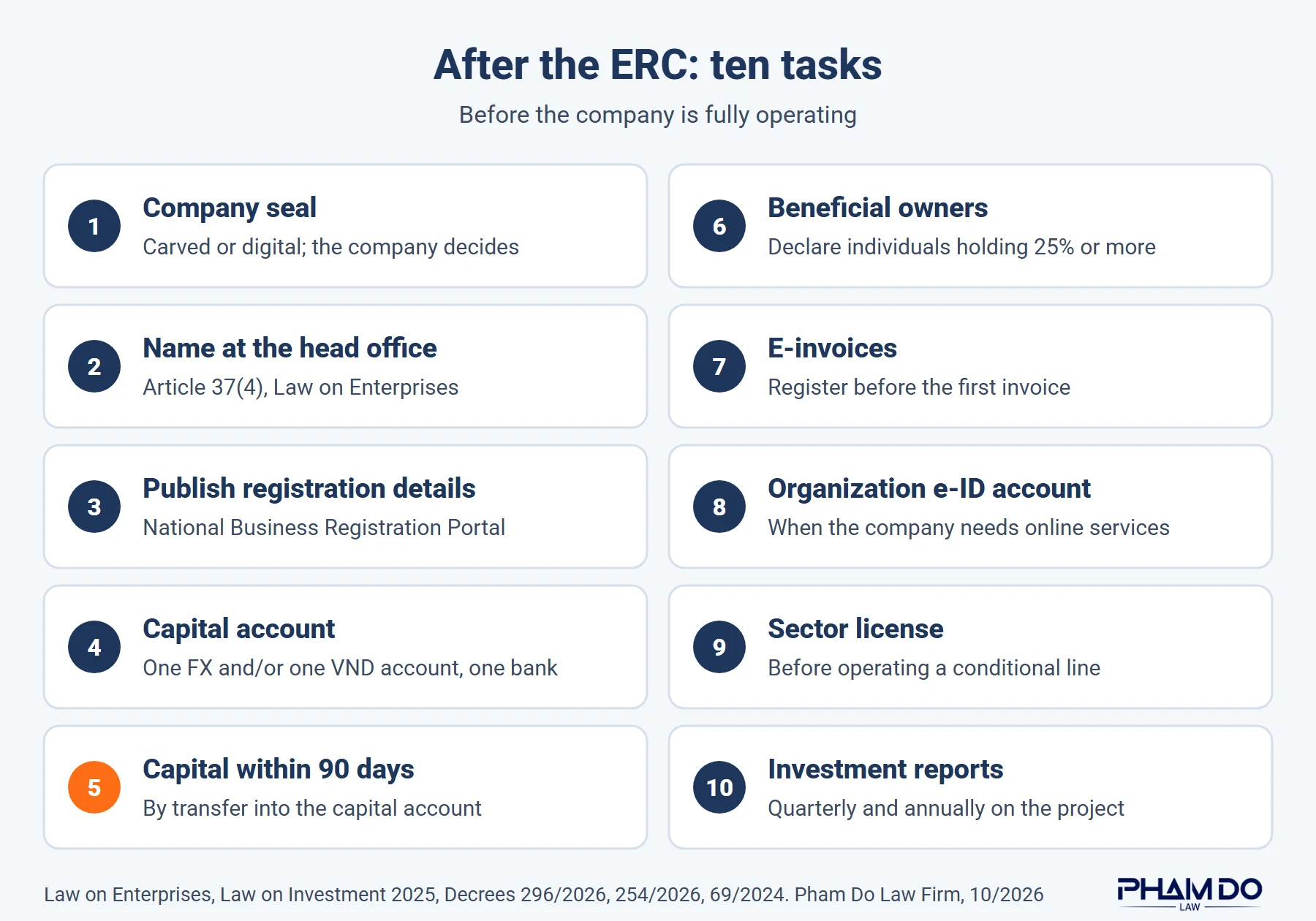
Once the ERC is issued, a new foreign-invested company must:
- Decide on its seal: a carved seal or a seal in the form of a digital signature, in the type and number the company chooses (Article 43). No seal specimen has to be notified to the registration office.
- Display its name at the head office (Article 37(4)).
- Publish its registration details on the National Business Registration Portal and pay the publication fee (Article 32(1)).
- Open a capital account, in foreign currency and/or VND, at one licensed bank (Article 7(1) of Circular 38/2026/TT-NHNN).
- Pay the charter capital into that account within 90 days of the ERC (see the 90-day deadline).
- Identify and declare its beneficial owners: individuals who own 25% or more of the charter capital or voting shares, directly or indirectly, or who control the company in fact (Articles 17 and 18 of Decree 168/2025/ND-CP, as replaced by Decree 296/2026/ND-CP).
- Register to use e-invoices before issuing the first invoice, under Decree 254/2026/ND-CP, in force from 1 July 2026.
- Apply for the company’s organization e-ID account if it will use online public services (Article 7(3) of Decree 69/2024/ND-CP, as amended).
- Obtain a digital signature for the company if it will file taxes, e-invoices or other procedures online.
- Obtain any sector license before operating a conditional line.
- Report quarterly and annually to the investment registration authority and the statistics office on the project (Article 47(2)(a) of the Law on Investment 2025).
Some duties recur from the first year: the investment reports above, tax returns, and annual financial statements audited by an independent auditor (Article 37(1)(a) of the Law on Independent Audit (No. 67/2011/QH12)). Bookkeeping and tax filings are covered by our tax and accounting service.
What a foreign-owned company pays in tax after setup
Foreign-owned companies pay the same corporate income tax as Vietnamese-owned ones. Under Article 10 of the Law on Corporate Income Tax 2025 (No. 67/2025/QH15), the standard rate is 20%, with 15% for annual revenue up to VND 3 billion and 17% for revenue above VND 3 billion up to VND 50 billion. Incentive rates depend on the sector and the location of the project (Article 12).
A newly registered small or medium-sized enterprise may be exempt from corporate income tax for 3 years from its first ERC (Article 10(4) of Resolution 198/2025/QH15; Article 7(3) of Decree 20/2026/ND-CP).
The exemption does not apply where, for example, the legal representative or the largest capital contributor holds or held that role in another enterprise that is operating or was dissolved less than 12 months earlier. A legal representative who has not contributed capital is not counted (Article 7(3)(b)(b2)). Foreign ownership does not exclude a company from this exemption. In Official Letter 3896/CT-CS of 11 June 2026, the Tax Department (Cục Thuế) of the Ministry of Finance confirmed that a foreign-invested company established under Vietnamese law qualifies when it receives its first ERC, meets the SME criteria and is not excluded by Article 7(3)(b).
An SME has no more than 200 employees with social insurance on annual average. It must also have total capital of no more than VND 100 billion or prior-year revenue of no more than VND 300 billion (Article 4 of the Law on Support for Small and Medium-sized Enterprises, No. 04/2017/QH14). The exemption does not cover income listed in Article 18(3) of the Law on Corporate Income Tax 2025.
Your own personal income tax depends on your residence status. Filings after setup are handled in the tax and accounting service.
How long it takes to set up a company in Vietnam
Vietnamese law sets a processing time for each certificate. The IRC is issued within 10 working days from receipt of a valid dossier when the project meets Article 39(3) of Decree 96/2026/ND-CP; the ERC within 3 working days from receipt of the dossier (Article 26(5) of the Law on Enterprises).
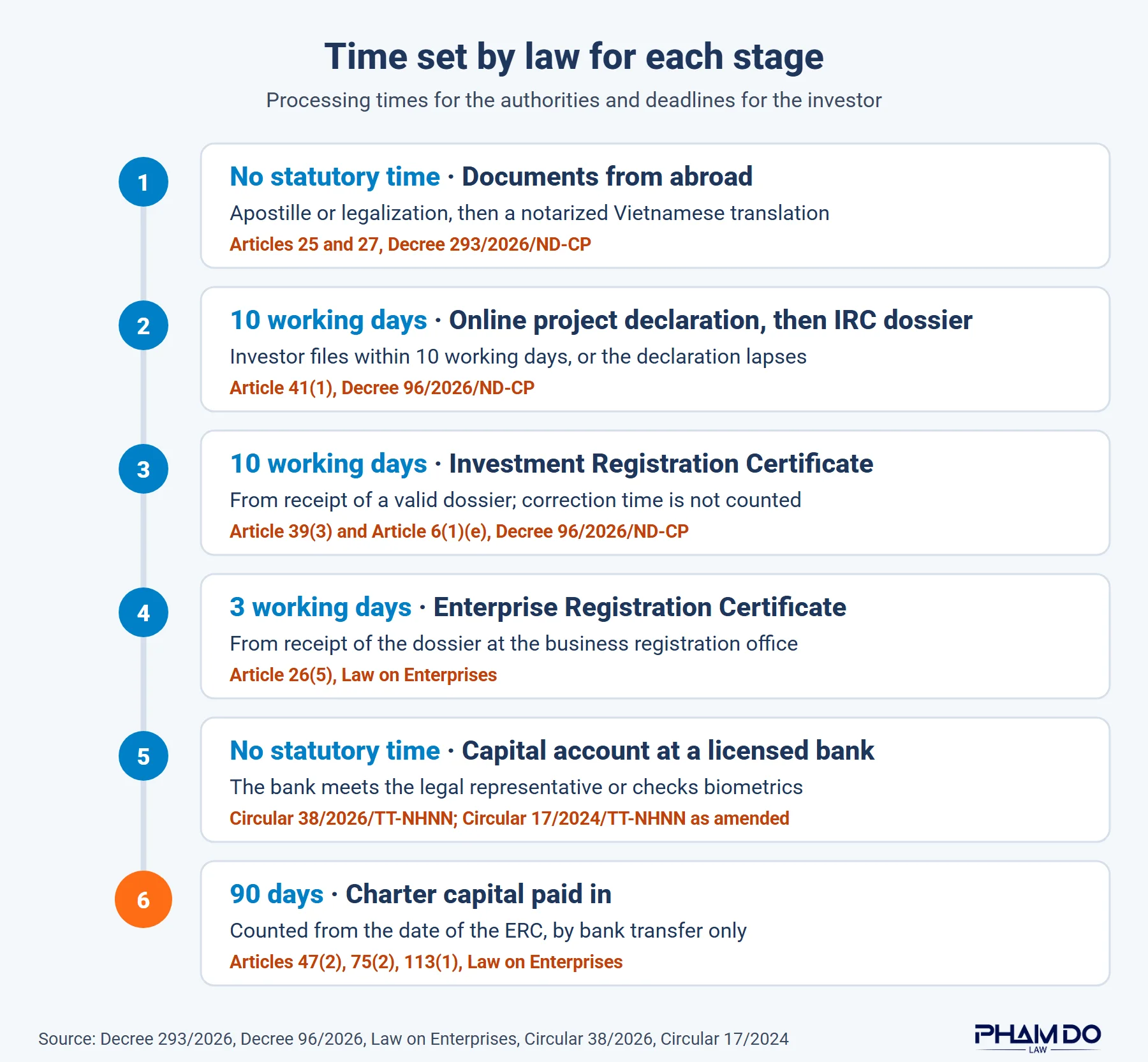
| Stage | Time set by law | Starts from | Basis |
|---|---|---|---|
| Documents abroad, translation, apostille or legalization | None set by Vietnamese law | Depends on the issuing country | Decree 293/2026/ND-CP |
| Filing the IRC dossier after the online project declaration (investor) | Within 10 working days, or the declaration lapses | Date of the online declaration | Article 41(1) Decree 96/2026/ND-CP |
| IRC (authority) | 10 working days | Receipt of a valid dossier | Article 39(3) Decree 96/2026/ND-CP |
| ERC (authority) | 3 working days | Receipt of the dossier | Article 26(5) Law on Enterprises |
| Capital account opening | None set | Bank’s onboarding of the company | Circular 38/2026/TT-NHNN |
| Charter capital contribution (investor) | Within 90 days | Date of the ERC | Articles 47(2), 75(2), 113(1) Law on Enterprises |
| IRC under the company-first route (investor) | Within 12 months | Date the company is established | Article 72(4) Decree 96/2026/ND-CP |
These are the authority’s own periods. Time the investor spends correcting the dossier or answering the authority’s questions is not counted in the IRC period (Article 6(1)(e) of Decree 96/2026/ND-CP), and documents prepared abroad have no period set by Vietnamese law. A complete first filing therefore matters most.
State fees for setting up a company in Vietnam

State fees are small; translation, legalization, the office and professional fees cost more.
| Item | State fee | Basis |
|---|---|---|
| IRC | No state fee | Schedule of the Law on Fees and Charges, which lists only the fee for outward investment certificates |
| Enterprise registration | VND 25,000 per filing from 1 July 2025 to 31 December 2026; VND 50,000 from 1 January 2027; exempt when filed online | Article 1 of Circular 64/2025/TT-BTC; Article 5(3) and schedule of Circular 47/2019/TT-BTC |
| Publication of registration details | VND 100,000 per time (not reduced) | Schedule of Circular 47/2019/TT-BTC |
| Business license fee (lệ phí môn bài) | Abolished from 1 January 2026 | Article 10(7) of Resolution 198/2025/QH15 |
Points foreign investors often overlook
| Mistake | Consequence | Legal basis |
|---|---|---|
| Registering through a nominee | A breach of the ban on standing in for another person; the capital is recorded in the nominee’s name | Article 4(1) Decree 168/2025/ND-CP, as amended |
| Choosing lines too narrowly on the company-first route | No new lines until the IRC is issued | Article 72(4) Decree 96/2026/ND-CP |
| Declaring the project online and filing late | The declaration lapses after 10 working days | Article 41(1) Decree 96/2026/ND-CP |
| Paying capital in cash or through a personal account | Breach of the transfer rule; profits can leave Vietnam only through the capital account (Article 12(1) Circular 38/2026/TT-NHNN) | Article 4(4) Circular 38/2026/TT-NHNN |
| Letting the 12 months run without the IRC | A breach of the 12-month duty; the decree sets no specific consequence, and the company still cannot carry out its project | Article 72(4) Decree 96/2026/ND-CP |
| Treating the ERC as a sector license | Operating a conditional line without its license | Article 7 Law on Investment 2025 |
| Registering a flat as the head office | Use of an apartment for non-housing purposes is prohibited | Article 3(8)(c) Law on Housing 2023 |
How this guide was prepared
- Legal sources: the official texts listed under the legal basis and cited in each section, read on 1 November 2026; Decree 393/2026/ND-CP and Government Resolutions 66.17/2026/NQ-CP and 66.18/2026/NQ-CP checked on 10 November 2026.
- Timing: every period stated is the maximum set by law, with its start point. Where the law sets no period, the guide says so and gives no estimate.
- Commercial relationship: Pham Do Law Firm provides company formation services; no fees are quoted here.
Frequently asked questions
Which business lines are closed to foreign investors?
Pham Do Law Firm’s answer: The 23 lines in section A of Appendix I of Decree 96/2026/ND-CP when the decree was issued, such as sending workers abroad under contract and temporary import for re-export. Outside Appendix I, a foreign investor may own 100% of the company.
Do I need to be in Vietnam to set up the company?
Pham Do Law Firm’s answer: Not for the filings, which a law firm can make under a power of attorney. The company still needs a legal representative residing in Vietnam (Article 12(3) of the Law on Enterprises).
Can I use a virtual office as the registered address?
Pham Do Law Firm’s answer: Vietnamese law does not regulate virtual offices. It requires a head office in Vietnam that serves as the contact address (Article 42 of the Law on Enterprises). A flat in an apartment building is not a safe choice (see the registered address section).
Are foreign-owned companies audited more?
Pham Do Law Firm’s answer: Their annual financial statements must be independently audited. Foreign-invested enterprises are in the list of entities subject to a mandatory audit under Article 37(1)(a) of the Law on Independent Audit (No. 67/2011/QH12).
Can my own company sponsor my work permit?
Pham Do Law Firm’s answer: Yes, as your employer. No work permit is needed for an LLC owner or member contributing VND 3 billion or more, or a JSC chairman or board member with VND 3 billion or more. No certificate of exemption is needed either, but the company must notify the authority at least 3 working days before the person starts work. Until 4 December 2026 the rule is Articles 7(2), 7(3) and 9(4) of Decree 219/2025/ND-CP. From 5 December 2026 it is Articles 8(2), 8(3) and 10 of Decree 393/2026/ND-CP, which replaces that decree. See our work permit service.
Do foreigners pay tax in Vietnam?
Pham Do Law Firm’s answer: Yes. Your company pays corporate income tax at 20%, or 15% or 17% for smaller revenue; a new small or medium-sized enterprise can be exempt for 3 years if it meets the conditions. The rule does not mention foreign ownership, so check the conditions for your company before you rely on it. The owner pays personal income tax according to residence status.
Legal basis for setting up a company in Vietnam in 2026
- Law on Investment 2025 (No. 143/2025/QH15);
- Law No. 24/2026/QH16 amending the Law on Investment;
- Decree 96/2026/ND-CP;
- Law on Enterprises 2020 (No. 59/2020/QH14), as amended by Law No. 76/2025/QH15 (Consolidated Text 67/VBHN-VPQH);
- Decree 168/2025/ND-CP, as amended by Decree 296/2026/ND-CP;
- Circular 38/2026/TT-NHNN;
- Decree 293/2026/ND-CP.
Pham Do Law Firm’s company setup service

Pham Do Law Firm sets up foreign-invested companies within its company incorporation service.
What the client provides
- Passport copy of each individual investor, or the establishment documents of a corporate investor;
- A document proving financial capacity;
- Planned business lines, capital, location and schedule;
- Lease or other document on the right to use the address.
Scope of work
- Checking market access for each business line and choosing the route;
- Preparing the online project declaration, the IRC dossier, the enterprise registration dossier and the charter;
- Filing, following up, correcting and collecting the certificates;
- Advising on the capital account, beneficial owner declaration and first obligations.
What you receive
- The IRC, or the filed IRC application under the company-first route;
- The ERC with the enterprise code, which is also the tax code;
- The charter as registered;
- A list of the company’s first obligations and their deadlines.
What happens next
Send us your planned business lines, capital and city. We review market access for each line and reply with the route we recommend.
This is Pham Do Law Firm’s advice on setting up a company in Vietnam as a foreign investor as of 10 November 2026. Contact Pham Do Law Firm for advice on your specific situation.