
Foreign direct investment in Vietnam takes four working forms: a new company, a capital contribution or share purchase, an investment project, and a business cooperation contract. Under Article 26(1) and (2)(c) of the Law on Investment 2025 (No. 143/2025/QH15), a foreign investor’s project needs an Investment Registration Certificate (Giấy chứng nhận đăng ký đầu tư, IRC), while a share purchase does not. Market access, investment policy approval and banking rules then shape each route. Pham Do Law Firm explains each step below.

By lawyer Do Thi Thu Hoai, Founder and Lawyer Partner of Pham Do Law Firm. Updated 10 November 2026.
FDI in Vietnam at a glance
Foreign investors in Vietnam registered USD 54.85 billion in the first ten months of 2026, and disbursed capital reached an estimated USD 24.08 billion.
| 1 January to 31 October 2026 | Figure |
|---|---|
| Total registered capital | USD 54.85 billion, up 74.0% on the same period of 2025 |
| Disbursed capital (estimate) | USD 24.08 billion, up 13.1%; highest ten-month figure in 5 years |
| New projects | 3,478 projects, USD 30.73 billion |
| Added capital in existing projects | 1,079 adjustments, USD 16.13 billion |
| Capital contributions and share purchases | 2,616 transactions, USD 7.99 billion |
| Largest source of new capital | Singapore, USD 9.52 billion |
| Largest sector for new capital | Manufacturing and processing, USD 14.61 billion, 47.5% of new registered capital |
These Vietnam FDI figures come from the Statistics Office (Cục Thống kê), Ministry of Finance (Bộ Tài chính), with data to 31 October 2026 published on 3 November 2026. Total, new, added and disbursed capital are from its ten-month report. The counts, source country, sector and five-year comparison are as reported by Thị trường Tài chính Tiền tệ on the same day.
That source keeps registered capital (vốn đăng ký) apart from disbursed capital (vốn thực hiện). Registered capital here covers the period only, not all FDI to date, and the two measures should not be added.
Five legal points matter most:
- Status: above 50% foreign, a company counts as a foreign investor for its next deal.
- Routes: a foreign investor’s new project needs an IRC, and a share purchase never does.
- Limits: prohibited lines, conditional lines and foreign market access are three separate lists.
- Approval: sensitive projects go to one of four levels.
- Money: capital, loans and profits each have their own rules.
Which route fits your plan?
The route follows from what you want to do in Vietnam. The periods below are set by law and run from a valid dossier.
| If you want to | Usual route | Key legal step |
|---|---|---|
| Build a factory or run a new project | New company, often in an industrial park | IRC from the Department of Finance or the zone board in 10 working days, if no policy approval is needed (Article 39(3) of Decree 96/2026/ND-CP) |
| Run a project on large land, with resettlement or of a listed type | New company, or a project of an existing foreign-invested company | Policy approval in 25 or 17 working days, then the IRC within 5 working days (Articles 34, 35 and 38 of Decree 96/2026/ND-CP) |
| Own a service business outright | New company, if the line is outside Appendix I or its conditions allow | Market access check, then the IRC |
| Buy into a Vietnamese business | Capital contribution or share purchase | No IRC; registration first only in the three Article 21(3) cases, in 10 working days |
| Work with a partner without forming a company | Business cooperation contract | IRC for the contract (Article 22(2) of the Law on Investment 2025) |
| Test the market first | Representative office | License from the Department of Industry and Trade or the zone board; no direct profit |
After the IRC, a new company still needs its ERC, bank accounts and capital contribution. Those steps and their deadlines are in the guide to setting up a company in Vietnam.
Who counts as a foreign investor in Vietnam?
A foreign investor is an individual of foreign nationality or an organization established under foreign law (Article 3(19) of the Law on Investment 2025). One such member or shareholder makes a Vietnamese company an economic organization with foreign investment capital (tổ chức kinh tế có vốn đầu tư nước ngoài) under Article 3(22).
That Law has no definition of “foreign direct investment” and no “control” test. Its line sits in Article 20, which looks at ownership above 50%.
The term does appear in foreign exchange law. Article 4(12) of the Ordinance on Foreign Exchange (No. 28/2005/PL-UBTVQH11), as amended, defines foreign direct investment in Vietnam as a foreign investor putting in capital and taking part in managing the investment in Vietnam.
| Foreign holding | Treatment when the company invests further |
|---|---|
| Above 50% of charter capital held by foreign investors, by a company itself above 50%, or by the two together; in a partnership, a majority of foreign general partners (Article 20(1)) | Like a foreign investor: an IRC for its projects (Article 26(1)(b)) and the market access list for onward investment (Article 16(1)(b) of Decree 96/2026/ND-CP) |
| 50% or less | Domestic conditions and procedures (Article 20(2)) |
Legal routes for foreign investors in Vietnam
Article 18 of the Law on Investment 2025 gives four working forms, and its clause 5 lets the Government add others.
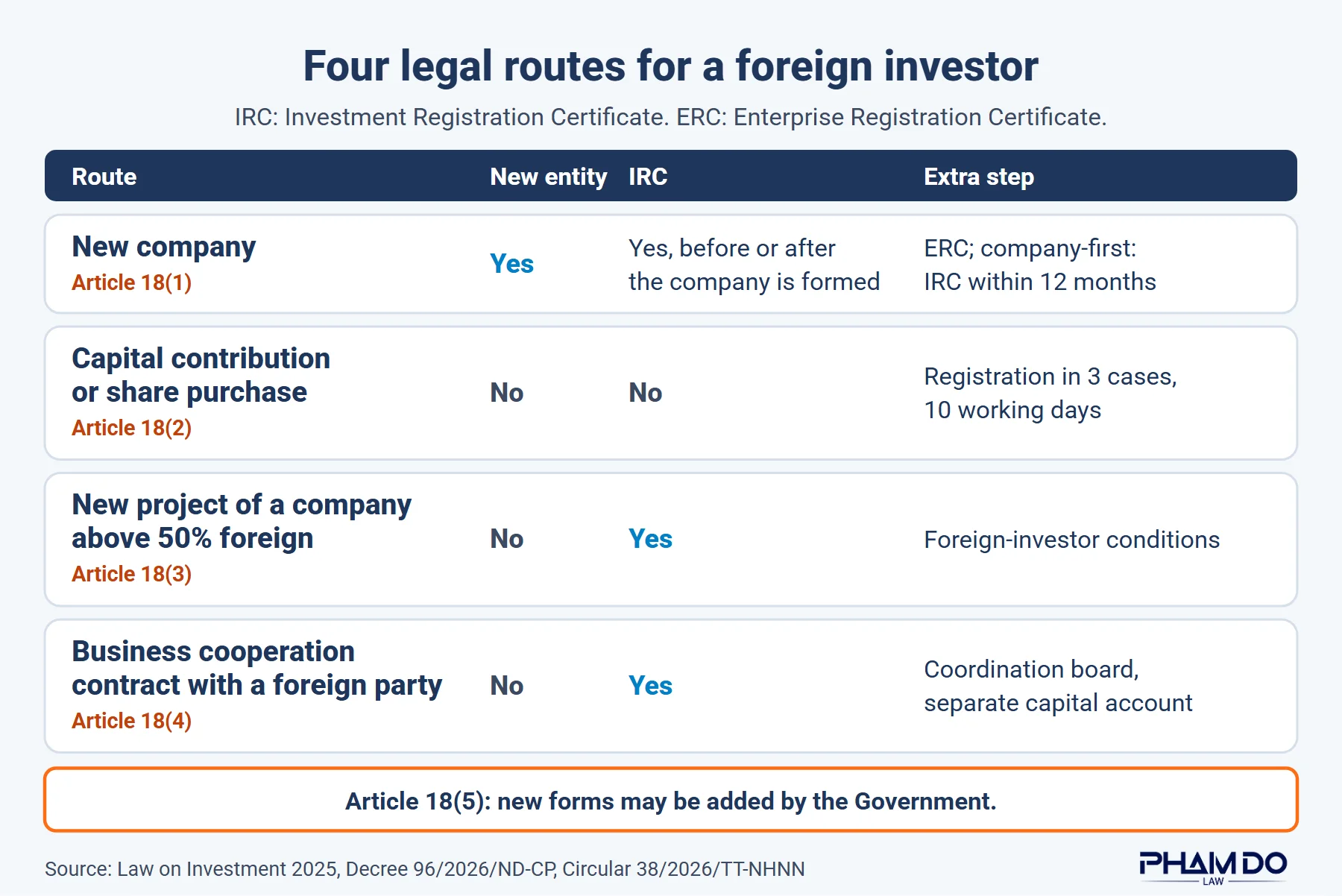
| Route | New entity | IRC |
|---|---|---|
| New company | Yes | Yes, before or after the company is formed |
| Capital contribution or share purchase | No | No (Article 26(2)(c)); registration in three cases |
| New project of a company above 50% foreign | No | Yes (Article 26(1)(b)) |
| Business cooperation contract with a foreign party | No | Yes (Article 22(2)) |
Setting up a new company
Since 1 March 2026, a foreign investor may form the company before the IRC, if it meets market access at that point (Article 19(2) of the Law on Investment 2025).
Forming a company brings two certificates: the IRC and the Enterprise Registration Certificate (Giấy chứng nhận đăng ký doanh nghiệp, ERC). Outside zones, the Department of Finance (Sở Tài chính) issues the IRC; inside them, the zone management board (Ban quản lý) does.
Article 39(3) of Decree 96/2026/ND-CP sets 10 working days from a valid dossier. The project must be in a line that is not prohibited, have an identified site, fit the planning, meet any provincial investment-rate condition, meet market access, and meet any technology condition.
Order is a choice. A company formed first must complete the IRC within 12 months and may add other lines only afterwards (Article 72(4) of Decree 96/2026/ND-CP).
Existing foreign-invested companies need no second company for a new project (Article 20(3)). Filing steps are in the guide to setting up a company in Vietnam.
Buying in never needs an IRC, whatever the percentage (Article 26(2)(c) of the Law on Investment 2025).
Every purchase must still meet market access, national defense and security conditions, and the land rules for islands, border and coastal communes (Article 21(2)). Stock market purchases follow securities law (Article 75(2) of Decree 96/2026/ND-CP).
Registration comes before the change of members or shareholders in three cases under Article 21(3):
- The purchase raises foreign ownership in a company running a conditional market access line, at any percentage.
- It takes foreign investors or Article 20(1) companies above 50%, or raises a holding already above 50%.
- The target holds a land-use certificate on an island, in a border or coastal commune or ward, or in another area affecting defense and security.
The target files at the investment registration authority (cơ quan đăng ký đầu tư) of its head office. That authority has 10 working days from a valid dossier.
For defense-area land the police and military opinions fall inside those 10 days (Article 76(3) to (5) of Decree 96/2026/ND-CP). Rights arise once the change is complete at the business registration authority (cơ quan đăng ký kinh doanh).
Outside the three cases, only that change is needed (Article 76(2)). Above 50%, later projects of the target need an IRC.
Joint ventures and keeping control
“Joint venture” is a commercial term, not a form in the Law on Investment 2025. It describes a company with Vietnamese and foreign members.

Control therefore comes from voting rules. Under Article 59(3) of the Law on Enterprises (Consolidated Text 67/VBHN-VPQH), a limited liability company passes resolutions with 65% of the capital at the meeting. Charter changes, reorganization, dissolution and a sale of 50% or more of assets need 75%, unless the charter says otherwise.
The 75% tier applies at a meeting, and it counts the capital present. A 70% member alone meets the 65% quorum (Article 58(1)), so if the minority stays away it holds all that capital. A written ballot passes at 65% of charter capital, though charter changes and reorganization go to a meeting unless the charter says otherwise (Article 59(2) and (5)).
Pham Do Law Firm recommends that both sides fix quorum, ballot and reserved matters in the charter before capital is paid.
Business cooperation contracts
Parties to a business cooperation contract (hợp đồng BCC) work together without forming a company. Under Article 22(2) of the Law on Investment 2025, a BCC between a domestic and a foreign investor, or between foreign investors, needs an IRC. Only a company at 50% foreign or less follows domestic rules for its BCC.
They form a coordination board (ban điều phối) and may later use the assets to set up a company (Article 22(3) and (4)). Each BCC runs its own capital account (Article 7(2) of Circular 38/2026/TT-NHNN).
No BCC gets around a restricted line. Form of investment is itself a market access condition (Article 8(3)(b) of the Law), and a closed line stays closed (Article 17(2) of Decree 96/2026/ND-CP).
Can a foreign business operate without a Vietnamese company?
Yes, within limits:
- Representative office (văn phòng đại diện). Outside zones, the Department of Industry and Trade (Sở Công Thương) issues the license, and inside them the zone board does (Article 5 of Decree 07/2016/ND-CP). The parent needs 1 year of operation, and the license lasts 5 years, capped by the term left on its registration (Article 9(1)). The office does liaison, market research and promotion and may not earn profit directly. Its head signs only under written authorization for each signing.
- Branch (chi nhánh). The parent needs 5 years of operation, and the provincial People’s Committee (Ủy ban nhân dân cấp tỉnh) issues the license under Decree 146/2025/ND-CP, which ends on 1 March 2027 unless extended. Activity outside Vietnam’s commitments needs the sector ministry’s approval (Article 8(5) of Decree 07/2016/ND-CP).
- Distributor or contract manufacturer. Selling to a local buyer needs no presence, yet an agent or a representative who regularly delivers goods can create a permanent establishment (Article 2(3) of the Law on Corporate Income Tax (No. 67/2025/QH15)). The supplier also falls under Foreign Contractor Tax (thuế nhà thầu) if it keeps ownership of the goods, bears distribution, marketing or quality costs, or sets prices (Article 7(1)(b) of Circular 20/2026/TT-BTC).
- Employer of record. The Labor Code (No. 45/2019/QH14) has no such term. Its nearest structure is labor outsourcing (cho thuê lại lao động), limited to listed jobs and 12 months per worker (Articles 52 to 54). From 1 July 2026 to 28 February 2027, Resolution 66.18/2026/NQ-CP replaces the license with a deposit and a notice to the Department of Home Affairs (Sở Nội vụ).
Market access conditions for foreign investors
Outside Appendix I of Decree 96/2026/ND-CP, foreign investors in Vietnam have the same market access as Vietnamese investors (Article 17(1)). Three layers must be kept apart:
| Layer | Applies to | Source | Effect |
|---|---|---|---|
| Prohibited lines | Every investor | Article 6, Law on Investment 2025 | 11 groups banned, with a narrow research and medical exception; nitrous oxide for inhalation becomes the 12th from 1 January 2027 |
| Conditional lines | Every investor | Article 7 and Appendix IV of that Law, as cut by Resolution 66.17/2026/NQ-CP | Sector license or other condition; see the guide to a business license in Vietnam |
| Market access list | Foreign investors only | Article 8 of that Law; Appendix I of Decree 96/2026/ND-CP | As issued, section A closes 23 lines and section B opens 62 on conditions |
Appendix I names business lines and states no percentages. The Ministry of Finance posts each line’s conditions on the National Investment Information Portal (Cổng thông tin quốc gia về đầu tư), and a condition in a law, decree or treaty applies even if unposted (Article 18).
Section B includes legal services, audit, education, banking and telecommunications. Press is in section A (A.2).
Sectors with ownership caps or partner requirements
A cap limits the foreign share of charter capital (Article 8(3)(a) of the Law), and a required form of investment is another kind of condition. Examples from the sector texts:
| Line | Condition | Source |
|---|---|---|
| Shipping agency (Appendix I, B.51) | Foreign capital up to 49% | Article 11, Decree 160/2016/ND-CP; Resolution 66.18/2026/NQ-CP applies in its place from 1 July 2026 to 28 February 2027 and also sets 49% |
| Sea transport, excluding domestic carriage, as a logistics service | Up to 49%, with a limit on foreign crew | Article 4(3), Decree 163/2017/ND-CP |
| Container handling, as a logistics service | Up to 50% | Same clause |
| Advertising (Appendix I, B.6) | Joint venture or BCC with a Vietnamese advertising business | WTO commitments; Article 40, Law on Advertising (No. 16/2012/QH13) |
Resolution 66.18/2026/NQ-CP also provides that, until 28 February 2027, a foreign-invested port operator handling cargo may only form a joint venture, with foreign capital at the WTO rate. Banking and telecommunications need a check of the portal and the sector law.
What happens when a company has several business lines?
Every line must pass.
Under Article 17(6) of Decree 96/2026/ND-CP, an investor in several Appendix I lines must meet all their conditions. Since a cap is a share of the company’s charter capital, one capped line in practice limits the whole company. Where treaties set different caps across its lines, the lowest applies (Article 17(10)(d)).
For caps set by domestic law, that result is a reading of Article 17(6) with Article 8(3)(a) of the Law, not express wording. A wholly foreign-owned company adding a line capped at 49% would then have to reduce foreign ownership or drop the line. Pham Do Law Firm recommends testing every planned line before the charter is signed.
How treaties change the answer
Three rules in Article 17 of Decree 96/2026/ND-CP matter. A treaty more favorable than Vietnamese law applies to the investor it covers (clause 8). An investor covered by several treaties may choose one, for all its lines, and is then bound by all of it (clause 9).
An investor from outside the WTO is treated like a WTO investor, unless Vietnamese law or a treaty says otherwise (clause 7).
Where Vietnam made no commitment on a line, domestic law decides, and with no domestic limit the foreign investor has the same access as a Vietnamese investor (Article 17(4)).
How to check your business line
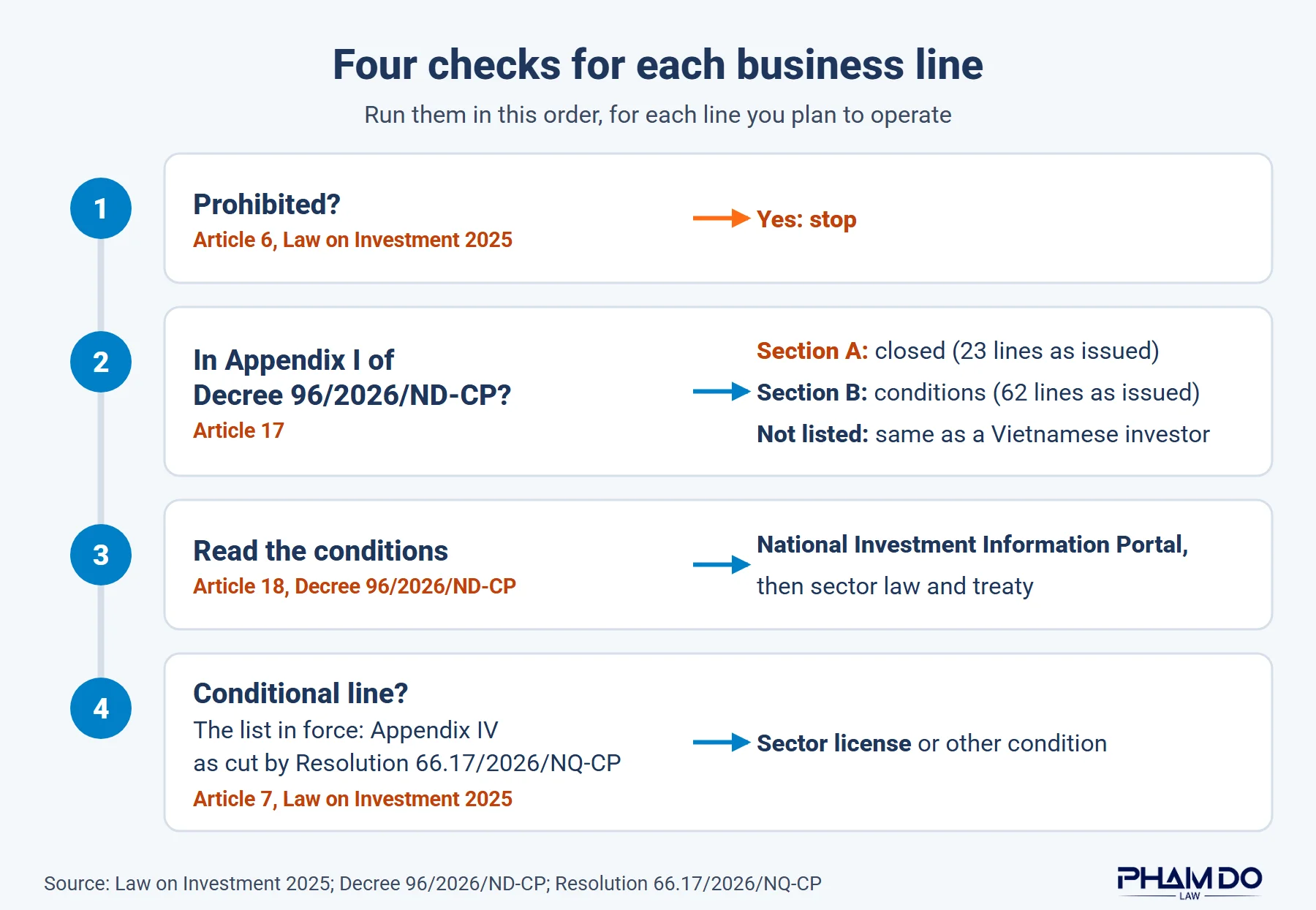
- Confirm that Article 6 of the Law on Investment 2025 does not prohibit the line.
- Find it in Appendix I of Decree 96/2026/ND-CP: section A is closed, section B has conditions, and no entry means ordinary access.
- Read the conditions on the National Investment Information Portal, then the sector law and any treaty that applies.
- Check the conditional list in force: Appendix IV as cut by Resolution 66.17/2026/NQ-CP, and as replaced from 1 March 2027. It decides whether a sector license is needed.
Pham Do Law Firm checks each planned business line against Appendix I, the portal conditions and the treaties that apply before the charter is drafted. Send us your planned business lines.
Why nominee arrangements are a risk
Holding shares through a Vietnamese nominee is banned, and it opens no route into a restricted line. Under Article 4(1) of Decree 168/2025/ND-CP, as amended by Decree 296/2026/ND-CP, owners, members and shareholders must not stand in for another person when contributing capital.
- False registration filings are prohibited, and a forged filing is a ground to revoke the ERC (Articles 16(4) and 212(1)(a) of the Law on Enterprises).
- A sham transaction made to hide another is void, and the hidden deal stands only if valid in itself (Article 124(1) of the Civil Code (No. 91/2015/QH13)).
- Beneficial owners at the 25% level must be declared (Article 17 of Decree 168/2025/ND-CP, as replaced).
- In a limited liability company, the member register names the nominee, and the right to profit belongs to the member (Articles 48(2) and 49(1)(c) of the Law on Enterprises).
Which projects need investment policy approval?
A project needs investment policy approval (chấp thuận chủ trương đầu tư) if it falls within Article 24 of the Law on Investment 2025. The triggers are land, resettlement and project type, not capital. Authority sits at four levels:
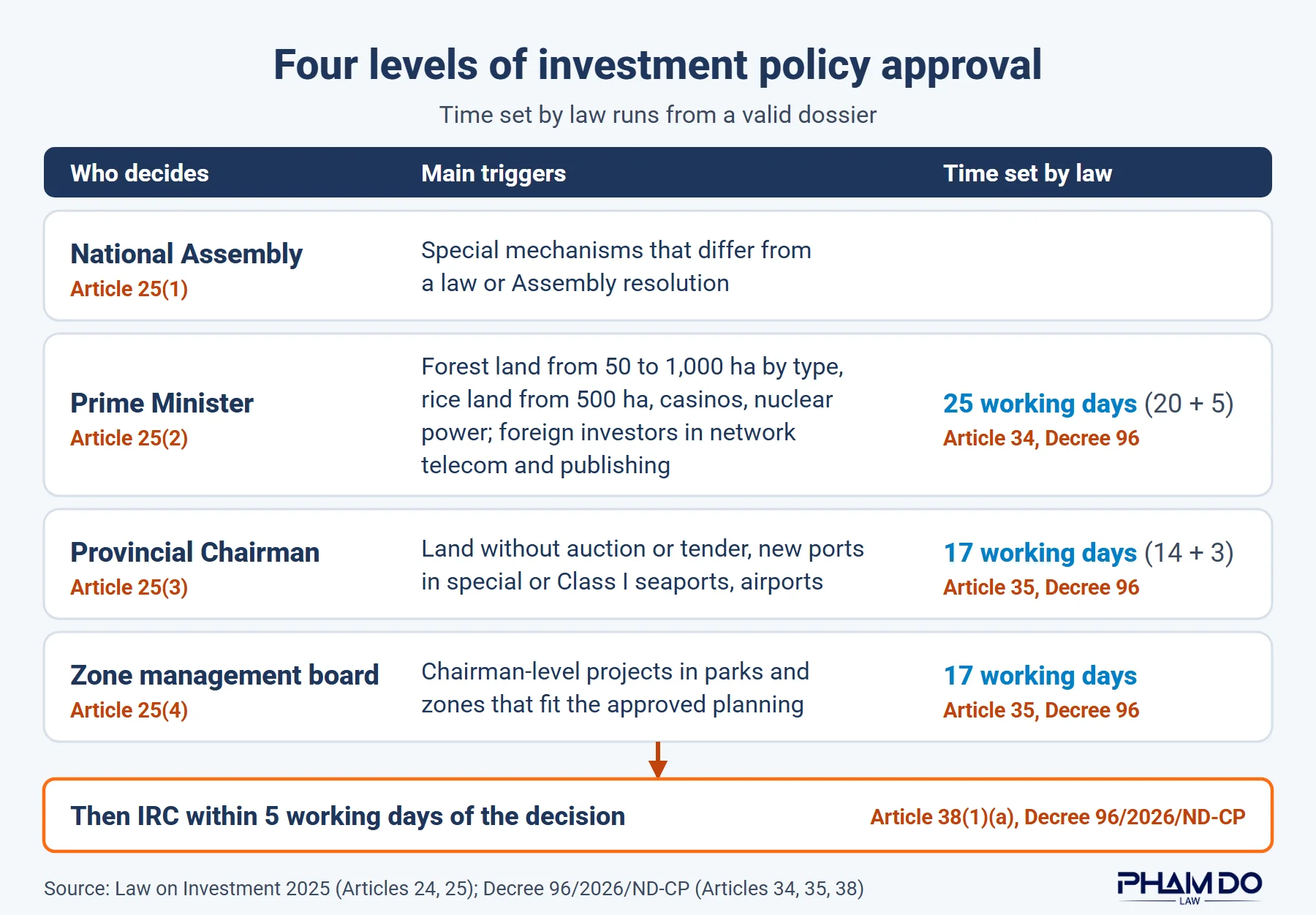
| Level | Typical projects | Time set by law from a valid dossier |
|---|---|---|
| National Assembly (Quốc hội) | Only projects asking for special mechanisms that differ from a law or Assembly resolution (Article 24(20)) | No period stated here |
| Prime Minister (Thủ tướng Chính phủ) | Forest land from 50 to 1,000 ha by type; rice land from 500 ha; casinos, nuclear power; foreign investors in network telecom and publishing; resettlement of 20,000 people in mountain areas or 50,000 elsewhere | 25 working days: report 20, decision 5 (Article 34 of Decree 96/2026/ND-CP) |
| Chairman of the provincial People’s Committee (Chủ tịch Ủy ban nhân dân cấp tỉnh) | Land without auction or tender, defense-area land, housing where the investor holds or has agreed the land, golf, park infrastructure, new ports in special or Class I seaports, airports, new airlines; resettlement from 10,000 in mountain areas or 20,000 elsewhere | 17 working days: report 14, decision 3 (Article 35(7) and (8)) |
| Zone management board | Chairman-level projects inside parks and zones that fit the approved planning (Article 25(4)) | 17 working days (Article 35(10)) |
An IRC follows within 5 working days of the decision (Article 38(1)(a) of Decree 96/2026/ND-CP). Those periods exclude corrections.
Special investment procedure in zones
Under Article 28 of the Law on Investment 2025, investors in parks and zones may choose. Through the special investment procedure (thủ tục đầu tư đặc biệt), they register by written commitment, without approval, environmental impact assessment, construction permit or fire approvals, except for projects the Government excludes (Articles 46 to 50 of Decree 96/2026/ND-CP).
Before construction, the investor must send a commencement notice with a technical report verified by a qualified party (Article 28(3)). A project in a high-tech park must also meet the high-tech criteria (Article 46(2) of Decree 96/2026/ND-CP).
The 2025 Investment Law in brief
Law No. 143/2025/QH15 took effect on 1 March 2026 and ended the earlier Law No. 61/2020/QH14 from that date. Its Article 7 and Appendix IV followed on 1 July 2026, when the old conditional list ended too (Article 51). Resolution 66.17/2026/NQ-CP cut the new list from that date. Decree 96/2026/ND-CP applies from 31 March 2026. Law No. 24/2026/QH16 adds nitrous oxide for inhalation to the prohibited lines from 1 January 2027 and replaces the conditional list from 1 March 2027 (its Article 2). For foreign investors, four points matter most, and each is covered on this page. They are the company-first option (Article 19(2)), the special procedure in zones (Article 28), the four approval levels and the Investment Support Fund (Article 16).
Investment incentives in Vietnam
The Law on Investment 2025 names the forms of incentive, and tax and land law set the amounts (Article 14(2) and (6)). Eligibility depends on the line, location or scale of a new or expansion project (Articles 14 and 15).
Corporate income tax (thuế thu nhập doanh nghiệp, CIT) rates come from the CIT Law, which prevails on CIT incentives with narrow exceptions (Article 12(1) of the CIT Law). The standard rate is 20%, lower for small companies by revenue, and the incentive tiers are:
| Tier | Examples | Rate | Exemption, then 50% reduction |
|---|---|---|---|
| Top | High tech, software, renewable energy; manufacturing of VND 12,000 billion or more, disbursed within 5 years and using technology that meets the science ministry’s requirements; especially difficult areas, high-tech parks | 10% for 15 years | Up to 4 years, then up to 9 years |
| Middle | High-grade steel, energy-saving products, car assembly; difficult areas; economic zones not on difficult land | 17% for 10 years | Up to 2 years, then up to 4 years |
A longer tier exists. Strategic technology enterprises, group 1 high-tech enterprises, and strategic technology or high-tech R&D centers pay 10% for 25 years. The tier is Article 13(1a) of the CIT Law, added by the Law on High Technology (No. 133/2025/QH15) from 1 July 2026.
As an illustration only, on taxable income of USD 1 million the 20% standard rate gives USD 200,000 of CIT and a 10% rate gives USD 100,000. That is before any exemption years and before any global minimum tax top-up.
An industrial park alone gives no CIT rate. Article 12(3) of the CIT Law lists difficult areas, economic zones, high-tech parks and similar locations, and industrial parks are absent. Decree 320/2025/ND-CP also leaves the park row out of its location test (Article 18(3)).
Parks remain incentive locations under Article 15(2)(b) of the Law on Investment 2025, so land rent and import duty incentives can still apply (Article 14(2)(b) and (c)), at levels set by customs and land rules. A park on a commune listed in its own right as a difficult or especially difficult area is different. In a published answer, which is guidance and not a legal text, the Ministry of Finance said that a project there can still take the area incentive if it meets the conditions. A project in an incentivized line keeps the line incentive.
Incentives are conditional. They are time-limited and based on results, they lapse for any period the conditions are not met, and sums may be clawed back with penalties (Article 14(8)).
Article 16 of the Law on Investment 2025 sets up an Investment Support Fund to attract strategic investors and multinational groups. Article 17 allows special incentives and support for large-impact projects, such as R&D centers, semiconductor chip projects and AI data centers, at a scale the Government sets.
The Government sets how both work. Special incentives do not apply to a project that already had an IRC or a policy approval decision before 1 March 2026 (Article 17(5)(a)).
Resolution 198/2025/QH15 exempts small and medium-sized enterprises from CIT for 3 years from their first ERC (Article 10(4)). Its scope clause refers to enterprises in general and does not mention foreign ownership (Article 2). The conditions are in Decree 20/2026/ND-CP, which guides the Resolution, so check them before counting on the exemption.
Resolution 107/2023/QH15 and Decree 236/2025/ND-CP apply to a group with consolidated revenue of EUR 750 million or more in at least 2 of the 4 preceding years (Article 3(1) of the Decree). Its entities in Vietnam pay a domestic top-up tax measured against a 15% minimum rate (Articles 4 and 5), so a 10% incentive rate is worth less to such a group than the table suggests.
Investment guarantees and disputes
The Law on Investment 2025 sets these guarantees:
- Assets. Lawful assets are not nationalized or confiscated by administrative measures, and requisition in defined emergencies is compensated (Article 9).
- Performance requirements. The State does not compel local buying, export ratios or localization (Article 10(1)).
- Remittance. After financial obligations, capital, proceeds and income may leave Vietnam (Article 11).
- Change of law. A worse rule leaves the earlier incentive in place, except for changes made for defense, security, order, morals, public health or the environment, where the investor has 3 years from the new text to request a remedy (Article 12).
- State guarantee. The Prime Minister may apply one to projects approved at the top two levels and other key infrastructure (Article 10(2)).
The dispute forum depends on the parties (Article 13). Where at least one party is a foreign investor or an Article 20(1) company, the options are a Vietnamese court or Vietnamese, foreign or international arbitration. A foreign investor against a state body goes to Vietnamese arbitration or court, unless a contract or treaty says otherwise.
Money in and out of Vietnam
Capital and loans follow rules of the State Bank of Vietnam (Ngân hàng Nhà nước Việt Nam). Profit remittance follows a Ministry of Finance circular and leaves through the capital account.
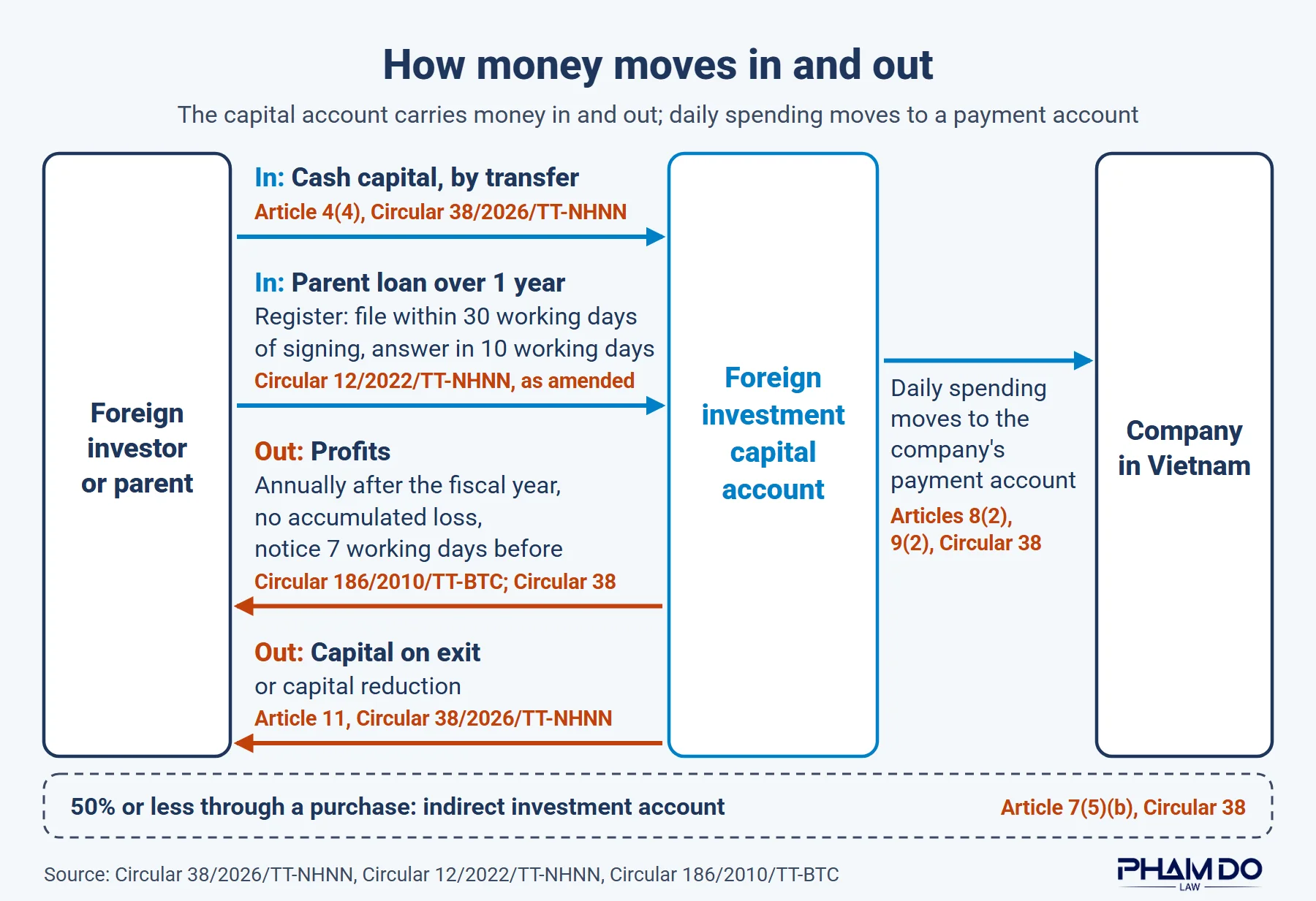
The foreign investment capital account and the indirect account
Circular 38/2026/TT-NHNN, in force since 18 August 2026, renamed the “direct investment capital account” the foreign investment capital account (tài khoản vốn đầu tư nước ngoài tại Việt Nam). How the holding arose decides which account applies:
| Situation | Rule |
|---|---|
| Company established by a foreign investor | Capital account (Article 6(1)(a)) |
| Above 50% foreign through a purchase | Capital account (Article 6(1)(b)) |
| 50% or less through a purchase | Indirect investment account (tài khoản đầu tư gián tiếp) (Article 7(5)(b)) |
| Crossing 50% up | Open the capital account (Article 7(6)) |
| Company above 50% through a purchase falling to 50% or less | Close the capital account and use the indirect account (Article 7(5)(b)) |
Cash contributions must go by transfer into the account (Article 4(4)). Share purchases follow a different test. In a company that holds a capital account under Article 6(1), a price paid between a non-resident and a resident runs through it, while a deal between two non-residents or two residents does not (Article 10(1), which adds limbs for member enterprises).
A company-first investor may open the account before the IRC, using it only for charter capital, interest, lawful preparation costs and refunds (Article 7(3)).
Loans from the parent company
Loans of more than one year must be registered with the State Bank, and no drawdown or repayment comes before its confirmation. A short loan that rolls past one year, or preparation money turned into a loan, is registered later.
Loans of one year or less are not registered. Decree 219/2013/ND-CP and Circular 12/2022/TT-NHNN govern these loans. Consolidated Text 23/VBHN-NHNN carries the current text of that circular, with amendments including Circular 21/2023/TT-NHNN and Circular 80/2025/TT-NHNN.
- Deadline. File within 30 working days of signing (Article 15(2)(a) of Circular 12/2022/TT-NHNN); rolled-over and converted loans have their own dates. The State Bank answers within 10 working days of a full, valid dossier.
- Authority. Since 25 July 2026, the Foreign Exchange Management Department (Cục Quản lý ngoại hối) handles loans above USD 20 million, and the regional branch (chi nhánh Khu vực) of the head office handles the rest.
- Account. Medium and long-term loans run through the capital account, or a separate loan account at the same bank if the currency differs (Article 26(2)).
- Limit. Medium and long-term debt for a project, domestic and foreign together, may not exceed total project capital minus the contributed capital on the IRC (Article 18 of Circular 08/2023/TT-NHNN). Under Circular 19/2024/TT-NHNN, debt from deferred-payment imports is left out of that calculation.
Pham Do Law Firm recommends fixing the mix of capital and loans before the IRC filing, because the figures on the IRC set the room to borrow.
When can profits be taken out of Vietnam?
Profits may leave annually, after the fiscal year ends. Article 11 of the Law on Investment 2025 gives the right, and Circular 186/2010/TT-BTC sets the conditions. It dates from an earlier investment law, and no replacing text was found.
- Financial obligations are met, and the audited statements and CIT finalization return are filed (Article 4(1)).
- Any accumulated loss left on the statements for the profit year, after tax loss carry-forward, blocks the remittance (Article 3(3)).
- The tax authority (cơ quan thuế) receives notice at least 7 working days before remitting (Article 5).
- Payment leaves through the capital account (Article 12(1) of Circular 38/2026/TT-NHNN).
Each bank sets its own internal rules and must check documents that match the transaction (Article 14(2) and (3) of Circular 38/2026/TT-NHNN), so it may ask to see these first. Pham Do Law Firm recommends preparing them before the notice is filed.
Tax on payments to foreign investors
Foreign Contractor Tax applies to interest, royalties and service fees, and dividends are not part of it. Rates are on revenue unless stated.
| Payment | Rate | Basis |
|---|---|---|
| Dividends to a foreign company | No Vietnamese tax at payment | Exempt under Article 4(7) of the CIT Law as profit shared by a Vietnamese company after CIT; Decree 320/2025/ND-CP has no dividend line in Article 12(3) |
| Dividends to a non-resident individual | 5% on gross, from 1 July 2026 | Article 22, Law on Personal Income Tax (No. 109/2025/QH15) |
| Interest | 5% | Article 12(3)(e), Decree 320/2025/ND-CP |
| Royalties | 10% | Article 12(3)(c) |
| Services | 5%; hotel, restaurant and casino management 10% | Article 12(3)(a) |
| Capital transfer by a foreign company | 2%, except qualifying intra-group restructuring | Article 12(3)(i) |
Article 7 of Circular 20/2026/TT-BTC has guided this tax since 12 March 2026. VAT and treaty relief need a separate check through the tax and accounting service.
Inside parks and zones, the zone board issues the IRC (Article 27(1) of the Law on Investment 2025). The ERC still comes from the business registration authority under the Department of Finance, because a board issues it only in a high-tech park (Article 20(1) of Decree 168/2025/ND-CP).
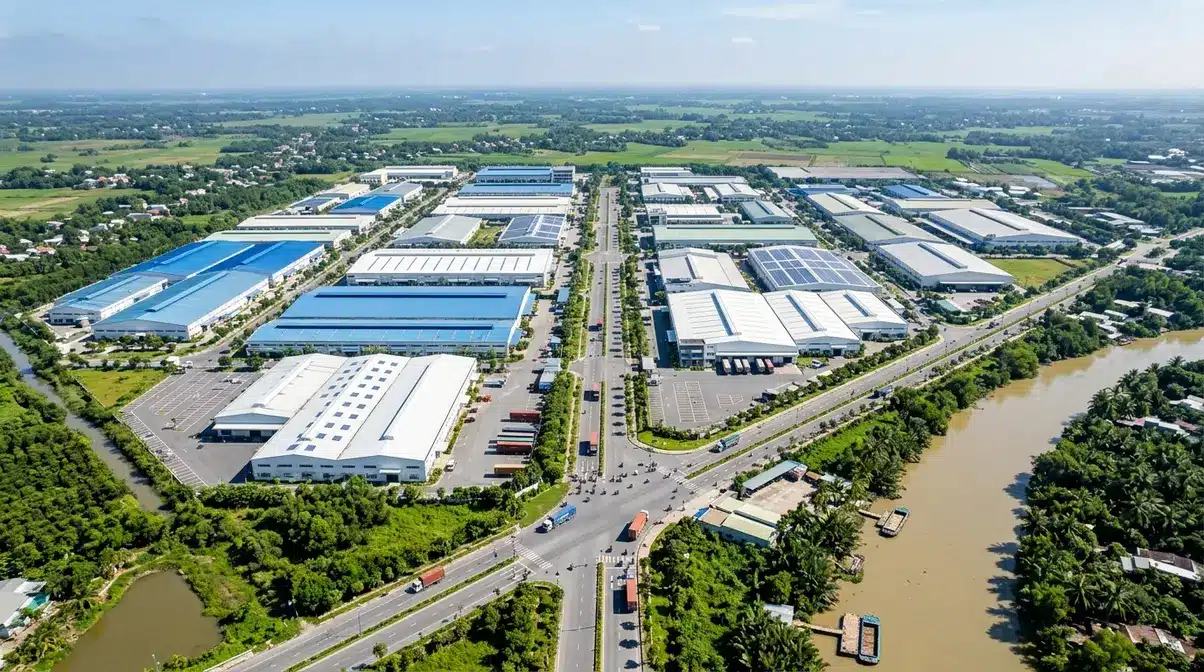
A park location by itself gives no CIT rate; it can support land rent and import duty incentives.
Land stays under public ownership, so a company holds land-use rights and not title (Article 12 of the Land Law (No. 31/2024/QH15)). A company that counts as a foreign investor usually leases from the State (Article 120) or takes rights inside a park (Article 28(1)(c)). Land allocated for a use fee is limited to cases such as commercial housing projects (Article 119(3)).
Land terms follow the project. A project runs for up to 50 years outside economic zones and up to 70 years inside them or in listed cases (Article 31 of the Law on Investment 2025). Land is leased for the project term, up to 50 years, or up to 70 years where the project runs longer (Article 172(1)(c) of the Land Law). Both terms can be considered for extension at expiry.
Closing and taking capital out on exit
On exit, the same remittance conditions apply, plus tax administration duties (Article 4(2) of Circular 186/2010/TT-BTC), and capital goes out through the capital account (Article 11 of Circular 38/2026/TT-NHNN), subject to its stated exceptions.
An investor can also take capital back without closing. A limited liability company may return part of its capital once it has operated continuously for 2 years and can still pay its debts (Articles 68(3)(a) and 87(3)(a) of the Law on Enterprises).
Frequently asked questions
Can foreigners own 100% of a Vietnamese company?
Pham Do Law Firm’s answer: Yes, outside Appendix I of Decree 96/2026/ND-CP. In an Appendix I line, the conditions and any applicable treaty decide.
Pham Do Law Firm’s answer: No, at any percentage. Three cases under Article 21(3) of the Law on Investment 2025 need registration first, which takes 10 working days from a valid dossier.
Can I take profits out of Vietnam?
Pham Do Law Firm’s answer: Yes, annually after the fiscal year ends, if obligations are met, no accumulated loss remains and the tax authority has 7 working days’ notice.
How long does foreign investment approval take?
Pham Do Law Firm’s answer: Without policy approval, 10 working days for the IRC. With approval, 25 or 17 working days, then 5 for the IRC. These periods run from a valid dossier, and the 10 days need the Article 39(3) conditions.
Can a company above 50% foreign invest in real estate?
Pham Do Law Firm’s answer: Yes, in set forms. It may build to sell or lease through a real estate project, build infrastructure in a project, lease in to sub-let, or take a project by transfer (Article 10(3) and (4) of the Law on Real Estate Business (No. 29/2023/QH15)). A company at 50% or less has the wider forms in Article 10(1) (Article 10(5)).
Is a foreign investor allowed to use a local nominee?
Pham Do Law Firm’s answer: No. Article 4(1) of Decree 168/2025/ND-CP, as amended, bars standing in for another person when contributing capital.
Does this cover stocks or property?
Pham Do Law Firm’s answer: No. Anyone asking how to invest in Vietnam through stocks, funds or an apartment faces different rules.
Legal basis for foreign investment in Vietnam in 2026
- Law on Investment 2025 (No. 143/2025/QH15) and Law No. 24/2026/QH16, and Resolution 66.17/2026/NQ-CP;
- Decree 96/2026/ND-CP;
- Law on Enterprises (Consolidated Text 67/VBHN-VPQH);
- Law on Corporate Income Tax (No. 67/2025/QH15), as amended by the Law on High Technology (No. 133/2025/QH15), and Decree 320/2025/ND-CP;
- Ordinance on Foreign Exchange (No. 28/2005/PL-UBTVQH11), as amended;
- Circular 38/2026/TT-NHNN and Circular 186/2010/TT-BTC;
- Circular 12/2022/TT-NHNN, in Consolidated Text 23/VBHN-NHNN, with Circular 21/2023/TT-NHNN and Circular 80/2025/TT-NHNN;
- Decree 168/2025/ND-CP, as amended by Decree 296/2026/ND-CP;
- Circular 08/2023/TT-NHNN, Circular 19/2024/TT-NHNN, Decree 219/2013/ND-CP and Circular 20/2026/TT-BTC;
- Law on Personal Income Tax (No. 109/2025/QH15), Resolution 198/2025/QH15 with Decree 20/2026/ND-CP, Resolution 107/2023/QH15 and Decree 236/2025/ND-CP;
- Decree 07/2016/ND-CP and Decree 146/2025/ND-CP;
- Decree 160/2016/ND-CP, Decree 163/2017/ND-CP and Resolution 66.18/2026/NQ-CP;
- Civil Code (No. 91/2015/QH13), Labor Code (No. 45/2019/QH14), Law on Advertising (No. 16/2012/QH13) and Land Law (No. 31/2024/QH15).
Foreign investment advice from Pham Do Law Firm
Pham Do Law Firm advises foreign investors on routes, market access and filings within its company incorporation service.
What you receive
- Advice on the route, the registration requirements and the decisions needed before filing;
- Application documents for your review and a checklist of investor documents;
- Filing updates and explanations of any extra documents the authority requests;
- The certificates issued, or written responses that need further action, with next steps explained.
What happens next
- You send the planned business lines, the site and the investor documents you already have.
- Pham Do Law Firm checks each line against market access and the conditional list and confirms the route.
- A written proposal sets out the registrations covered and who is responsible for each step.
- The documents are prepared, signed and filed, and the firm follows up with the authority until the outcome.
Approval and a fixed completion date depend on the authority and are not guaranteed.
This is Pham Do Law Firm’s advice on foreign direct investment in Vietnam as of 10 November 2026. Contact Pham Do Law Firm for advice on your specific situation.