

A foreign investor in Vietnam can set up a limited liability company (LLC) or a joint stock company (JSC), and the choice turns on the number of owners and on issuing shares. Pham Do Law Firm explains each difference below.
Under Articles 46, 74 and 111 of the Law on Enterprises 2020 (No. 59/2020/QH14), an LLC has 1 to 50 owners and cannot issue shares, except to convert into a JSC, while a JSC needs at least 3 shareholders and can.
In both forms the owners are liable for company debts only up to their capital, the charter capital in a single-member LLC and the capital contributed otherwise, as long as the capital rules are kept (Articles 46(1), 74(1) and 111(1)(c)). By contrast, the general partners of a partnership and the owner of a private enterprise are liable with all their assets (Articles 177(1)(b) and 188(1)).
With several owners, the real differences are who can block a decision, who may sell and how much governance the company must keep. Partnerships, private enterprises and the other types of companies, with the registration steps, are in the guide to setting up a company in Vietnam.
What is a limited liability company in Vietnam?
A limited liability company (LLC) in Vietnam is a company whose owners are liable for its debts only up to their capital, and which cannot issue shares except to convert into a JSC. In other words, an owner risks only that capital, not personal assets, as long as the capital rules are kept.
Single-member and multi-member LLCs have legal personality from the date of their Enterprise Registration Certificate (ERC) under Articles 46(2) and 74(2).
Single-member LLC (one member limited liability company)
A single-member LLC is owned by one organization or one individual, liable up to the charter capital under Article 74(1). One owner is what defines the form.
When an organization owns it, the company is run by a Company President or a Members’ Council. Either way it also has a Director or General Director under Article 79(1). An individual owner is the Company President and may also act as Director (Article 85(2)).
Multi-member LLC (two to 50 members)
A multi-member LLC has 2 to 50 members, organizations or individuals (Article 46(1)). It is run by a Members’ Council, its Chairman and a Director (Article 54(1)).
What is a joint stock company (JSC) in Vietnam?
JSC in Vietnam means joint stock company: a company whose charter capital is divided into equal shares, held by at least 3 shareholders with no maximum (Article 111(1)).
Only a JSC may issue shares, apart from an LLC issuing them to convert into a JSC (Articles 46(3), 74(3) and 111(3)). A JSC must have ordinary shares and may also issue preference shares (Article 114). Voting preference shares are limited: only founding shareholders and organizations authorized by the Government may hold them, and a founder’s voting preference lasts 3 years from the ERC date (Article 116(1)).
A holder of voting preference shares cannot transfer them, except under a final court judgment or decision or by inheritance (Article 116(3)).
A foreign investor setting up a joint stock company should note that the company must have at least 3 shareholders. A new JSC needs at least 3 founding shareholders, who together subscribe for at least 20% of the ordinary shares offered at registration (Article 120(1) and (2)). Shareholders may be organizations or individuals (Article 111(1)(b)), and the Law on Enterprises sets no Vietnamese shareholder requirement.
LLC vs JSC in Vietnam side by side
An LLC has 1 to 50 owners and issues no shares except to convert, and a multi-member LLC offers a stake to the other members first. A JSC needs at least 3 shareholders, can issue shares that transfer freely within limits, and must keep more bodies. The filing steps for each form are part of setting up a company in Vietnam.
Single-member LLCs, multi-member LLCs and JSCs share limited liability and a 90-day deadline to pay in capital, which a JSC’s charter or subscription contract may shorten. Time spent transporting or importing contributed assets, or transferring their title, does not count (Articles 47(2), 75(2) and 113(1)).
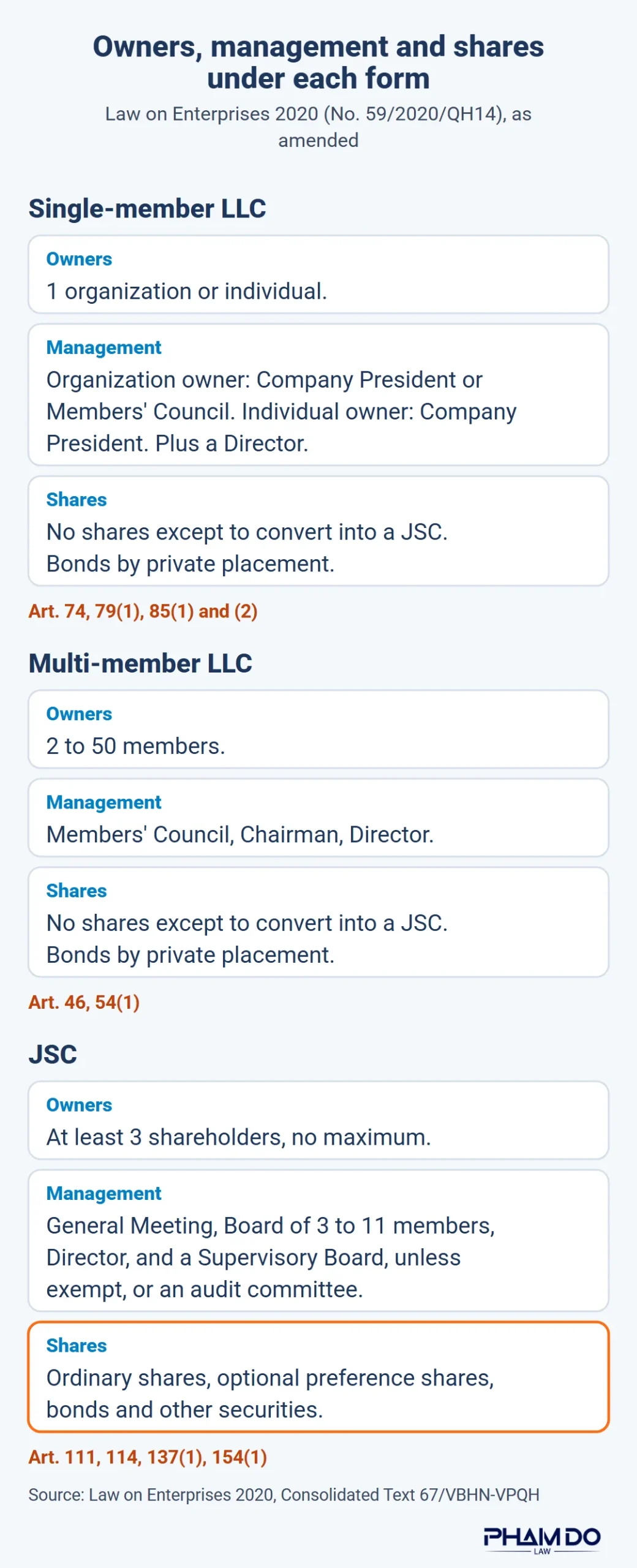
| Single-member LLC | Multi-member LLC | JSC | |
|---|---|---|---|
| Owners | 1 organization or individual (Art. 74(1)) | 2 to 50 members (Art. 46(1)) | At least 3 shareholders, no maximum (Art. 111(1)(b)) |
| Liability | Up to charter capital (Art. 74(1)) | Up to capital contributed (Art. 46(1)) | Up to capital contributed (Art. 111(1)(c)) |
| Capital deadline | 90 days from the ERC (Art. 75(2)) | 90 days from the ERC (Art. 47(2)) | 90 days from the ERC, or shorter by charter or subscription contract (Art. 113(1)) |
| Capital not paid on time | Lower capital registered within 30 days. The owner is liable with all assets for the company’s financial obligations and losses caused (Art. 75(3), (4)) | A member who paid nothing ceases to be a member. Lower capital registered within 30 days (Art. 47(3), (4)) | A shareholder who paid nothing ceases to be a shareholder. Unpaid shares are unsold and the Board may sell them. Registration within 30 days unless sold by then (Art. 113(3)) |
| Raising new capital | The owner contributes more. Taking capital from another person means reorganizing as a multi-member LLC or a JSC (Art. 87(1), (2)) | Members contribute more, or new members contribute (Art. 68(1)) | The company offers shares (Art. 123(1)) |
| Shares and bonds | No shares except to convert into a JSC. Bonds by private placement under Articles 128 and 129 (Art. 74(3), (4)) | No shares except to convert into a JSC. Bonds by private placement under Articles 128 and 129 (Art. 46(3), (4)) | Ordinary shares, optional preference shares, bonds and other securities (Art. 111(3), 114) |
| Transfer | Transfer allowed. Selling or giving part of the capital, or admitting a member, means changing form and registering within 10 days of completing it (Art. 78(1)). Other withdrawals make the owner liable for company debts (Art. 77(5)) | Offer to the other members first, outsiders after 30 days, with exceptions (Art. 52(1)) | Free, except founders’ shares for 3 years, voting preference shares and charter limits printed on the share certificate (Art. 116(3), 120(3), 127(1)) |
| Management | Organization owner: Company President or Members’ Council. Individual owner: Company President. Plus a Director (Art. 79(1), 85(1) and (2)) | Members’ Council, Chairman, Director (Art. 54(1)) | General Meeting, Board of 3 to 11 members, Director, and a Supervisory Board, unless exempt, or an audit committee (Art. 137(1), 154(1)) |
| Returning capital to owners | After 2 years of continuous business, if debts can still be paid (Art. 87(3)(a)) | The same, pro rata (Art. 68(3)(a)) | By General Meeting decision after 2 years of business, excluding suspension periods, if debts can still be paid in full (Art. 112(5)(a)) |
| Minority inspection rights | Not applicable | Members holding 10% of charter capital, or less if the charter says so (Art. 49(2)) | Shareholders holding 5% of ordinary shares, or less if the charter says so (Art. 115(2)) |
Who controls an LLC and a JSC
The owners’ body controls both forms: the Members’ Council or Company President in an LLC, the General Meeting of Shareholders in a JSC. An LLC needs larger majorities, so a minority partner blocks more easily there.
The Director is not necessarily an owner: the individual owner of a single-member LLC may act as Director or hire another person (Article 85(2)). In a multi-member LLC and a JSC, major decisions such as reorganization and dissolution stay with the Members’ Council or the General Meeting (Articles 55(2)(l) and (m) and 138(2)(i)). In those companies, hiring a Director does not hand these decisions over.
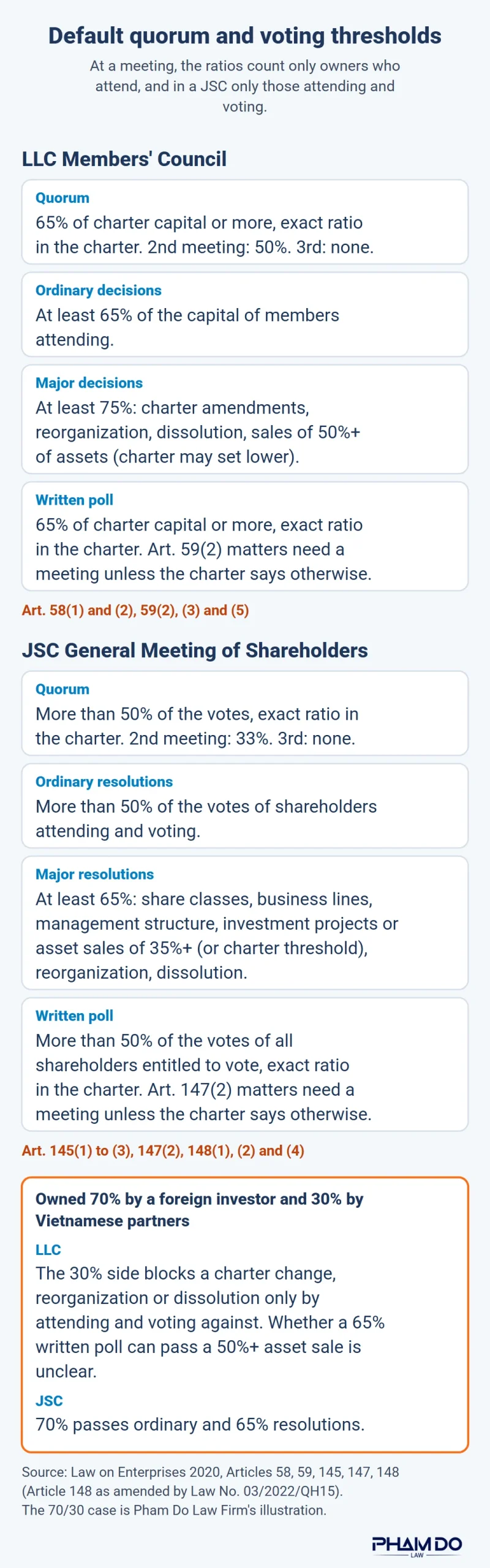
- LLC Members’ Council. A meeting needs members holding at least 65% of charter capital, the exact ratio being set by the charter (Article 58(1)). Unless the charter sets other ratios, decisions need at least 65% of the capital of members attending. Charter amendments, reorganization, dissolution and sales of assets worth 50% or more of total assets need at least 75%, and the charter can set a lower asset threshold (Article 59(3)).
- JSC General Meeting of Shareholders. A meeting needs shareholders holding more than 50% of the votes, the exact ratio being set by the charter (Article 145(1)). Ordinary resolutions need more than 50% of the votes of shareholders attending and voting. Share classes, business lines, the management structure, investments or asset sales worth 35% or more of total assets (or another threshold set by the charter), reorganization and dissolution need at least 65% (Article 148(1) and (2)).
At a meeting, the ratios count only owners who attend, and in a JSC only those attending and voting. An LLC written poll needs at least 65% of charter capital, the exact ratio being set by the charter, so members who do not approve in writing in effect count against it (Article 59(5)).
A JSC written poll passes with more than 50% of the votes of all shareholders entitled to vote, the exact ratio being set by the charter (Article 148(4)).
Unless the charter says otherwise, a JSC must decide at a meeting on charter amendments, development direction, share classes, election and removal of Board and Supervisory Board members, investments or asset sales of 35% or more, annual financial statements, and reorganization or dissolution (Article 147(2)).
At a meeting, by default a charter amendment needs 75% in an LLC. In a JSC it is not on the 65% list, so at a meeting it passes with more than 50% at the specific ratio the charter sets (Article 148(2)).
The charter can also put charter amendments on the 65% list (Article 148(1)(e)). An amendment that changes an item on that list, such as share classes, business lines or the management structure, needs at least 65% (Article 148(1)(a) to (c)).
If the first meeting lacks a quorum, the second needs 50% of charter capital in an LLC and 33% of the votes in a JSC, and the third needs no quorum (Articles 58(2), 145(2) and (3)).
Take a company owned 70% by a foreign investor and 30% by Vietnamese partners, on the default rules. In an LLC, the 30% side can block a charter change, reorganization or dissolution if it attends and votes against, since these must go to a meeting unless the charter says otherwise (Article 59(2)).
A sale of 50% or more of assets is not on that list (Article 59(2)), and Article 59(5) sets 65% of charter capital for a written poll. The law does not say whether the 75% meeting ratio for such a sale also binds a written poll. In a JSC, 70% passes both ordinary and 65% resolutions.
The figure shows the statutory defaults, and the charter can change the result within the limits each article allows, so settle the voting rules when setting up a company in Vietnam.
A JSC elects its Board of Directors by cumulative voting unless the charter says otherwise, so a minority can put all its votes on its own nominee (Article 148(3)).
Advantages and disadvantages of an LLC and a JSC in Vietnam
An LLC gives a small group control over who joins and fewer bodies to run. A JSC gives access to share capital and more owners, at the cost of more governance.
The main disadvantage of an LLC is that it cannot issue shares or take more than 50 owners (Articles 46(1), 46(3) and 74(3)), so taking equity from more than 50 owners, or offering shares, means converting to a JSC first. Either form can be set up through the company incorporation service.
Advantages and disadvantages of an LLC
Advantages of an LLC:
- One owner is enough (Article 74(1)), which a JSC cannot offer.
- Control over who joins. Members have first refusal on a stake (Article 52(1)).
- Fewer bodies. An LLC has no Board of Directors. Its bodies are the Members’ Council or Company President and a Director (Articles 54(1) and 79(1)).
- A stronger minority veto. The default 75% threshold lets a partner holding more than 25% of the capital represented at the meeting block charter changes, since these go to a meeting unless the charter says otherwise (Articles 59(2) and (3)).
Disadvantages of an LLC:
- No shares. An LLC cannot issue shares except to convert (Articles 46(3) and 74(3)), so it cannot offer shares to employees or outside investors.
- Funding from owners and loans. New money comes from the members, from new members or from borrowing, including bonds by private placement (Articles 46(4) and 68(1)).
- A ceiling of 50 members (Article 46(1)).
- A change of form for outside capital. A single-member LLC that takes capital from another person must reorganize as a multi-member LLC or a JSC (Article 87(2)).
Advantages and disadvantages of a JSC
A joint stock company has a greater advantage in raising capital than the two types of limited liability company. A JSC may issue shares, bonds and other securities (Article 111(3)) and may offer new shares to increase its charter capital (Article 123(1)).
Advantages of a JSC:
- No maximum number of owners (Article 111(1)(b)).
- Shares that move freely, except founders’ shares in the first 3 years, transfer limits in the charter and the voting preference shares described above (Articles 111(1)(d), 116(3), 120(3) and 127(1)).
- A path to public company status. Only a JSC can become a public company (Article 32(1) of the Law on Securities (No. 54/2019/QH14)).
Disadvantages of a JSC:
- Three shareholders from the start (Article 111(1)(b)).
- More bodies to run: a Board of 3 to 11 members and, unless exempt, a control body (Articles 137(1) and 154(1)).
- A weaker minority veto. By default a shareholder needs more than 35% of the votes of shareholders attending and voting to block a 65% resolution (Article 148(1)), where an LLC member with more than 25% of the capital at the meeting can block charter changes (Article 59(3)(b)).
Fines that apply to both forms
Both forms face the same fines when the owner and capital rules are broken or a filing is late. The amounts are for an organization under Decree 122/2021/ND-CP, as amended by Decree 288/2026/ND-CP from 21 July 2026.
| Breach | Fine for an organization | Article of Decree 122/2021/ND-CP |
|---|---|---|
| Fewer members or shareholders than the law requires | VND 10,000,000 to 20,000,000 | Art. 46(1) |
| Capital or founders not adjusted after the contribution deadline and the adjustment period, where no member or founder fulfilled the unpaid capital commitment | VND 30,000,000 to 50,000,000, plus a forced adjustment | Art. 46(3)(a), 46(5)(b) |
| Charter capital declared but not actually contributed | VND 20,000,000 to 100,000,000, by the amount declared, plus a forced adjustment | Art. 47 |
| Beneficial owner information not declared at registration | VND 50,000,000 to 100,000,000, plus a forced filing of the information | Art. 46(4)(c) and 46(5)(d), added by Decree 288/2026/ND-CP |
| Beneficial owner information not added at the next registration change, for a company set up before 1 July 2025 | VND 70,000,000 to 100,000,000, plus a forced filing | Art. 44(6) and (7), as amended by Decree 288/2026/ND-CP |
| Information, including beneficial owner information, reported incompletely or late when requested | VND 20,000,000 to 30,000,000, plus a forced supplement of the missing content | Art. 48(1) and (4)(a), as amended by Decree 288/2026/ND-CP |
| A change of ERC content, a notice of changed registration content or a beneficial owner change filed late, such as the 10-day filings after a sale | A warning for 1 to 10 days late. VND 10,000,000 to 20,000,000 for 11 to 30 days, VND 30,000,000 to 40,000,000 for 31 to 90 days and VND 50,000,000 to 60,000,000 for 91 days or more | Art. 44(1) to (4), as amended by Decree 288/2026/ND-CP |
| Such a change not registered or notified at all | VND 30,000,000 to 70,000,000, plus a forced filing | Art. 44(5) and (7), as amended by Decree 288/2026/ND-CP |
Selling a stake or bringing in a new investor
In a multi-member LLC the other members have first refusal on a stake. JSC shares move freely except founders’ shares in the first 3 years (Article 120(3)), voting preference shares (Article 116(3)) and charter limits stated on the share certificate (Article 127(1)).
For either form, a foreign investor’s capital contribution or purchase of shares or capital is registered before the owners change in three cases (Article 21(3) of the Law on Investment 2025 (No. 143/2025/QH15)).
- The contribution or purchase raises foreign ownership in a company whose business lines have market-access conditions for foreign investors.
- It brings foreign investors, together with companies more than 50% foreign-held under Article 20(1)(a) to (c) of that law, above 50% of charter capital, or raises foreign ownership further when already above 50%.
- The company holds a land use right certificate for land on an island or in a border, coastal or other defence-sensitive area.
Apart from gifts, payment of debts with the stake and a buy-back the company fails to pay (Articles 51(4), 53(6) and (7)), a member of a multi-member LLC must first offer the stake to the other members pro rata, on the same terms.
Only what they do not buy within 30 days of the offer may go to an outsider, on the same terms (Article 52(1)).
The buyer of an LLC stake does not become a member at signing. The selling member keeps the rights and obligations attached to the stake until the buyer’s details are fully recorded in the members register (Article 52(2)).
In a JSC, founding shareholders may transfer their ordinary shares to each other freely for 3 years from the ERC. A transfer to anyone else in that period needs General Meeting approval, and the selling founder cannot vote on it (Article 120(3)).
The limit does not cover shares a founder acquires after registration or shares already sold to a non-founder (Article 120(4)). Any other charter limit binds only if it is stated on the share certificate (Article 127(1)).
When a sale brings in a new member, a multi-member LLC registers the change of members within 10 days (Article 30(2) of the Law on Enterprises; the file follows Article 45(2) of Decree 168/2025/ND-CP). The filing goes to the business registration office.
A JSC that is not listed or registered for securities trading reports new or changed details of its foreign shareholders within 3 working days (Article 176(3) of the Law on Enterprises). A purchase by a foreign investor or a sale by a foreign shareholder is one such change. It also notifies the change within 10 days (Article 31(1)(b) and (3) of the same law).
If a sale changes a beneficial owner, either form notifies the business registration office within 10 days, unless the company is listed or registered for securities trading (Article 31(1)(c) and (2) of the Law on Enterprises; Article 52(1) of Decree 168/2025/ND-CP).
| Filing linked to a change of owners | Deadline | Basis |
|---|---|---|
| Registration of a foreign investor’s capital contribution or purchase, in the three cases of Article 21(3) of the Law on Investment 2025 (either form) | Before the owners change; decision within 10 working days of a valid file, after a defence and security consultation where the company holds a land use right certificate in an area affecting defence or security | Law on Investment 2025 Art. 21(3); Decree 96/2026/ND-CP Art. 76(3) to (5) |
| Change of members when a sale brings in a new member (multi-member LLC) | 10 days | Law on Enterprises Art. 30(2); Decree 168/2025/ND-CP Art. 45(2) |
| Change of form after a single-member LLC owner sells or gives part of the capital, or admits a member | 10 days from completing the sale, gift or admission | Law on Enterprises Art. 78(1) |
| Change of form after a transfer or change of capital contributions leaves a multi-member LLC with 1 member | 15 days from completing the transfer | Law on Enterprises Art. 52(3) |
| Report of new or changed foreign shareholder details, such as a foreign investor’s purchase or a foreign shareholder’s sale (JSC not listed or registered for securities trading) | 3 working days | Law on Enterprises Art. 176(3) |
| Notice of changed foreign-investor shareholders (the same JSC) | 10 days | Law on Enterprises Art. 31(1)(b) and (3) |
| Notice of a beneficial owner change (either form, not listed or registered for securities trading) | 10 days | Law on Enterprises Art. 31(1)(c) and (2); Decree 168/2025/ND-CP Art. 52(1) |
An owner who voted against a reorganization or a change of owners’ rights can exit. An LLC member asks within 15 days of the resolution, and the company pays within 15 days of the request if it stays solvent (Article 51). A JSC shareholder asks within 10 days of the resolution, and the company buys within 90 days of the request (Article 132).
For a foreign investor’s contribution or purchase in the three cases above, the company submits the registration file. For the first two cases (Article 21(3)(a) and (b)) the investment registration authority decides within 10 working days of receiving a valid file (Article 76(3) and (4) of Decree 96/2026/ND-CP).
A company holding a land use right certificate in an area affecting defence or security goes through a review in which the authority first consults the provincial military command and police, still within 10 working days of a valid file (Article 76(5)). The file and the three cases are explained under capital purchase registration.
The registration timeline is not the only delay to plan for.
Where the Vietnamese company was set up long ago, it often carries legal, tax and financial risks, so the foreign investor will need extra time and cost to review its whole legal and financial position before contributing capital or buying shares.
Running costs, audit and tax under each form
A JSC costs more to run because it must keep more bodies. For a company with foreign investment the audit and corporate income tax rules are the same under either form. Besides the General Meeting, a Board of 3 to 11 members (Article 154(1)) and a Director, a JSC follows one of two models under Article 137(1), a Supervisory Board or independent Board members with an Audit Committee.
- A Supervisory Board has 3 to 5 members, more than half permanently residing in Vietnam (Article 168(1) and (2)). It is optional when the company has fewer than 11 shareholders and organizations hold less than 50% of its shares (Article 137(1)(a)).
- In the other model at least 20% of Board members are independent and an Audit Committee sits under the Board (Article 137(1)(b)).
| Item | LLC | JSC | Basis |
|---|---|---|---|
| Supervision model | No Article 137 choice | Supervisory Board, or independent Board members with an Audit Committee | Law on Enterprises Art. 137(1) |
| Audit of annual financial statements, company with foreign investment | Required | Required | Law on Independent Audit Art. 37(1)(a) |
| Filing annual financial statements | Within 90 days of the fiscal year end | Within 90 days of the fiscal year end | Circular 99/2025/TT-BTC Art. 25 |
| Corporate income tax | Paid by the company | Paid by the company | Law on Corporate Income Tax Art. 2(1)(a) |
| Paying out profit | Single-member LLC: no withdrawal while debts and other property obligations that are due are unpaid. Multi-member LLC: after tax and other financial obligations, and still able to pay its debts | Dividends on ordinary shares: after tax and other financial obligations, funds and past losses, and still able to pay its debts | Law on Enterprises Art. 69, 77(6) and 135(2) |
Audit and financial statements
The annual financial statements of every company with foreign investment must be audited, whatever its form (Article 37(1)(a) of the Law on Independent Audit (No. 67/2011/QH12)). Public companies, which can only be JSCs, and securities issuers are on the same list (Article 37(1)(d)). Law No. 56/2024/QH15 added other large companies that must be audited under a Government rule (Article 3(4)).
Under Article 25 of Circular 99/2025/TT-BTC, a company files its annual financial statements no later than 90 days from the end of its fiscal year. The deadline is the same for both forms. These annual filings are part of the tax and accounting service.
Corporate income tax and profits
Corporate income tax applies to enterprises established under Vietnamese law without distinguishing LLCs from JSCs (Article 2(1)(a) of the Law on Corporate Income Tax (No. 67/2025/QH15)). An LLC therefore pays corporate income tax itself, as a JSC does. The rates in its Article 10 depend on revenue and activity. Tax on selling capital or shares is a separate question.
Where one Vietnamese company receives dividends or profit from another domestic company out of income already taxed, including where the payer enjoys tax incentives, that income is exempt from corporate income tax (Article 4(7)).
The owner of a single-member LLC may not withdraw profit while the company has not paid in full its debts and other property obligations that are due (Article 77(6) of the Law on Enterprises).
A multi-member LLC may share profit only after meeting its tax and other financial obligations, and only if it can still pay its debts as they fall due (Article 69). A JSC pays dividends on ordinary shares only when three conditions are met (Article 135(2)):
- it has fulfilled its tax and other financial obligations;
- it has set aside its funds and covered past losses;
- right after paying the dividends, it can still pay its debts and other obligations as they fall due.
A foreign owner may transfer its income from the investment abroad after meeting its financial obligations to the State of Vietnam (Article 11(2) of the Law on Investment 2025). Where the company must have a direct investment capital account (Article 6(1) of Circular 38/2026/TT-NHNN), the transfer goes through that account.
The account is held at a licensed credit institution (Article 11(1) of the Ordinance on Foreign Exchange (No. 28/2005/PL-UBTVQH11), as amended by Ordinance No. 06/2013/UBTVQH13, consolidated in 2026). That circular lists the payment of profits abroad among the outflows of that account (Article 8).
When is a joint stock company the better choice?
A JSC is the better choice when the company needs more than 50 owners, will issue shares or aims for public company status, three things an LLC cannot do without converting.
By default, a partner with more than 35% of the votes of shareholders attending and voting can block a 65% resolution in a JSC (Article 148(1)), unless the charter sets a different ratio. The veto holds at a meeting, and the Article 147(2) matters go to a meeting unless the charter says otherwise.
A minority partner should keep that meeting requirement in the charter and extend it to every item on the 65% list.
A sector rule can also decide the form. An audit firm, for example, may only be a multi-member LLC, a partnership or a private enterprise (Article 20(1) of the Law on Independent Audit).
Public company status follows set tests. Under Article 32(1)(a) of the Law on Securities, as amended by Law No. 56/2024/QH15, one of the two cases is a company with paid-up charter capital of VND 30 billion or more and equity of VND 30 billion or more.
In that case, at least 10% of its voting shares must also be held by at least 100 investors who are not major shareholders. The equity test applies from 1 January 2026.
Where a share issue is only a possibility, starting as an LLC and converting later is a workable path. Business cooperation contracts, representative offices, joint ventures and other routes are compared in the guide to foreign direct investment in Vietnam.
Converting an LLC into a JSC, and back
An LLC can become a JSC without being dissolved, provided the JSC has at least 3 shareholders. The conversion may keep the same owners, add investors, sell capital or combine these (Article 202(2)).
A single-member LLC therefore needs at least two more shareholders as part of the conversion. It can bring in new investors or sell part of the existing stake to reach that number (Article 202(2)(b) and (c)). Converting by bringing in new investors is usually the method for a single-member LLC or a two-member LLC.
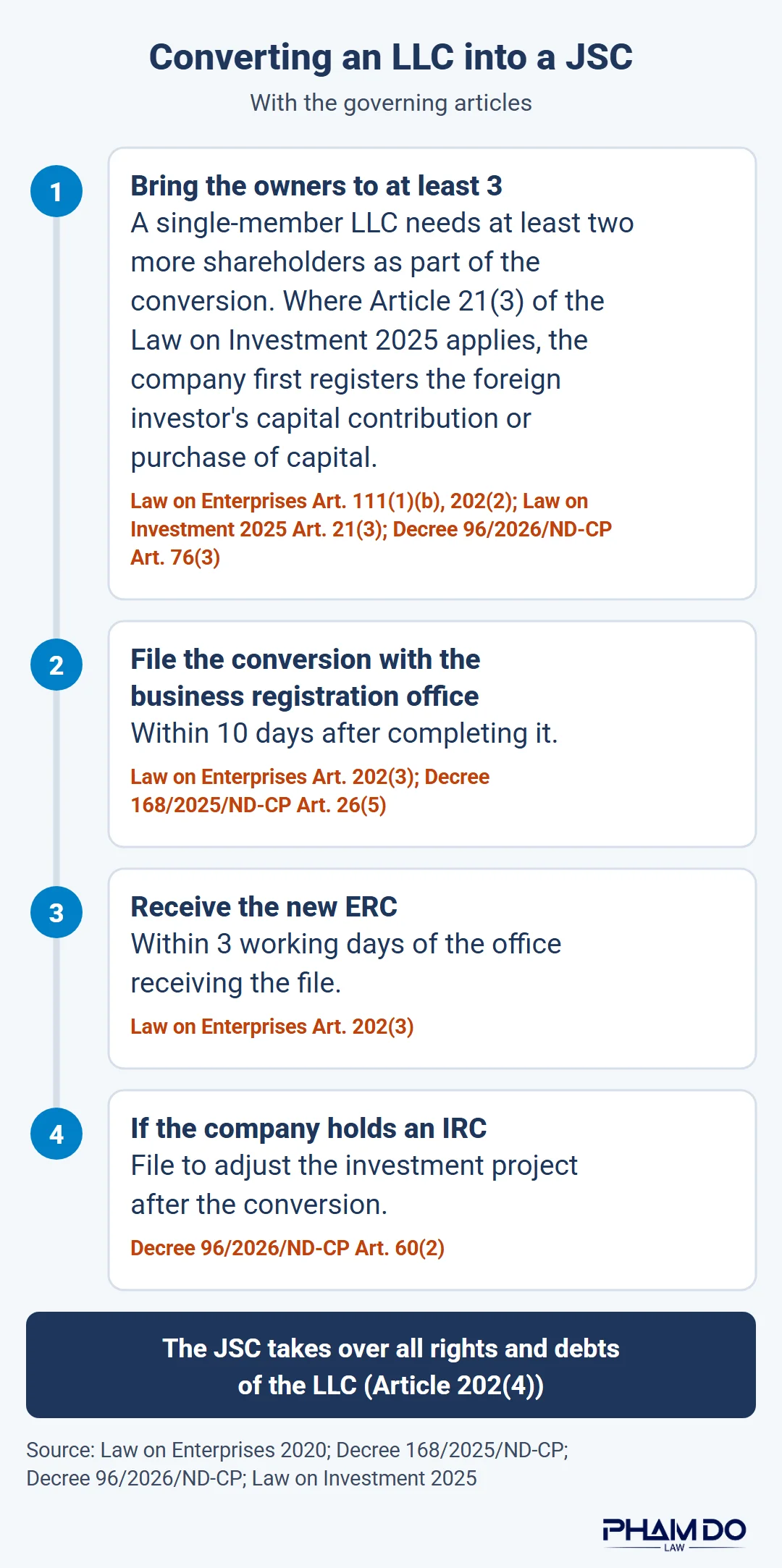
- Bring the owners to at least 3. Where Article 21(3) of the Law on Investment 2025 applies, the company first registers the foreign investor’s capital contribution or purchase of capital.
- File the conversion with the business registration office within 10 days after completing it (Article 202(3)). The file holds the JSC documents, the transfer or contribution papers and any required investment approval (Article 26(5) of Decree 168/2025/ND-CP).
- Receive the new ERC within 3 working days of the office receiving the file (Article 202(3)).
- If the company holds an Investment Registration Certificate (IRC), file to adjust the investment project after the conversion (Article 60(2) of Decree 96/2026/ND-CP).
The JSC takes over all rights and debts of the LLC, including tax debts and labor contracts (Article 202(4)). It keeps the investment incentives of its projects if it still meets their conditions (Article 20(6)(a) of Decree 96/2026/ND-CP). A JSC created by conversion need not have founding shareholders (Article 120(1)).
The reverse route exists too. A JSC can convert into a single-member LLC (Article 203(1)) or a multi-member LLC (Article 204(1)), for example when it has only 1 or 2 shareholders left (Articles 203(1)(c) and 204(1)(d)).
A multi-member LLC that a transfer or change of capital contributions leaves with 1 member reorganizes as a single-member LLC and registers the change within 15 days of completing the transfer (Article 52(3)). A single-member LLC whose owner sells or gives part of the capital, or admits a member, reorganizes into the matching form and registers within 10 days of completing the sale, gift or admission (Article 78(1)).
A JSC left with 1 shareholder sends the conversion file within 15 days of being left with 1 shareholder (Article 203(3)). A JSC with fewer than 3 shareholders that neither converts nor brings in new shareholders must be dissolved after 6 consecutive months (Article 207(1)(c)).
2025 and 2026 changes to the Vietnam enterprise law for LLCs and JSCs
The main changes since 1 July 2025 concern beneficial owners, foreign shareholder reports, nominee holdings, capital return in a JSC and company setup before the IRC. Every company must now collect, keep and provide information on its beneficial owners. The exemption from the 3-working-day foreign shareholder report now also covers companies registered for securities trading, and owners must not hold capital in their own name for someone else.
The Law on Enterprises 2020 still governs both forms, as amended, most relevantly by Law No. 03/2022/QH15 and Law No. 76/2025/QH15 (in force from 1 July 2025), and consolidated in Consolidated Text 67/VBHN-VPQH. The rules relevant here are:
- Beneficial owners. Law No. 76/2025/QH15 requires every company to collect, keep and provide information on its beneficial owners (Articles 4(35) and 8(5a)). Under Article 17 of Decree 168/2025/ND-CP, they include any individual owning, directly or indirectly, 25% or more of the charter capital or voting shares. From 23 July 2026, Decree 296/2026/ND-CP also counts family members, or individuals under a contract, who together hold 25% or more.
- Returning capital in a JSC. The 2 years of business before returning capital are counted without registered suspension periods (Article 112(5)(a)).
- Foreign shareholders of a JSC. A JSC already had to report its foreign shareholders’ details to the business registration office within 3 working days. Law No. 76/2025/QH15 extended the exemption from listed companies to companies registered for securities trading (Article 176(3)).
- The shareholder list for beneficial owners. Decree 296/2026/ND-CP repealed Article 52(2) of Decree 168/2025/ND-CP, the 10-day notice of the shareholder list used to identify beneficial owners (Article 19(9) of Decree 296/2026/ND-CP). A JSC that is not listed or registered for securities trading still notifies changes of foreign-investor shareholders within 10 days (Article 31(1)(b) and (3) of the Law on Enterprises; Article 51 of Decree 168/2025/ND-CP). The 3-working-day report on foreign shareholders under Article 176(3) of the Law on Enterprises also stays. Beneficial owner changes still need a 10-day notice unless the company is listed or registered for securities trading (Article 31(1)(c) and (2) of the Law on Enterprises; Article 52(1) of Decree 168/2025/ND-CP).
- Nominee holdings. Decree 296/2026/ND-CP states that owners must not hold capital in their own name for someone else (Article 4(1) of Decree 168/2025/ND-CP as amended), in both forms.
- The company before the IRC. Under Article 19(2) of the Law on Investment 2025, a foreign investor may set up the company and obtain its enterprise registration certificate before the IRC procedure. When setting up the company, the investor must meet the market access conditions for foreign investors under Article 8 of that Law. The company must then complete the IRC procedure within 12 months of its establishment. It may add other business lines only after the IRC is issued, and carry out the project only after completing the IRC procedure (Article 72(4) of Decree 96/2026/ND-CP).
- IRC processing time. The investment registration authority issues the IRC within 10 working days of receiving a valid file, for a project that needs no investment policy approval and meets Article 39(3) of Decree 96/2026/ND-CP.
| Change | Applies to | Basis |
|---|---|---|
| Collect, keep and provide beneficial owner information | Both forms | Law on Enterprises Art. 4(35) and 8(5a), as amended by Law No. 76/2025/QH15 |
| Family members, or individuals under a contract, who together hold 25% or more are beneficial owners | Both forms | Decree 168/2025/ND-CP Art. 17(1), as amended by Decree 296/2026/ND-CP Art. 3 |
| Suspension periods do not count toward the 2 years before returning capital | JSC | Law on Enterprises Art. 112(5)(a) |
| 3-working-day foreign shareholder report not needed for companies registered for securities trading | JSC | Law on Enterprises Art. 176(3) |
| 10-day shareholder list notice for beneficial owners repealed | JSC | Decree 296/2026/ND-CP Art. 19(9) |
| No holding capital in one’s own name for someone else | Both forms | Decree 168/2025/ND-CP Art. 4(1), as amended |
| Company set up before the IRC, IRC procedure within 12 months | Both forms, foreign investor | Law on Investment 2025 Art. 19(2); Decree 96/2026/ND-CP Art. 72(4) |
Frequently asked questions about LLCs and JSCs in Vietnam
Can one foreigner own a single-member LLC in Vietnam?
Pham Do Law Firm’s answer: Yes. Between an LLC and a JSC, only the LLC can have a single owner, since a JSC needs 3 shareholders (Articles 74(1) and 111(1)(b)). Its business lines must still meet the market access conditions for foreign investors (Article 8 of the Law on Investment 2025).
Pham Do Law Firm’s answer: No, a JSC needs at least 3 shareholders, and the Law on Enterprises does not require any of them to be Vietnamese (Articles 17 and 111(1)(b)). The law on enterprises sets no maximum or minimum on the share of charter capital a foreign investor may hold in a company.
Market access conditions under Article 8 of the Law on Investment 2025 still apply, so a sector with a foreign ownership cap may require a Vietnamese partner.
Pham Do Law Firm’s answer: It must bring in new shareholders or convert into an LLC. A company below the minimum number of owners for 6 consecutive months without converting must be dissolved (Article 207(1)(c)). A JSC left with 1 shareholder sends the conversion file within 15 days of being left with 1 shareholder (Article 203(3)).
Is an LLC in Vietnam a corporation?
Pham Do Law Firm’s answer: It is a company with its own legal personality, but it cannot issue shares except to convert into a JSC. Legal personality starts on its ERC date (Articles 46(2) and 74(2)), and the share rule is in Articles 46(3) and 74(3).
Its Vietnamese name shows the type as “công ty trách nhiệm hữu hạn” or “công ty TNHH”, and a JSC name shows “công ty cổ phần” or “công ty CP” (Article 37(2)). The Law on Enterprises has no separate Inc. or corporation type (Articles 1 and 194(1)), and a company’s English name is a translation of its Vietnamese name (Article 39(1)).
Can the owners of an LLC or JSC be personally liable?
Pham Do Law Firm’s answer: Not for ordinary company debts, but yes when the capital rules are broken. A member or shareholder who does not pay the committed capital is liable, in proportion to the capital committed or the par value of shares subscribed, for company financial obligations that arose before the capital change was registered (Articles 47(4) and 113(4)).
A single-member LLC owner is liable with all its assets for the company’s financial obligations and losses from not contributing, or not contributing in full or on time (Article 75(4)), and jointly liable for company debts after withdrawing capital other than by transfer (Article 77(5)).
Who owns a JSC, and who is the beneficial owner?
Pham Do Law Firm’s answer: The shareholders own a JSC (Article 111(1)). The beneficial owner is the individual behind them, for example any individual owning 25% or more of the charter capital or voting shares, directly or indirectly (Article 17 of Decree 168/2025/ND-CP, as amended).
Is a joint venture a separate company type in Vietnam?
Pham Do Law Firm’s answer: No. A foreign investor and a Vietnamese partner who set up a company together can use a multi-member LLC or a JSC, since both forms accept organizations and individuals as owners (Articles 46(1) and 111(1)(b)). The investment side of joint ventures is covered in the foreign direct investment guide.
Legal basis for LLCs and JSCs in Vietnam
- Law on Enterprises 2020 (No. 59/2020/QH14), as amended, most relevantly by Law No. 03/2022/QH15 and Law No. 76/2025/QH15 (from 1 July 2025), Consolidated Text 67/VBHN-VPQH of 2025.
- Decree 168/2025/ND-CP, as amended by Decree 296/2026/ND-CP (from 23 July 2026).
- Law on Investment 2025 (No. 143/2025/QH15) and Decree 96/2026/ND-CP.
- Decree 122/2021/ND-CP, as amended by Decree 288/2026/ND-CP (from 21 July 2026).
- Law on Independent Audit (No. 67/2011/QH12) and Law on Securities (No. 54/2019/QH14), both as amended by Law No. 56/2024/QH15.
- Circular 99/2025/TT-BTC.
- Law on Corporate Income Tax (No. 67/2025/QH15), as amended, lastly by Law No. 09/2026/QH16.
- Ordinance on Foreign Exchange (No. 28/2005/PL-UBTVQH11), as amended by Ordinance No. 06/2013/UBTVQH13, consolidated in 2026, and Circular 38/2026/TT-NHNN.
Company setup advice from Pham Do Law Firm
Pham Do Law Firm advises foreign investors on the choice of form as part of its company incorporation service.
- We compare the LLC and the JSC against your ownership plan, your sector and any partner arrangement.
- We draft the charter, including voting ratios, transfer limits and Board seats.
- We prepare the registration or conversion file, submit it and answer the authority’s requests.
This is Pham Do Law Firm’s advice on choosing between an LLC and a JSC in Vietnam. Contact Pham Do Law Firm for advice on your specific situation.