

A company formed in Vietnam today receives an Enterprise Registration Certificate (ERC), and a foreign investor’s project also needs an Investment Registration Certificate (IRC). Under Article 26(1) of the Law on Investment 2025 (No. 143/2025/QH15), the IRC is required for projects of foreign investors and of companies more than 50% foreign-owned, directly or indirectly. A share purchase needs no IRC. Pham Do Law Firm explains each step below.
The ERC proves that the company exists. The IRC records the project the company or investor carries out: its objectives, capital, location and schedule.
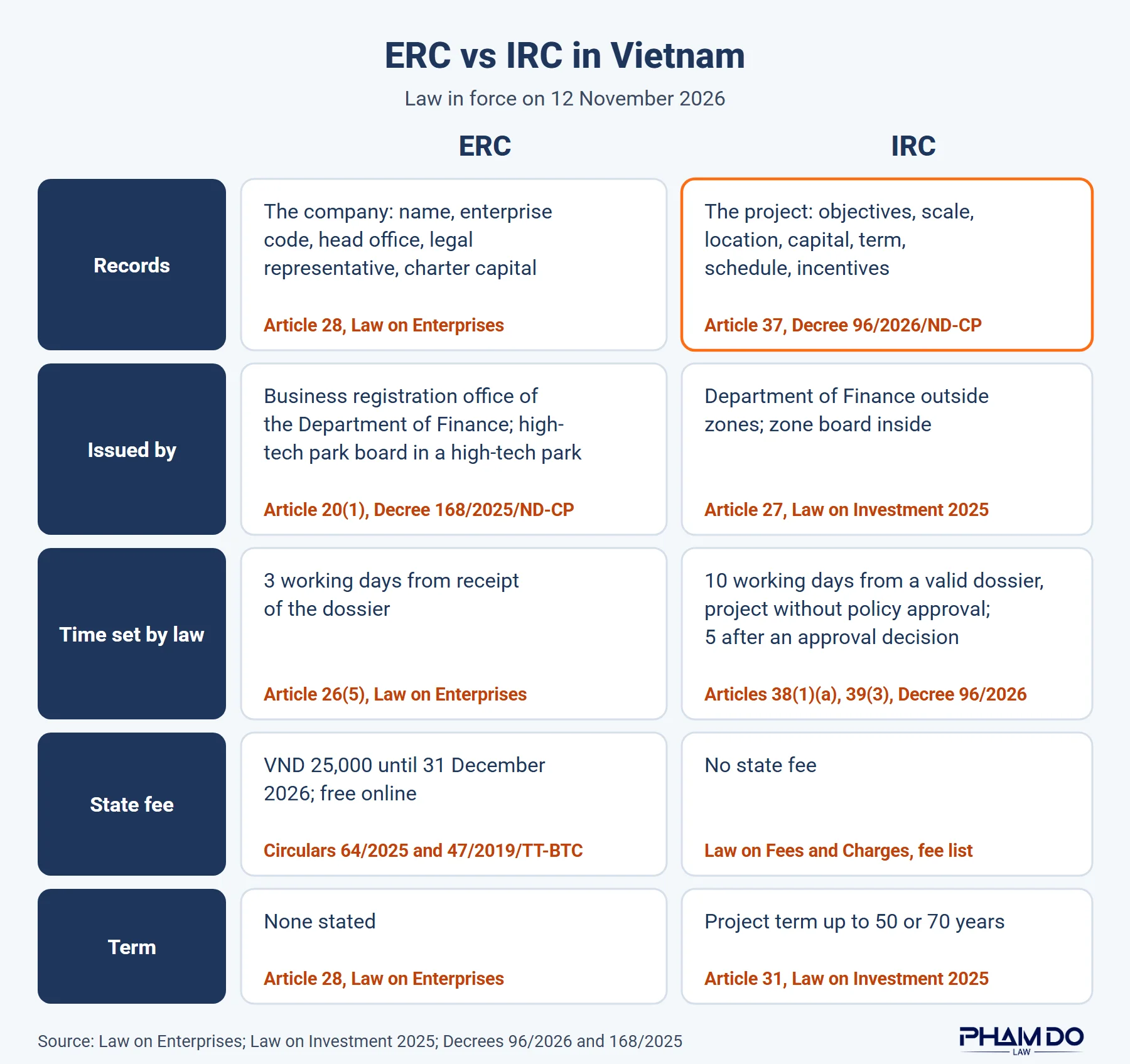
What is an Enterprise Registration Certificate in Vietnam
The ERC is the paper or electronic document in which the business registration office records a company’s registration details (Article 4(15) of the Law on Enterprises (No. 59/2020/QH14), as amended by Law No. 76/2025/QH15).
It is issued by the business registration office of the provincial Department of Finance, or by the high-tech park management board for a company located in a high-tech park (Article 20(1) of Decree 168/2025/ND-CP). Foreign investors also call it a business registration certificate or a certificate of incorporation.
What the ERC shows
Article 28 of the Law on Enterprises lists four groups of information.
| On the ERC (Article 28) | Not on the ERC |
|---|---|
| Company name and enterprise code, which is also the company’s tax code (Article 8(1) of Decree 168/2025/ND-CP) | Business lines, published on the National Business Registration Portal (Article 32(1)(a)) |
| Head office address | Founding shareholders and foreign shareholders of a joint stock company, also published on the Portal (Article 32(1)(b)) |
| Legal representative’s name, address, nationality and ID number; for a limited liability company (LLC), its members | Any expiry date or term of operation |
| Charter capital | The investment project, which is on the IRC |
Paper or electronic, and does an ERC expire?
The Law defines the ERC as a paper or electronic document (Article 4(15)), and it can be filed online through the Portal (Article 26(1)(c)). No expiry date is set: Article 28 lists no term, and the enterprise code lasts until the company ceases to exist (Article 8(2) of Decree 168/2025/ND-CP).
What is an Investment Registration Certificate in Vietnam
The IRC is the paper or electronic document that records an investor’s registered information about an investment project (Article 3(11) of the Law on Investment 2025). It is about the project, not the company. One company can hold several IRCs, because each project receives its own project code (Article 20(3) of the Law; Article 40(1) of Decree 96/2026/ND-CP).
Who issues the IRC
The investment registration office depends on where the project sits (Article 27 of the Law on Investment 2025):
- Inside an industrial park, export processing zone, high-tech park, digital technology zone or economic zone: the zone management board.
- Outside those zones: the provincial Department of Finance.
- A project in two or more provinces, inside and outside a zone, or in a zone without a board: the office where the project’s executive office is or will be.
Some older English guides still name the Department of Planning and Investment instead.
What the IRC shows
Article 37 of Decree 96/2026/ND-CP lists ten fields: project name, investor, project code, location and land area, objectives and scale, investment capital (contributed and mobilized), term, schedule for capital and main objectives, incentives with their basis and conditions, and any conditions on the investor. Charter capital on the ERC need not equal the IRC’s investment capital (Article 72(5)).
How long an IRC lasts
The IRC carries the project’s term of operation, not an expiry date of its own. The term is up to 70 years in an economic zone and up to 50 years elsewhere, or up to 70 years for some projects in difficult areas (Article 31(1) and (2) of the Law on Investment 2025). It can be extended, except for the projects in Article 31(5).
The term is not a guarantee. The investment registration office terminates a project if, 24 months after the end of the schedule for its main objectives, the investor still has not met them and the case does not qualify for a schedule adjustment (Article 36(2)(b) of the Law).
Who needs an IRC and who does not
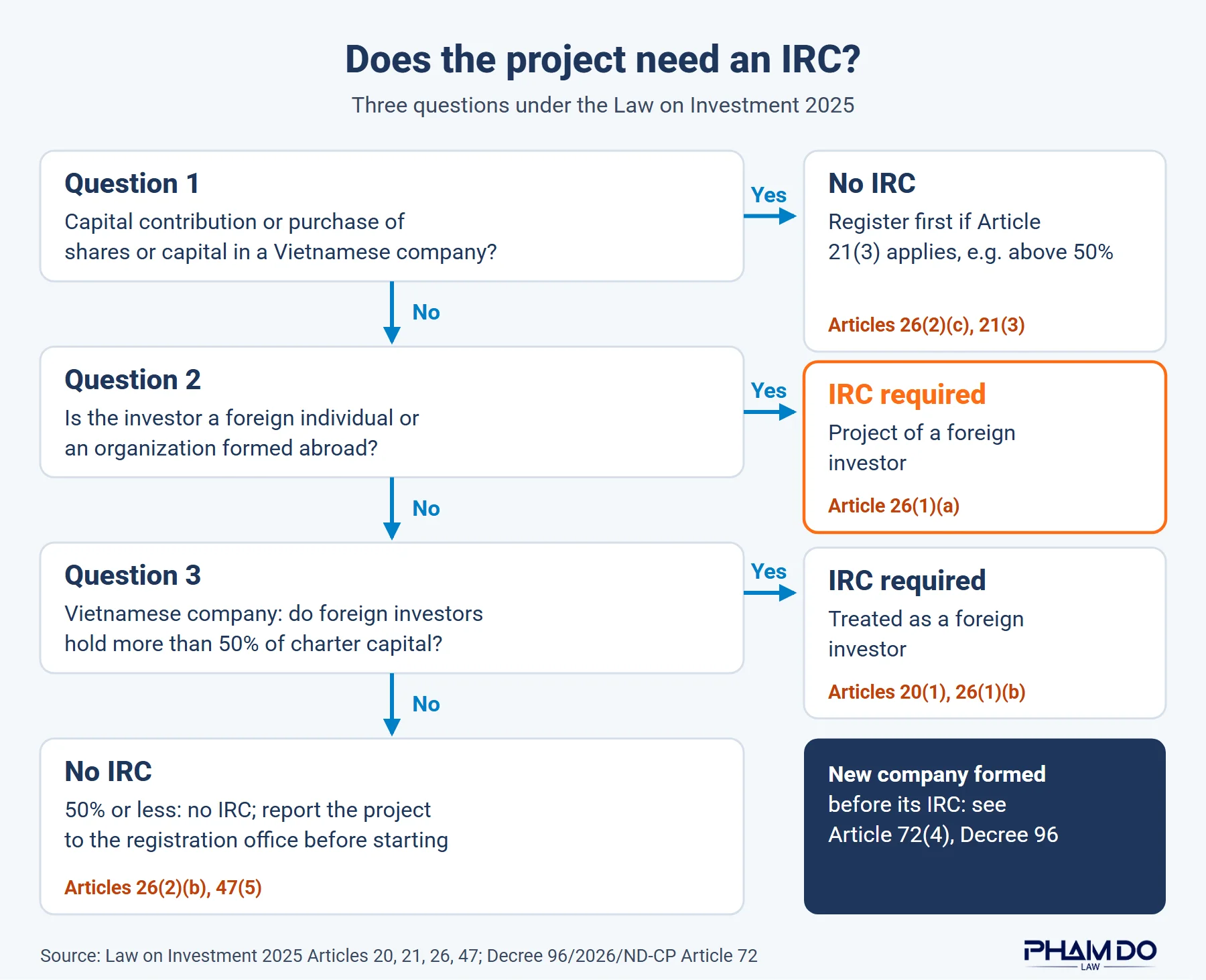
An IRC is required for a project of a foreign investor, meaning an individual of foreign nationality or an organization formed under foreign law (Articles 3(19) and 26(1)(a)). It is also required for a project of a Vietnamese company more than 50% foreign-owned, directly or through another such company (Articles 20(1) and 26(1)(b)). A domestic investor and a company 50% or less foreign-owned need none but may request one (Article 26(2)(a), (b) and (4)). A capital contribution or share purchase needs none, and Article 26(4) does not let the investor request one for it (Article 26(2)(c)).
A share purchase still needs prior registration with the investment registration office in the three cases of Article 21(3). The purchase raises foreign ownership in a company with a conditional business line for foreign investors, or takes foreign ownership above 50% or raises it further. Or the company holds land use rights on islands, in border or coastal communes, or in other areas that affect defense and security. The guide to foreign direct investment in Vietnam covers that route.
Example: a Vietnamese company owned 49% by a Korean investor and 51% by Vietnamese shareholders plans a second workshop. It does not need an IRC for that project (Article 26(2)(b)), but, like any project without an IRC, it is reported to the investment registration office before it starts (Article 47(5)). Once foreign ownership passes 50%, which must first be registered (Article 21(3)(b)), its next project needs an IRC.
New companies with 50% or less foreign capital
The 50% test in Article 20 is written for companies already formed. For a company that a foreign investor sets up before obtaining an IRC, Article 72(4) of Decree 96/2026/ND-CP requires the IRC within 12 months without mentioning ownership. Article 26(2)(b) of the Law, read with Article 20(2), exempts projects of companies with 50% or less foreign capital. No published guidance resolves the case of, say, 40% foreign capital, so Pham Do Law Firm recommends asking the investment registration office before filing.
Projects that need investment policy approval
Projects listed in Article 24 of the Law on Investment 2025, such as casino projects (Article 24(4)), need investment policy approval before they are carried out (Article 29(1)). Where the approval is granted together with approval of the investor, the IRC follows within 5 working days of receipt of the decision (Article 38(1)(a) of Decree 96/2026/ND-CP). The 10 working days in Article 39 apply only to projects without policy approval.
Which certificate comes first
Since 1 March 2026, either one can come first. Under Article 19(2) of the Law on Investment 2025, a foreign investor may form the company before the IRC procedure, provided it meets the market access conditions for foreign investors when it registers the company.
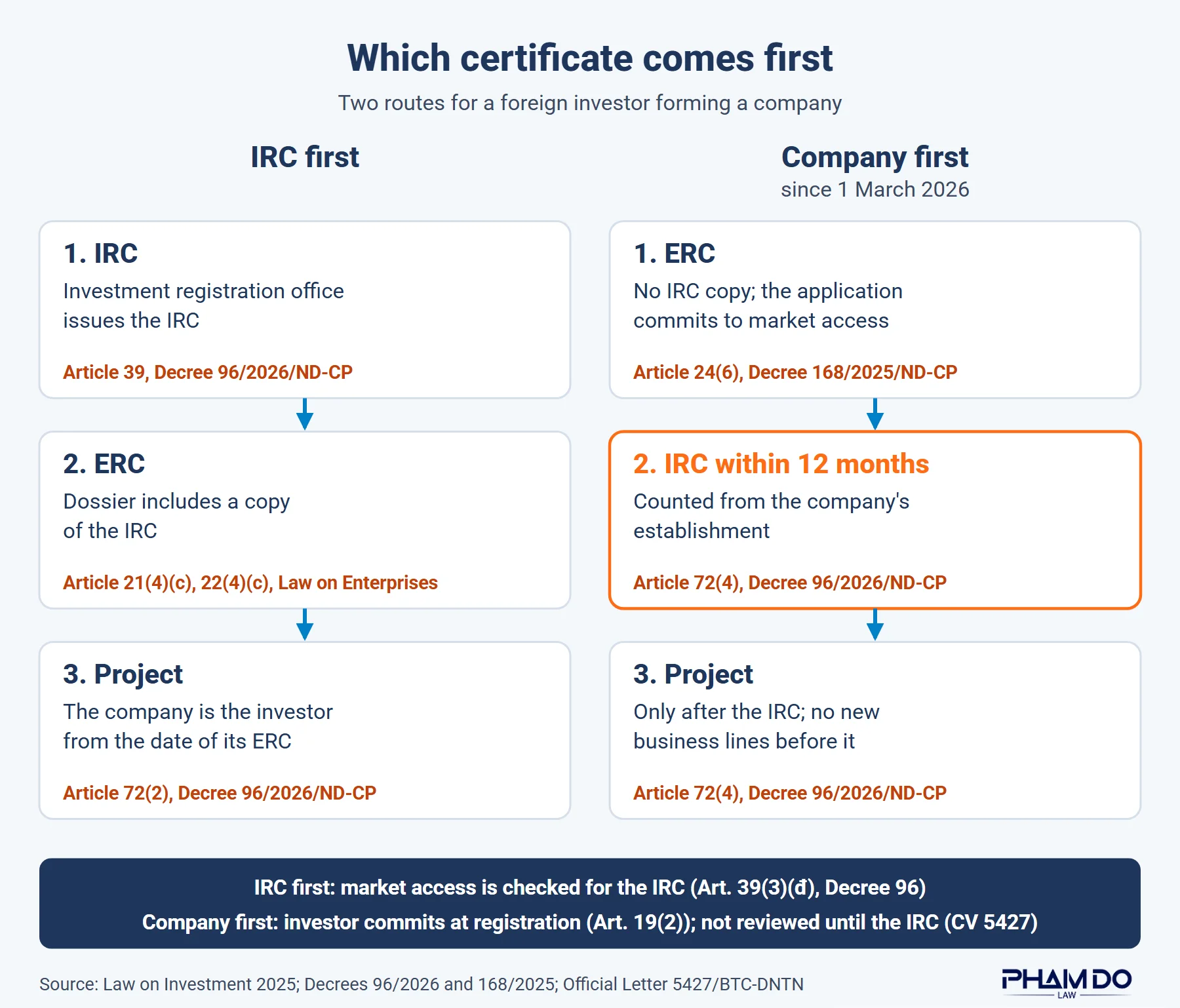
- IRC first. The ERC dossier includes a copy of the IRC (Articles 21(4)(c) and 22(4)(c) of the Law on Enterprises). The new company becomes the investor of the project from the date of its ERC (Article 72(2) of Decree 96/2026/ND-CP).
- Company first. The ERC dossier omits the IRC copy, and the application includes a commitment to meet the market access conditions (Article 24(6) of Decree 168/2025/ND-CP, added by Article 7 of Decree 296/2026/ND-CP; Article 72(3) of Decree 96/2026/ND-CP). The company must complete the IRC within 12 months of its establishment. Until then it may not carry out the project or add other business lines (Article 72(4)).
The business registration office does not review that commitment. Official Letter 5427/BTC-DNTN of the Ministry of Finance (29 April 2026) states that neither the Law nor the Decree asks it to. A restricted line is therefore tested only at the IRC stage. The full route is in the guide on how to set up a company in Vietnam.
After the ERC, the owner, members or shareholders contribute the charter capital within 90 days of its issue (Articles 47(2), 75(2) and 113(1) of the Law on Enterprises). The capital account, tax and other first steps are covered in the same guide.
Is the ERC a business license?
No. Vietnam issues no general business license. A conditional business line also needs the sector license that its own law requires, as set out in the guide to the business license in Vietnam. Article 29(3) of the Law on Investment 2025 obliges investors to comply with other laws while carrying out the project.
Documents for each certificate
The IRC dossier follows Article 32(1) of Decree 96/2026/ND-CP and the ERC dossier Articles 21 and 22 of the Law on Enterprises; both lists are in the guide on setting up a company in Vietnam. Two rules in Decree 96/2026/ND-CP limit what the investment registration office may ask for:
- Financial statements offered as proof of financial capacity need not be audited, and a parent company’s or financial institution’s support commitment or guarantee need not state a term, unless another law requires it (Article 6(7)).
- The office may not ask for papers beyond those in the Law and the Decree (Article 6(1)(b)).

Documents issued abroad
For the ERC, the legal papers of a foreign corporate member or shareholder must be legalized (Articles 21(4)(b) and 22(4)(b) of the Law on Enterprises). From 11 September 2026, a public document from a state with apostille relations with Vietnam needs an apostille instead of consular legalization (Article 25(2) of Decree 293/2026/ND-CP). The guide to the apostille in Vietnam lists the states and documents excluded. For the IRC, a foreign-language document comes with a Vietnamese translation (Article 5(2) of Decree 96/2026/ND-CP).
Processing time and state fees for the ERC and IRC
| Step | Time set by law | Starts from | Basis |
|---|---|---|---|
| Online project declaration, then filing of the IRC dossier | Dossier within 10 working days, or the declaration lapses | The online declaration | Article 41(1) of Decree 96/2026/ND-CP |
| IRC, project without investment policy approval | 10 working days | Receipt of a valid dossier | Article 39(3) |
| IRC after policy approval granted together with investor approval | 5 working days | Receipt of the approval decision | Article 38(1)(a) |
| ERC | 3 working days | Receipt of the dossier | Article 26(5) of the Law on Enterprises |
The investment dossier is filed in person or by public post; online filing depends on the National Investment Information System being ready (Article 6(3) of Decree 96/2026/ND-CP).
In Pham Do Law Firm’s experience, for some projects the investment registration office consults specialized agencies and the locality to check that the project fits local planning, so the IRC can take longer than the time set by law, depending on the province.
| Fee | Amount | Basis |
|---|---|---|
| IRC | No state fee | The fee list of the Law on Fees and Charges (No. 97/2015/QH13) names only a fee for outward investment certificates |
| Enterprise registration (ERC) | VND 25,000 per filing from 1 July 2025 to 31 December 2026; VND 50,000 under the schedule of Circular 47/2019/TT-BTC once the reduction ends; free when filed online | Article 1 of Circular 64/2025/TT-BTC; schedule and Article 5(3) of Circular 47/2019/TT-BTC |
| Publication of registration details on the Portal | VND 100,000 per publication, not reduced | Schedule of Circular 47/2019/TT-BTC; Article 32(1) of the Law on Enterprises |
Why an ERC or IRC application is returned
Each certificate has a short list of legal conditions, and a file that misses one is returned for correction or refused. Points foreign investors often overlook, all drawn from the texts:
- IRC conditions (Article 39(3) of Decree 96/2026/ND-CP): no prohibited line, an identified site, fit with the planning, any provincial investment-per-hectare or labor rule, market access for foreign investors and any technology review.
- ERC conditions (Article 27(1) of the Law on Enterprises): the business lines are not prohibited, the name follows Articles 37, 38, 39 and 41, the dossier is valid and the fee is paid.
- One notice, then a deadline. The investment registration office lists everything to fix in one written notice, with the basis and a deadline, and may close a file not fixed in time (Article 6(1)(d) of the Decree); a refusal must give written reasons (Article 6(1)(g)). Time spent fixing it does not count toward the processing period (Article 6(1)(e)).
- Consistent figures. The investor is legally responsible for the lawfulness, accuracy and truthfulness of the dossier (Article 6(1)(a)) and for any difference between a translation or copy and the original (Article 5(4)). Check that names, passport numbers and capital figures match across the IRC request, the charter and the ERC application.

When each certificate must be amended
- ERC: a change of name, head office, legal representative, LLC member or charter capital is registered within 10 days of the change (Article 30(2) of the Law on Enterprises). A change of business lines is notified separately; for a line restricted for foreign investors, the office checks market access at this stage (Article 49(2) of Decree 168/2025/ND-CP), unlike at formation. A company formed under the company-first route may add lines only after its IRC (Article 72(4) of Decree 96/2026/ND-CP), and new lines must meet market access (Article 73(1)).
- IRC: the investor adjusts it when a change to the project alters the main contents recorded on it (Article 33(2) of the Law on Investment 2025). For a project without policy approval, the procedure is Article 56 of Decree 96/2026/ND-CP (Article 39(4)).
- Both at once: if the project runs at the head office and both move, the head office address on the ERC (Article 28(2) of the Law on Enterprises) and the project location on the IRC (Article 37(4) of Decree 96/2026/ND-CP) change together.
Lost or wrong certificates
A lost or damaged IRC is reissued within 3 working days of the written request, and an IRC that does not match the dossier is corrected within the same period (Article 44 of Decree 96/2026/ND-CP). A lost or damaged paper ERC is reissued within 1 working day of the office’s receipt of the written request (Article 62 of Decree 168/2025/ND-CP).
Holders of an old Investment Certificate or Investment License
An Investment License or Investment Certificate issued before 1 March 2026 still governs the project: the investor carries out the project under it (Article 52(1) of the Law on Investment 2025). Its number serves as the project code (Article 40(2) of Decree 96/2026/ND-CP).
- A company operating under one of these certificates, which also served as its business registration certificate, may continue without switching to an ERC (Article 109(2) of Decree 96/2026/ND-CP).
- An investor may instead obtain an IRC within 3 working days of filing a request with a copy of the old certificate; one who wants both new certificates obtains the ERC first, then the IRC (Article 109(1) and (3)).
How to check an ERC or IRC
Company registration details are published on the National Business Registration Portal (Article 32(1) of the Law on Enterprises). Compare the enterprise code, name, head office and legal representative on the paper with the Portal, where the business lines also appear. Our guide to a Vietnam company search shows each step of the Portal search and how to read the record.

For an IRC, ask for the project code and the latest adjusted certificate. Where the paper differs from the electronic record in the National Investment Information System, the content matching the registration dossier prevails (Article 44(2) of Decree 96/2026/ND-CP).
Frequently asked questions
Is the ERC the same as the IRC?
Pham Do Law Firm’s answer: No. The ERC records the company; the IRC records a project of a foreign investor or a company more than 50% foreign-owned, directly or indirectly (Article 26(1) of the Law on Investment 2025).
Pham Do Law Firm’s answer: No. A share purchase needs no IRC (Article 26(2)(c) of the Law on Investment 2025). It must be registered first in the cases of Article 21(3), such as taking foreign ownership above 50%.
Can a foreigner be the legal representative named on the ERC?
Pham Do Law Firm’s answer: Yes. Article 12 of the Law on Enterprises sets no nationality requirement, but the company must always have at least one legal representative residing in Vietnam (Article 12(3)).
Does the ERC or IRC give me a visa or residence card?
Pham Do Law Firm’s answer: No. Neither certificate is an immigration document; see the firm’s business visa and temporary residence card service.
How long does each certificate take?
Pham Do Law Firm’s answer: 3 working days for the ERC (Article 26(5) of the Law on Enterprises). The IRC takes 10 working days, or 5 working days after a policy approval granted together with investor approval (Articles 38(1)(a) and 39(3) of Decree 96/2026/ND-CP).
How can I check a company’s registration status in Vietnam?
Pham Do Law Firm’s answer: Search the company on the National Business Registration Portal, where registration details are published, and compare the enterprise code, name, head office and legal representative with the ERC (Article 32(1) of the Law on Enterprises).
Is the enterprise code the same as the tax code?
Pham Do Law Firm’s answer: Yes. The enterprise code on the ERC is also the company’s tax code (Article 8(1) of Decree 168/2025/ND-CP). It stays the same until the company ceases to exist.
Can I apply for an ERC online?
Pham Do Law Firm’s answer: Yes. Enterprise registration can be filed online through the National Business Registration Portal (Article 26(1)(c) of the Law on Enterprises). The registration fee is waived for an online filing, but publishing the registration details on the Portal still costs VND 100,000.
Legal basis
- Law on Investment 2025 (No. 143/2025/QH15), effective 1 March 2026, as amended by Law No. 24/2026/QH16 from 1 March 2027, some provisions from 1 January 2027 (consolidated text 142/2026/VBHN-LQ-VPQH of 23 September 2026);
- Decree 96/2026/ND-CP, effective 31 March 2026;
- Law on Enterprises (No. 59/2020/QH14), as amended by Law No. 76/2025/QH15 from 1 July 2025;
- Decree 168/2025/ND-CP, as amended by Decree 296/2026/ND-CP from 23 July 2026;
- Official Letter 5427/BTC-DNTN of the Ministry of Finance, 29 April 2026;
- Law on Fees and Charges (No. 97/2015/QH13); Circular 47/2019/TT-BTC; Circular 64/2025/TT-BTC;
- Decree 293/2026/ND-CP, effective 11 September 2026.
ERC and IRC applications with Pham Do Law Firm
Pham Do Law Firm prepares both certificates as part of its company incorporation service for foreign investors.
- We check the business lines against the market access conditions and advise whether the IRC or the company should come first.
- We prepare and file the IRC and ERC dossiers, answer the authority’s requests and later handle amendments to either certificate.
Issuance of each certificate is decided by the authority and is not guaranteed. This is Pham Do Law Firm’s advice on the Enterprise Registration Certificate and the Investment Registration Certificate in Vietnam as of 12 November 2026. Contact Pham Do Law Firm for advice on your specific situation.