
An apostille is valid in Vietnam from 11 September 2026 for public documents issued in a state that applies the Hague Apostille Convention with Vietnam. Under Article 25(2) of Decree 293/2026/ND-CP, such a document needs no consular legalization. Documents from Germany, Austria, the Czech Republic, Thailand until 28 February 2027 and states outside the Convention stay on the old route, as do some document types. A Vietnamese translation is still required.
The apostille replaces the embassy step, not the rest of the file. A foreign investor still needs the right document, a translation and a filing that meets the Vietnamese rule for that procedure, such as the steps to set up a company in Vietnam.
Is an apostille valid in Vietnam?
Yes, since 11 September 2026, for 125 states that have apostille relations with Vietnam. Vietnam acceded to the Hague Convention of 5 October 1961 Abolishing the Requirement of Legalisation for Foreign Public Documents, and the Convention entered into force for Vietnam on that date.
| Date | Event | Source |
|---|---|---|
| 31 December 2025 | Vietnam deposits its instrument of accession | HCCH status table |
| 20 May, 19 June and 2 July 2026 | Germany, Austria and the Czech Republic object to Vietnam’s accession | HCCH notifications |
| 23 July 2026 | The Government issues Decree 293/2026/ND-CP | Decree 293/2026/ND-CP |
| 11 September 2026 | The Convention enters into force for Vietnam, and the Decree takes effect (Article 34) | HCCH status table; Decree 293/2026/ND-CP |
| 28 February 2027 | The Convention enters into force for Thailand | HCCH status table |
The HCCH table lists 130 contracting parties as of 11 November 2026. The Ministry of Foreign Affairs published the list of 125 states with apostille relations in its notice of 11 September 2026 on the Consular Department website. The United States, the United Kingdom, China, Japan, Korea, Singapore, India, Australia, Canada and France are on it.
What changed for foreign documents used in Vietnam
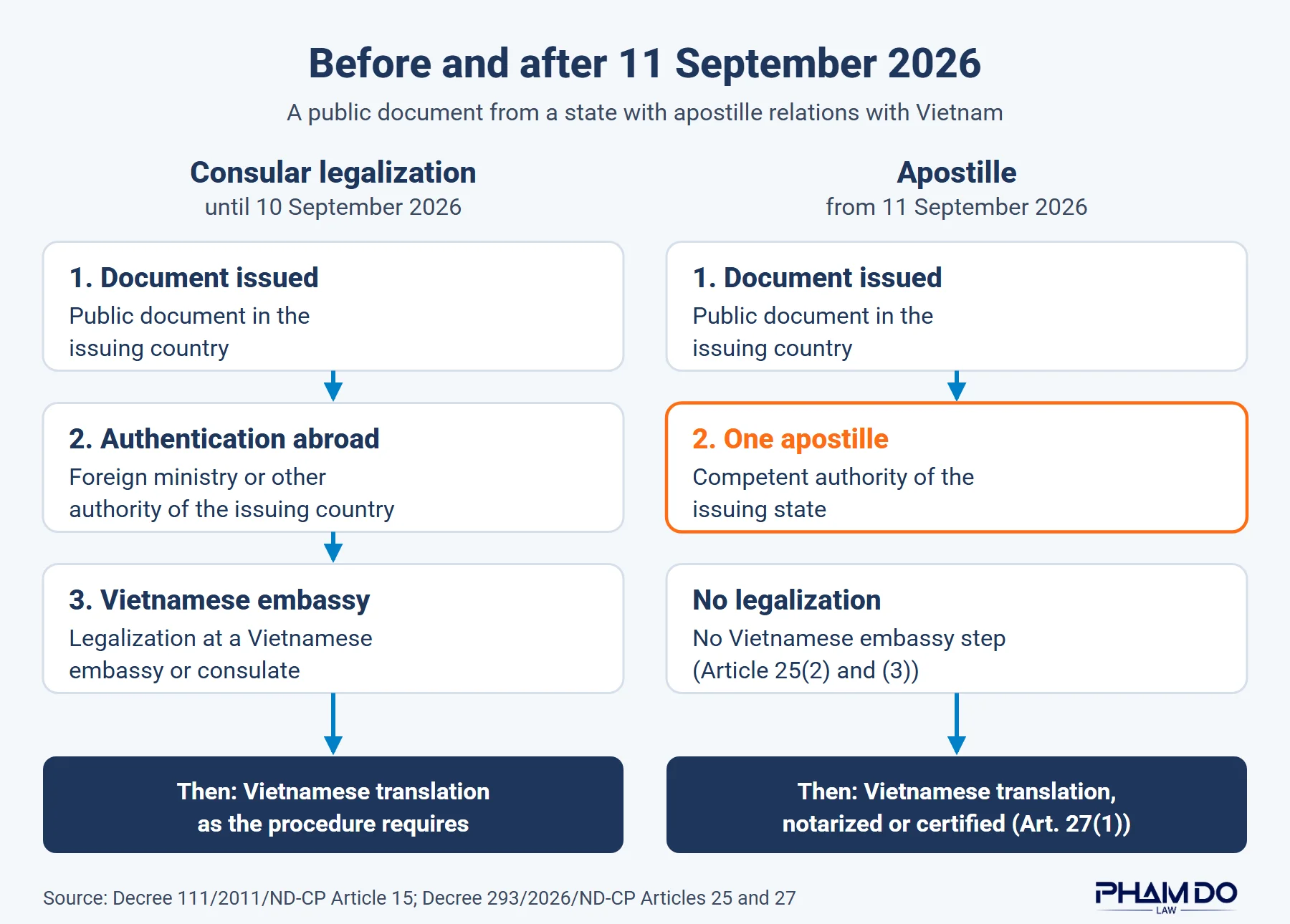
One certificate from the issuing country now replaces a chain that ended at a Vietnamese embassy or consulate. Under Article 25(3), no Vietnamese authority or organization may ask for consular legalization of a document that carries a valid apostille.
| Consular legalization | Apostille | |
|---|---|---|
| Who certifies | A competent authority of the issuing country, then a Vietnamese embassy or consulate abroad, or the Ministry of Foreign Affairs in Vietnam (Articles 14 and 15 of Decree 111/2011/ND-CP, as amended by Decree 196/2025/ND-CP) | One competent authority in the issuing country (Decree 293/2026/ND-CP, Article 25(2)) |
| What it confirms | Seal, signature and title, not content (Article 3 of Decree 111/2011/ND-CP) | Signature, title, authority of the signer and seal, not content or form (Article 4) |
| Vietnamese translation | Set by the procedure the document is used for, for example a translation with the translator’s signature certified for enterprise registration (Article 10(2) of Decree 168/2025/ND-CP, as amended by Article 19(1) of Decree 296/2026/ND-CP) | Required, and notarized or certified under Vietnamese law, unless a sector law provides otherwise (Article 27(1)) |
| Time and state fee | 1, 2 or 4 working days by number of documents (Article 11(5), applied by Articles 14(4) and 15(4) of Decree 111/2011/ND-CP). Fee: VND 30,000 per legalization in Vietnam (Article 5(1)(b) of Circular 157/2016/TT-BTC) or USD 10 per copy at a Vietnamese mission abroad from 1 November 2026 (Circular 163/2026/TT-BTC, Appendix II, item D.1) | Set by the issuing state |
| Checking it | Comparison with seal and signature samples | Online e-Register or QR code of the issuing state (Article 27(2)) |
From the same date, Vietnamese embassies and consulates stopped legalizing public documents covered by the Convention (Article 37(1)). The Embassy of Vietnam in the United States, for example, announced that it no longer accepts legalization of US public documents from 11 September 2026 in its notice on legalization.
When consular legalization still applies
Consular legalization under Decree 111/2011/ND-CP still applies when the issuing state has no apostille relations with Vietnam, or when the document is outside the Convention (Articles 5(3)(b), 5(4), 26(1) and 35(2)(c) of Decree 293/2026/ND-CP).

In Vietnam, legalization is handled by the Consular Department, the Ho Chi Minh City Department of Foreign Affairs and the provincial bodies given that power (Article 2 of Circular 11/2025/TT-BNG). Circular 03/2026/TT-BNG gives Hai Phong, Da Nang and Can Tho the whole procedure, and nine provinces the receipt and return of files (Articles 3 and 4).
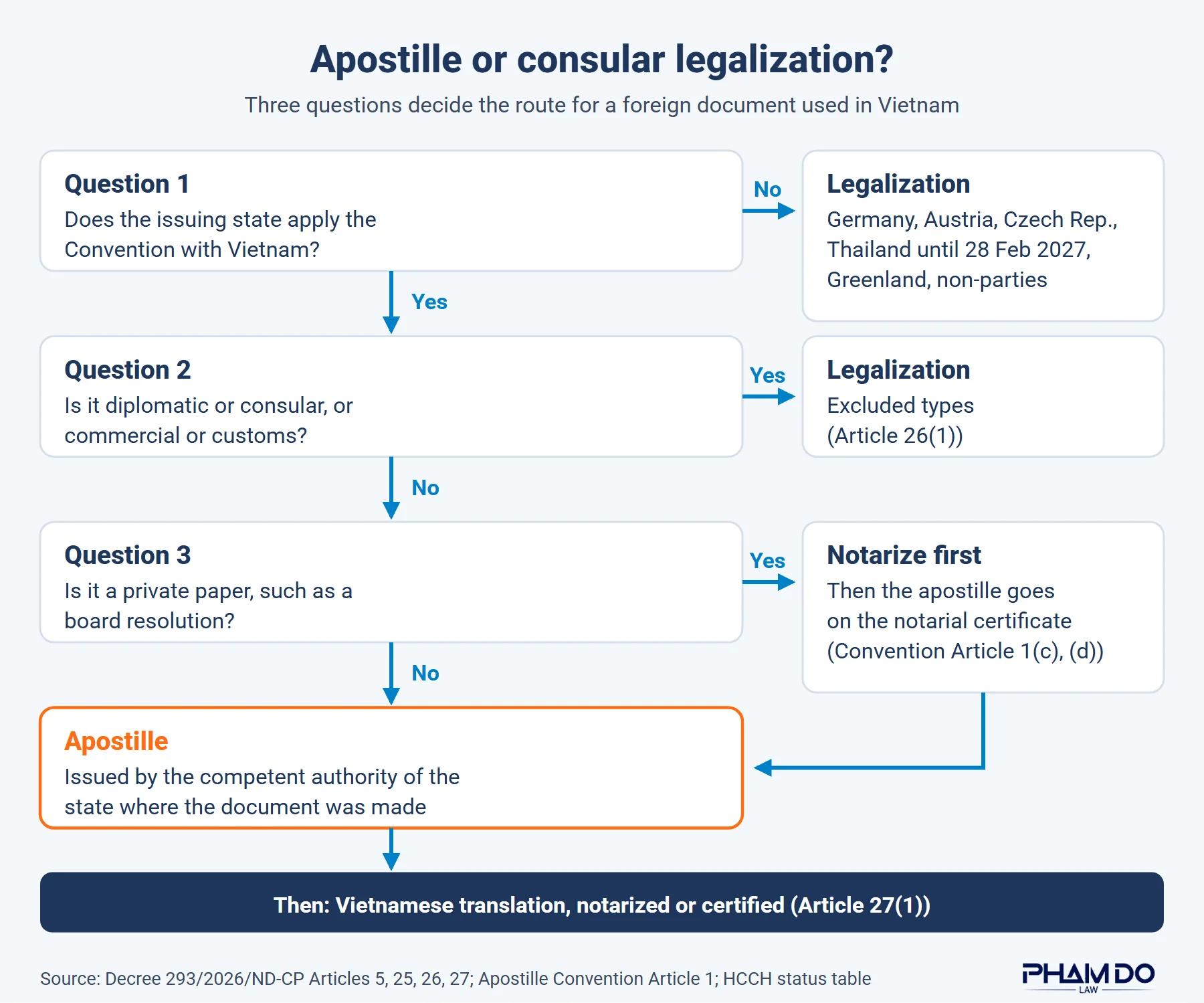
Germany, Austria, the Czech Republic, Thailand and Greenland
Under Article 12 of the Convention, an accession works only with states that did not object within six months. Germany, Austria and the Czech Republic objected, so documents between those states and Vietnam still need consular legalization.
- Thailand: acceded on 30 June 2026; the Convention applies from 28 February 2027, so legalization continues until then.
- Greenland: the Ministry of Foreign Affairs notice states that Denmark does not apply the Convention to Greenland, while the Faroe Islands are covered.
Some states also apply the Convention to territories with their own apostille authority, such as the overseas territories of the United Kingdom, Hong Kong and Macao. The Ministry notice asks applicants to identify the territory where the document was issued, not only the state. The Embassy of Vietnam in the United States also lists Tokelau (New Zealand) as an exception; the Ministry list does not mention it.
States that are not parties at all still use legalization. As of 11 November 2026, Malaysia, Cambodia, Laos, the United Arab Emirates and Qatar do not appear in the HCCH status table.
Diplomatic, consular and commercial or customs documents
Article 1 of the Convention excludes documents executed by diplomatic or consular agents and administrative documents dealing directly with commercial or customs operations. Under Article 26(1) of Decree 293/2026/ND-CP, an apostilled document of those types is refused in Vietnam.
Whether a document falls inside the Convention depends on the law of the state where it was issued, as the Consulate General of Vietnam in Shanghai notes in point 5 of its notice of 10 September 2026. A document outside the apostille scope stays on the consular legalization route (Article 35(2)(c) of Decree 293/2026/ND-CP).
Which documents foreign investors usually apostille
Vietnamese law decides which foreign documents need authentication; the apostille is only the form that authentication now takes. The table lists common cases for a foreign investor.
| Document | Vietnamese rule | What to do |
|---|---|---|
| Certificate of incorporation or other legal status document of a foreign corporate member or shareholder, for the Enterprise Registration Certificate (ERC) | A foreign organization’s legal documents must be legalized (Article 21(4)(b) and 22(4)(b) of the Law on Enterprises (No. 59/2020/QH14), as amended) | Apostille in the issuing state if it has apostille relations with Vietnam (Article 25(2) of Decree 293/2026/ND-CP); otherwise legalization |
| Foreign-language documents in an investment dossier for the Investment Registration Certificate (IRC) | A Vietnamese translation must be attached (Article 5(2) of Decree 96/2026/ND-CP) | Translate; the investor is responsible for any difference between translation and original (Article 5(4)) |
| Degrees, criminal record checks and other foreign documents for a work permit | Must be legalized unless a treaty, reciprocity or law exempts them (Article 5(1) of Decree 219/2025/ND-CP); from 5 December 2026, Article 6(1) of Decree 393/2026/ND-CP, which excludes the passport | Apostille in the issuing state, then a Vietnamese translation that is notarized or certified (Article 27(1) of Decree 293/2026/ND-CP) |
| Board resolutions, powers of attorney and other papers signed privately | Not public documents on their own (Article 3(3) of Decree 293/2026/ND-CP) | Have the signature notarized in the issuing state first; the notarial certificate is then apostilled (Convention Article 1(c) and (d)) |
Whether a corporate paper falls under the commercial and customs exclusion above is decided under the law of the issuing state, and under Article 26(1) one that does is refused in Vietnam. Ask the Vietnamese registration office how it treats the paper before you order the apostille abroad.
Age limits come from the sector rule, not from the apostille. Until 4 December 2026, Decree 219/2025/ND-CP accepts a criminal record check issued no more than 6 months before the work permit filing (Article 18(4)). Decree 393/2026/ND-CP replaces that decree from 5 December 2026 (Article 36).
One practical point concerns the licence itself rather than its apostille: some home states issue business licences only in electronic form. Pham Do Law Firm has met this case for a foreign parent company opening a representative office. Our advice: provide equivalent documents that show the enterprise code, company name, address, business lines and legal representative, and we explain the file to the Vietnamese authority.
Step by step from apostille to filing in Vietnam
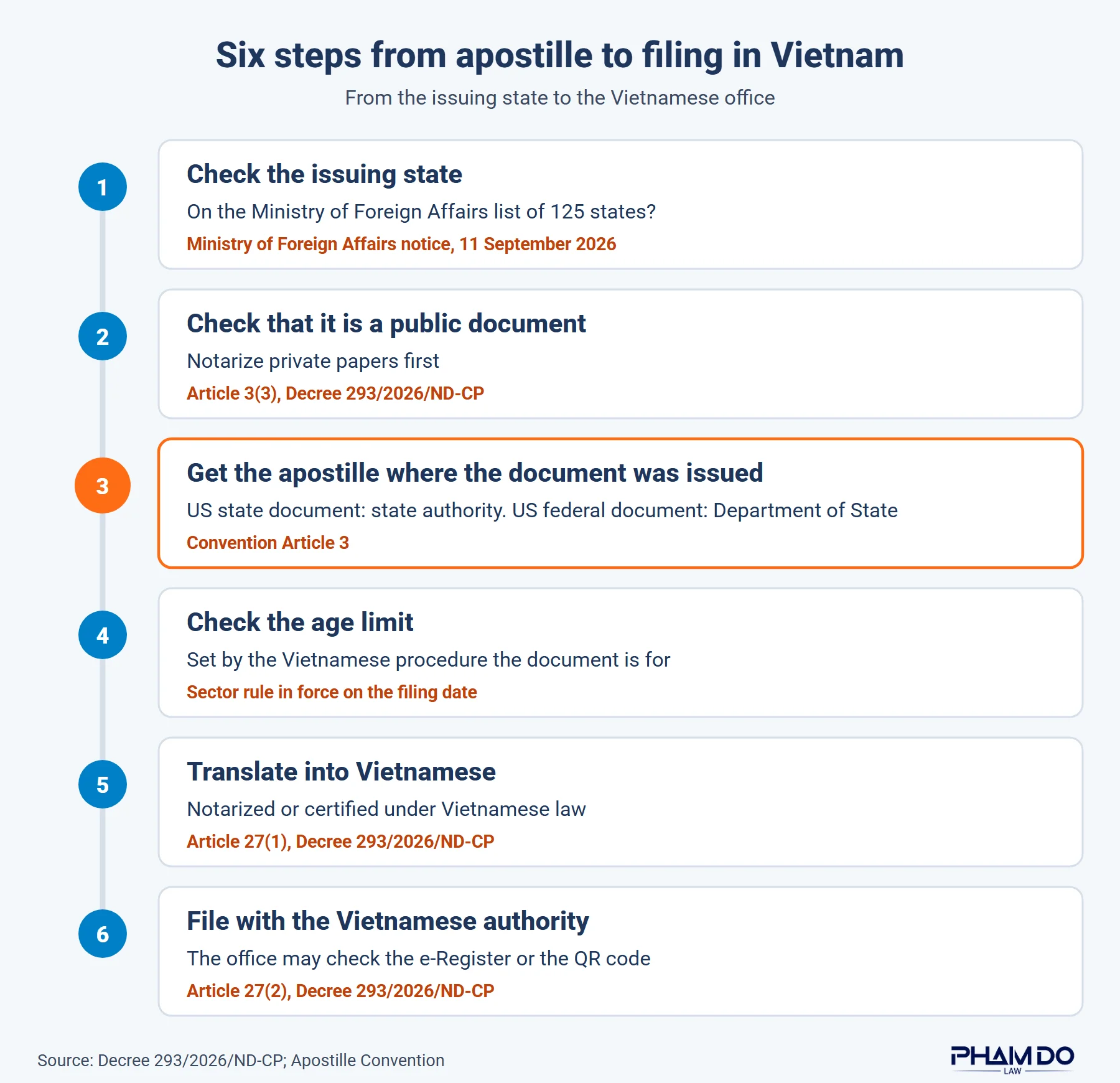
- Check the issuing state. Find it on the Ministry of Foreign Affairs list of 125 states. If it is Germany, Austria, the Czech Republic, Thailand before 28 February 2027, Greenland or a non-party, plan for legalization.
- Check that it is a public document. A court document, an administrative document, a notarial act or an official certificate on a private document qualifies (Article 3(3) of Decree 293/2026/ND-CP). Notarize private papers first.
- Get the apostille where the document was issued. In the United States, a state document is apostilled by that state’s authority, usually the Secretary of State, listed on the HCCH page of US authorities. A federal document, such as an FBI background check, goes to the US Department of State (State Department guidance). In the United Kingdom, the Legalisation Office attaches the apostille.
- Check the age limit set by the Vietnamese procedure the document is for.
- Translate into Vietnamese. The translation must be notarized or certified under Vietnamese law, unless a sector law provides otherwise (Article 27(1)).
- File with the Vietnamese authority. The receiving office may check the apostille on the issuing state’s e-Register or by its QR code (Article 27(2)).
Note: for a US federal document, send the original or a certified copy and do not have it notarized. The State Department page warns that a notarized original is no longer valid.
Can an apostilled document be refused in Vietnam?
Yes. Article 26 of Decree 293/2026/ND-CP lists five cases in which an apostilled document is refused:
- the document is not a public document under the law of the issuing state, was executed by a diplomatic or consular agent, or is an administrative document directly related to commercial or customs operations;
- the apostille was not issued by the competent authority of the state where the document was made, or lacks the French title “Apostille (Convention de La Haye du 5 octobre 1961)” and does not contain all items of the model certificate;
- the document or the apostille shows signs of forgery, erasure or unlawful alteration;
- the content of the document violates Vietnamese law, harms the interests of the Vietnamese State or breaches basic principles of public order and morality;
- the issuing authority has cancelled or revoked the apostille.
An apostille also does not settle whether the document is enough for the procedure. The receiving office still decides, after comparing the document with the law and the rest of the file (Article 33(2)(a)). If an office doubts an apostille that it cannot check online, it may ask the Ministry of Foreign Affairs to verify it with the issuing state (Articles 27(3) and 28).
Documents legalized before 11 September 2026
A foreign public document that a Vietnamese authority legalized before 11 September 2026 remains valid in Vietnam, and no office may ask for an apostille on it (Article 36(2)(a)). An apostille issued abroad before that date is also accepted if none of the Article 26 grounds applies (Article 36(3)).
For Vietnamese documents, an application for consular certification received in valid form before 11 September 2026 is processed under the old rules (Article 36(1)). A Vietnamese document certified before that date can receive an apostille without a new original (Article 36(2)(b)).
Vietnamese documents for use abroad
A Vietnamese public document gets its apostille from the Ministry of Foreign Affairs, not from a notary or an embassy (Article 6(1)). For now, Circular 12/2026/TT-BNG names two issuing offices (Article 2(1)):
- the Consular Department, 40 Tran Phu, Ba Dinh Ward, Hanoi;
- the Ho Chi Minh City Department of Foreign Affairs, 6 Alexandre de Rhodes, Sai Gon Ward, Ho Chi Minh City.
Article 6(3) of Decree 293/2026/ND-CP allows the Minister to delegate the power to provinces later, and Circular 12/2026/TT-BNG plans that from 2027 to 2030 (Article 6(1)). The addresses are from the Ministry’s notice of 11 September 2026.
Both receive files Monday to Friday and on Saturday morning, 8:30 to 11:00 and 14:00 to 16:00, according to the same notice. Anyone may apply for their own or another person’s document without a power of attorney (Article 7(1) of Decree 293/2026/ND-CP).
A paper application can be handed in at the one-stop desk of either office or sent by post. It consists of the application form and the original public document; a certified copy or certified translation is filed as it is (Article 12(1) of Decree 293/2026/ND-CP). When the file is sent and returned by post, the applicant pays the postage (Article 9(2)). Until the Apostille information system is running, online applications are received on the Ministry of Foreign Affairs’ administrative procedure system linked to the National Public Service Portal (Article 36(4)(a)). Fully online filing through the Portal or the VNeID app will need an electronic document with a valid digital signature (Article 12(2)).

| Documents in one application | Paper application | Fully online application, once the Ministry announces the system is running (Article 36(4)) |
|---|---|---|
| 1 to 4 | 1 working day | Same working day, if received before the cut-off time |
| 5 to 9 | 2 working days | 1 working day |
| 10 or more | 4 working days | 3 working days |
These periods run from receipt of a complete and valid application and exclude any verification time (Article 17). If the issuing office must confirm a seal or signature, it has 5 working days to reply, or up to 10 in complex cases (Article 15(3)).
The procedure has a state fee of VND 30,000 per document. Article 9(1) applies the consular certification fee, set at VND 30,000 per certification by Article 5(1)(a) of Circular 157/2016/TT-BTC, and the Ministry notice quotes the same amount per document.
The apostille covers judicial documents, administrative documents such as civil status papers, criminal record checks and degrees, notarial documents and certified copies or signatures (Article 10 of Decree 293/2026/ND-CP). It does not cover, among others, documents issued by Vietnamese diplomatic or consular officers, or administrative documents directly related to commercial or customs operations (Article 11(1)). The commercial exclusion does not apply to documents that could receive consular certification before the Convention took effect for Vietnam, and the Ministry is to list them (Articles 11(1)(b) and 30(7)). Vietnam’s apostille is in Vietnamese and English, with the French title required by the Convention (Article 8(1)).
Vietnam’s own e-Apostille, the QR code on its apostilles, the public e-Register and fully online filing start only when the Minister of Foreign Affairs announces that the Apostille information system is running (Article 36(4)(b) and (c)). Until then, the Ministry issues paper apostilles and keeps the records on file (Article 36(4)(a)).
Notary in Vietnam and the apostille
A Vietnamese notary does not issue apostilles. A notary’s work can be apostilled for use abroad, because notarized contracts, transactions, translations and copies are within scope (Article 10(3) of Decree 293/2026/ND-CP).

Foreigners in Vietnam sometimes sign a document at their own embassy or consulate. That document is “executed by diplomatic or consular agents”, which Article 1 of the Convention excludes. If it is for use in Vietnam, it is refused under Article 26(1) if it carries only an apostille, and consular legalization is the route.
Frequently asked questions
Is Vietnam a member of the Hague Apostille Convention?
Pham Do Law Firm’s answer: Yes. Vietnam acceded on 31 December 2025, and the Convention has applied to Vietnam since 11 September 2026 (HCCH status table). It does not apply with Germany, Austria and the Czech Republic, which objected (HCCH notifications), or with Thailand until 28 February 2027.
Do I still need the Vietnamese embassy to legalize a US document?
Pham Do Law Firm’s answer: No, for a US public document. An apostille from the competent US authority is enough (Article 25(2) of Decree 293/2026/ND-CP), and the Embassy of Vietnam in the United States stopped legalizing such documents on 11 September 2026.
How do I apostille a US document for Vietnam?
Pham Do Law Firm’s answer: Send a state document to the apostille authority of the issuing state and a federal document to the US Department of State. Then have it translated into Vietnamese and the translation notarized or certified under Vietnamese law (Article 27(1)).
Can a notary in Vietnam issue an apostille?
Pham Do Law Firm’s answer: No. For now only the Ministry of Foreign Affairs issues apostilles for Vietnamese documents, through two offices (Article 6(1) of Decree 293/2026/ND-CP). Article 6(3) allows later delegation to provinces. A notarized document can then receive an apostille (Article 10(3)).
Is an e-Apostille accepted in Vietnam?
Pham Do Law Firm’s answer: Yes. An e-Apostille issued by a member state has the same legal value as a paper apostille (Article 25(4) of Decree 293/2026/ND-CP). It is checked on the issuing state’s e-Register.
How long does an apostille take in Vietnam?
Pham Do Law Firm’s answer: 1 working day for 1 to 4 paper documents, 2 for 5 to 9 and 4 for 10 or more, from a complete application and excluding verification (Article 17(1) of Decree 293/2026/ND-CP).
Can I apply for an apostille in Vietnam online or by post?
Pham Do Law Firm’s answer: Both. Send the form and the original by post and pay the postage, or file on the Ministry of Foreign Affairs’ system linked to the National Public Service Portal (Article 36(4)(a) of Decree 293/2026/ND-CP).
What is the fastest way to get an apostille in Vietnam?
Pham Do Law Firm’s answer: File 1 to 4 documents in one paper application; the result is due in 1 working day, not counting any verification (Article 17 of Decree 293/2026/ND-CP). Same-day handling starts only with fully online filing.
How do I apostille a Vietnamese criminal record certificate?
Pham Do Law Firm’s answer: A Judicial Record Certificate is a public document within apostille scope (Article 10(2) of Decree 293/2026/ND-CP). File the original with the Consular Department in Hanoi or the Ho Chi Minh City Department of Foreign Affairs.
Does an apostille expire?
Pham Do Law Firm’s answer: Neither the Convention nor Decree 293/2026/ND-CP sets an expiry date for an apostille. The Vietnamese procedure the document is for may still limit how old the document can be.
Legal basis
- Hague Convention of 5 October 1961 Abolishing the Requirement of Legalisation for Foreign Public Documents, Articles 1 to 4 and 12;
- Decree 293/2026/ND-CP of 23 July 2026, effective 11 September 2026;
- Decree 111/2011/ND-CP on consular certification and legalization, as amended by Decree 196/2025/ND-CP from 3 August 2025; Circulars 11/2025/TT-BNG and 03/2026/TT-BNG;
- Circular 157/2016/TT-BTC on consular certification and legalization fees; Circular 163/2026/TT-BTC on fees at Vietnamese missions abroad, from 1 November 2026; Circular 12/2026/TT-BNG on apostille issuing offices;
- Law on Enterprises (No. 59/2020/QH14), as amended; Decree 168/2025/ND-CP, as amended by Decree 296/2026/ND-CP; Decree 96/2026/ND-CP;
- Decree 219/2025/ND-CP on foreign workers, replaced by Decree 393/2026/ND-CP from 5 December 2026;
- Ministry of Foreign Affairs notice on receiving apostille applications and the list of states with apostille relations, 11 September 2026.
Document advice from Pham Do Law Firm
Pham Do Law Firm reviews foreign investor documents as part of its company incorporation service and its work permit service.
- We identify the investor and employee documents each filing needs, and the translation and authentication checks for each, taking account of where it was issued.
- We explain the signing and supporting-document requirements before you order an apostille abroad.
- We prepare the application, submit it and answer the authority’s requests for clarification.
Acceptance of a document is decided by the receiving authority and is not guaranteed. For the wider process, see the guides to setting up a company in Vietnam, foreign direct investment in Vietnam and the business license in Vietnam.
This is Pham Do Law Firm’s advice on the apostille in Vietnam as of 11 November 2026. Contact Pham Do Law Firm for advice on your specific situation.