
A representative office in Vietnam (RO) lets a foreign company study the Vietnamese market and promote its business without trading in Vietnam. Under Article 7 of Decree 07/2016/ND-CP, the company must have operated for at least one year, and its home registration, if it states a term, must have at least one year left when it files. A company outside Vietnam’s treaty commitments also needs a minister’s approval. Pham Do Law Firm explains each step below.
The license is decided within 7 working days of a complete file, or longer where a ministry’s opinion is needed, and lasts up to 5 years. Since 11 September 2026, the parent’s business registration from a state that applies the Apostille Convention with Vietnam can carry an apostille instead of consular legalization (see the exclusion noted below), while a document already legalized before that date stays valid. Decree 07/2016/ND-CP still governs on 15 November 2026, and an amendment to the Commercial Law (No. 36/2005/QH11) passed on 13 November 2026 takes effect on 1 July 2027, with some repeals from 1 January 2028, according to reports of the National Assembly session.
What is a representative office in Vietnam?
Under Article 3(6) of the Commercial Law, an RO of a foreign trader is a dependent unit of that trader. It is set up under Vietnamese law to study the market and carry out the trade promotion activities the law allows. It is not a separate company, and the foreign company answers to Vietnamese law for everything its RO does (Article 16(3)). The RO provisions of the Commercial Law (Articles 16 to 18) and Decree 07/2016/ND-CP set no charter capital for an RO.

Decree 07/2016/ND-CP still sets the detailed rules; the amending law’s text was not yet published on 15 November 2026. A foreign company may not open two ROs with the same name in one province (Article 3(2) of the Decree), and an RO in a sector with its own law, such as education, follows that law (Article 1(2)).
What can a representative office do, and what can it not do?
Article 30 of Decree 07/2016/ND-CP gives an RO three functions: liaison office, market research, and promotion of investment and business opportunities for the company it represents.
| An RO may | An RO may not |
|---|---|
| Carry out the three functions in Article 30 of the Decree | Carry out any direct profit-making activity in Vietnam (Article 18(1) of the Commercial Law) |
| Rent premises, buy equipment and hire Vietnamese and foreign staff (Article 17(2) and (3)) | Carry out trade promotion beyond what the Commercial Law permits (Article 18(2)) |
| Open an account in foreign currency or in VND of foreign-currency origin, used only for RO activity (Article 17(4)) | Sign or amend the parent’s contracts without a lawful authorization (Article 18(3)) |
| Have a seal bearing the RO’s name (Article 17(5)) | Lend or sublet its office (Article 28(2) of the Decree) |
Can a representative office sign contracts?
Only with written authority for each contract. Under Article 18(3) of the Commercial Law, an RO may not sign or amend the parent’s contracts unless its chief representative holds a lawful authorization. Article 33(7) of Decree 07/2016/ND-CP requires that authorization in writing for each contract and each amendment, so one standing power of attorney is not enough. The office’s own lease and equipment, its staff hiring and its account are excepted (Article 18(3), referring to Article 17(2) to (4)).
“Monitoring the performance of contracts” is not an RO activity. Article 30 of the Decree, in force since 2016, omits it, so a list of RO activities that includes it is out of date.
Should you choose a representative office, a branch or a company?
| Representative office | Branch | Company | |
|---|---|---|---|
| Legal status | Dependent unit of the foreign trader (Article 3(6) of the Commercial Law) | Dependent unit of the foreign trader (Article 3(7)) | Treated as a Vietnamese trader (Article 16(4)) |
| Commercial activity | None that earns profit directly (Article 18(1)) | Commercial activities (Article 3(7)), limited to service sectors (Article 31 of the Decree) | As registered (see Legal status) |
| Document issued | RO establishment license | Branch establishment license | Enterprise Registration Certificate |
In Pham Do Law Firm’s experience, an RO cannot be converted into a company, because it is a dependent unit of the foreign company with no legal personality, and Vietnamese law has no provision allowing a company to be formed by converting an RO.
A company that plans to sell should read how to set up a company in Vietnam and the guide to foreign direct investment in Vietnam. Because an RO may not earn profit directly, it cannot use the sector licenses for trading covered in the guide to the business license in Vietnam. An individual without a foreign parent company cannot open an RO and starts with a company instead, as explained in starting a business in Vietnam as a foreigner.
What conditions must the foreign company meet?
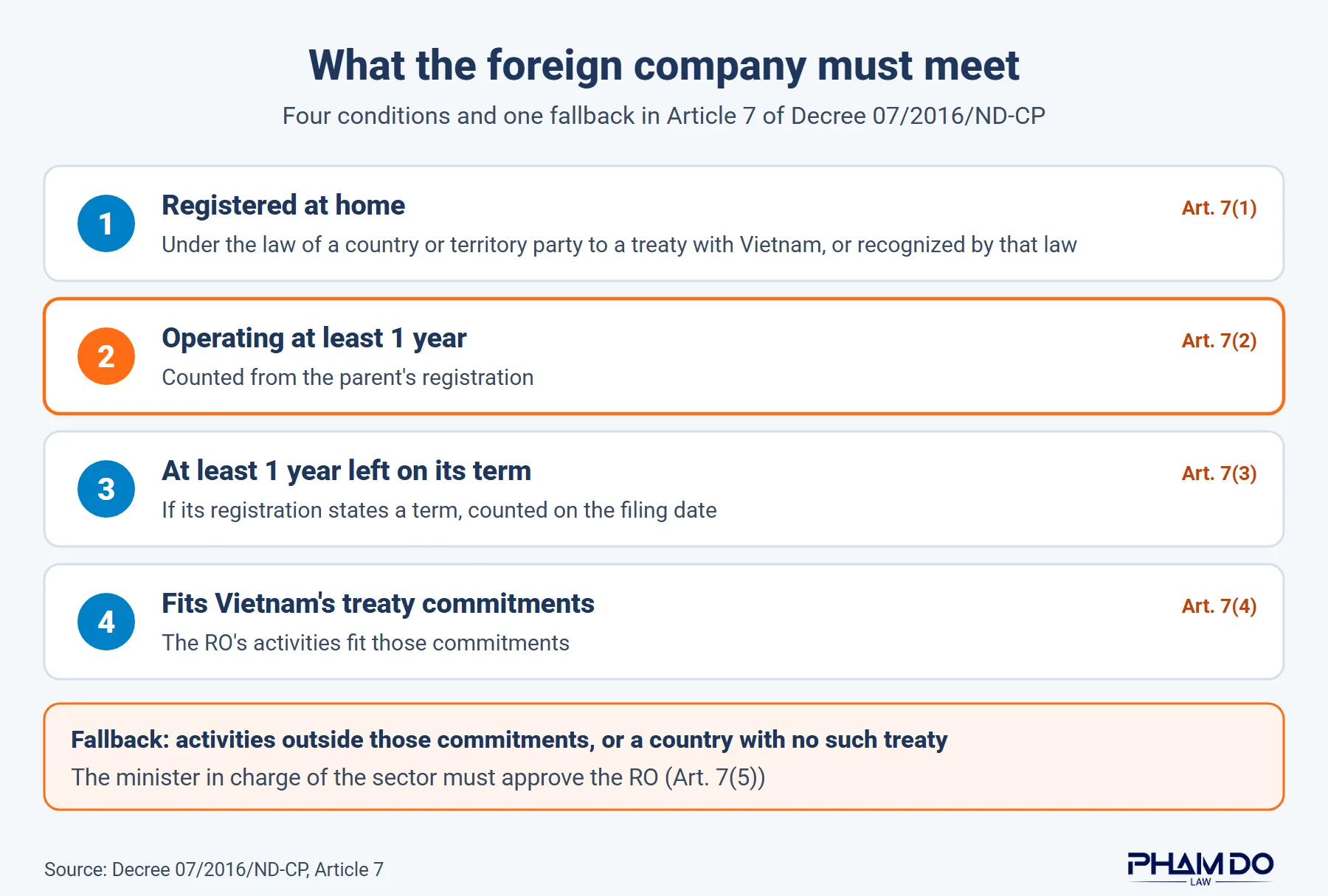
Article 7 of Decree 07/2016/ND-CP sets four conditions and one fallback:
- The company is registered under the law of a country or territory party to a treaty with Vietnam, or recognized by that law (Article 7(1)).
- It has operated for at least one year since registration (Article 7(2)).
- If its registration states a term, at least one year remains on the filing date (Article 7(3)).
- The RO’s activities fit Vietnam’s treaty commitments (Article 7(4)).
- If the activities do not fit those commitments, or the company’s country is not party to such a treaty, the minister in charge of the sector must approve the RO (Article 7(5)).
The home registration term also caps the RO license term. In Pham Do Law Firm’s experience, business licenses of Hong Kong companies are often valid for only one to two years. Pham Do Law Firm therefore recommends obtaining a home license of two years or more before filing, to make setting up the RO easier.
Which documents does the license application need?
Article 10(1) of Decree 07/2016/ND-CP requires one set of documents. The application form (MĐ-1) is in Circular 11/2016/TT-BCT, as amended.
| Document | Notes |
|---|---|
| Application for the RO license (form MĐ-1) | Signed by the parent’s authorized representative (Article 10(1)(a)) |
| Copy of the parent’s business registration | Translated, certified, and legalized or apostilled (Article 10(1)(b)); see the apostille note below |
| Parent’s letter appointing the head of the RO | Translated and certified (Article 10(1)(c)) |
| Audited financial statements or a tax or financial confirmation for the latest year | Or an equivalent home document proving the company operated that year; translated and certified (Article 10(1)(d), 10(2)) |
| Copy of the head’s passport, or ID card for a Vietnamese head | A foreign passport is translated and certified (Article 10(1)(đ)) |
| Premises documents | Lease or memorandum, or proof of the right to use the site, plus a copy of documents on the site under Article 28 (Article 10(1)(e)) |

Documents issued abroad: apostille or legalization
Under Article 10(2) of the Decree, only the business registration must also be legalized. Since 11 September 2026, Decree 293/2026/ND-CP has changed how that is done:
- From a state that applies the Apostille Convention with Vietnam: the public document needs an apostille (Article 5(2) of Decree 293/2026/ND-CP).
- From any other state: consular legalization still applies (Article 5(3)(b)).
- Already legalized: a document from a Convention state legalized by a Vietnamese authority before 11 September 2026 stays valid, and the receiving office may not ask for an apostille on it (Article 36(2)(a)).
- Treaty exemptions: no apostille is needed where a treaty to which Vietnam is a party, or Vietnamese law and practice, exempts that type of document (Article 5(2)).
- Translation: an apostilled document not in Vietnamese is translated, and the translation is notarized or certified under Vietnamese law, unless sector law provides otherwise (Article 27(1)).
Article 26 lists grounds for refusing an apostilled document, such as forgery. Its clause 1 also covers administrative documents directly related to commercial or customs operations. The decree does not say whether a company registration falls under that clause, so ask the licensing office how it treats the parent’s registration before you order the apostille abroad. The guide to the apostille in Vietnam lists the states and document types that stay on the old route.
Where do you file, and how long does it take?
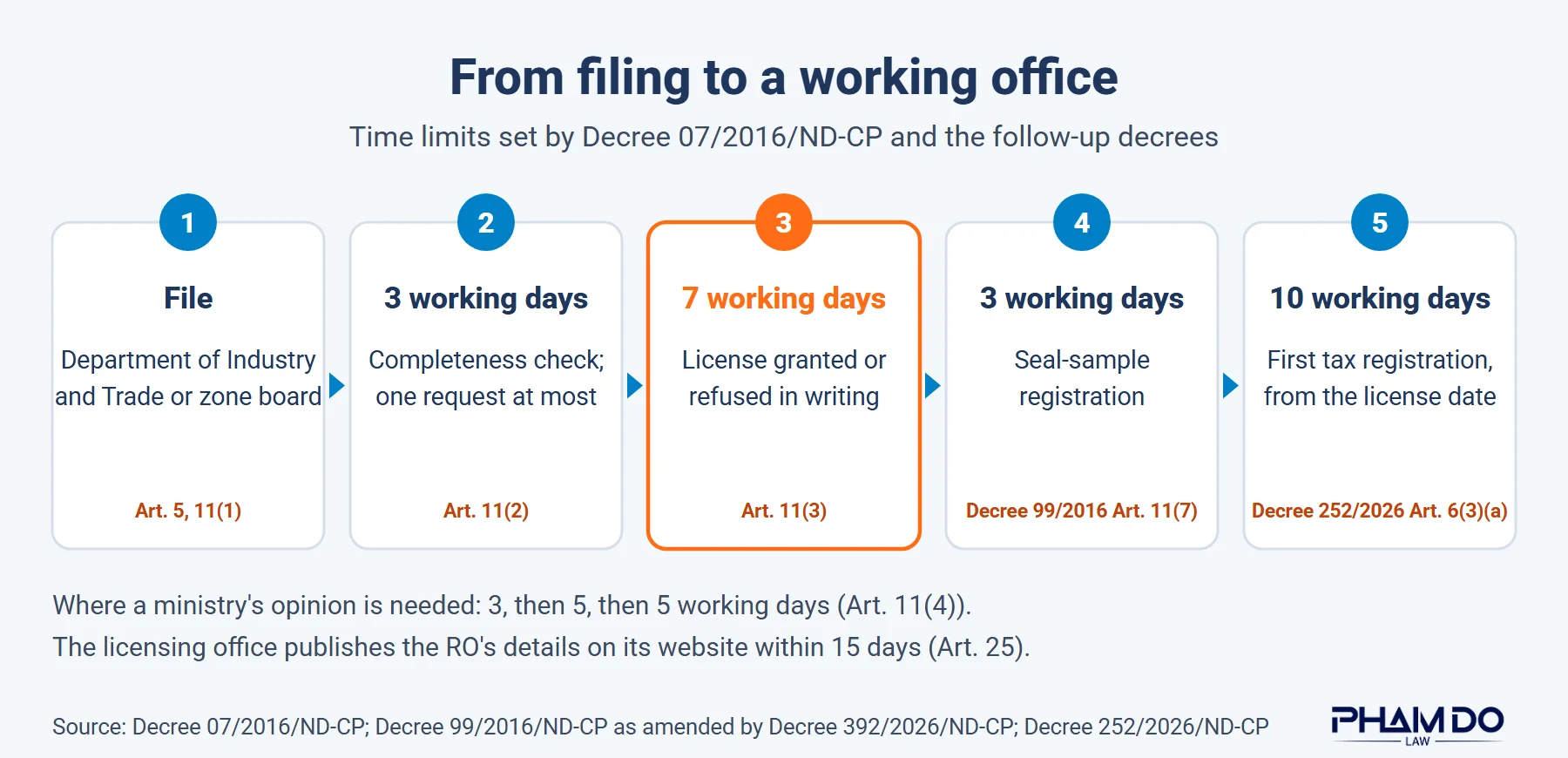
The license comes from the provincial Department of Industry and Trade where the RO will sit. For an office inside an industrial park, export processing zone, economic zone or high-tech park, it comes from that zone’s management board (Article 5(1) and (2) of Decree 07/2016/ND-CP). The file goes in person, by post or online where available (Article 11(1)).
| Step | Time set by law | Basis |
|---|---|---|
| Completeness check; any request for more documents is made only once | 3 working days from receipt | Article 11(2) |
| License granted or refused, with written reasons for a refusal | 7 working days from a complete file | Article 11(3) |
| Where a ministry’s opinion is needed: request sent, ministry replies, license decided | 3, then 5, then 5 working days | Article 11(4) |
License term and state fees
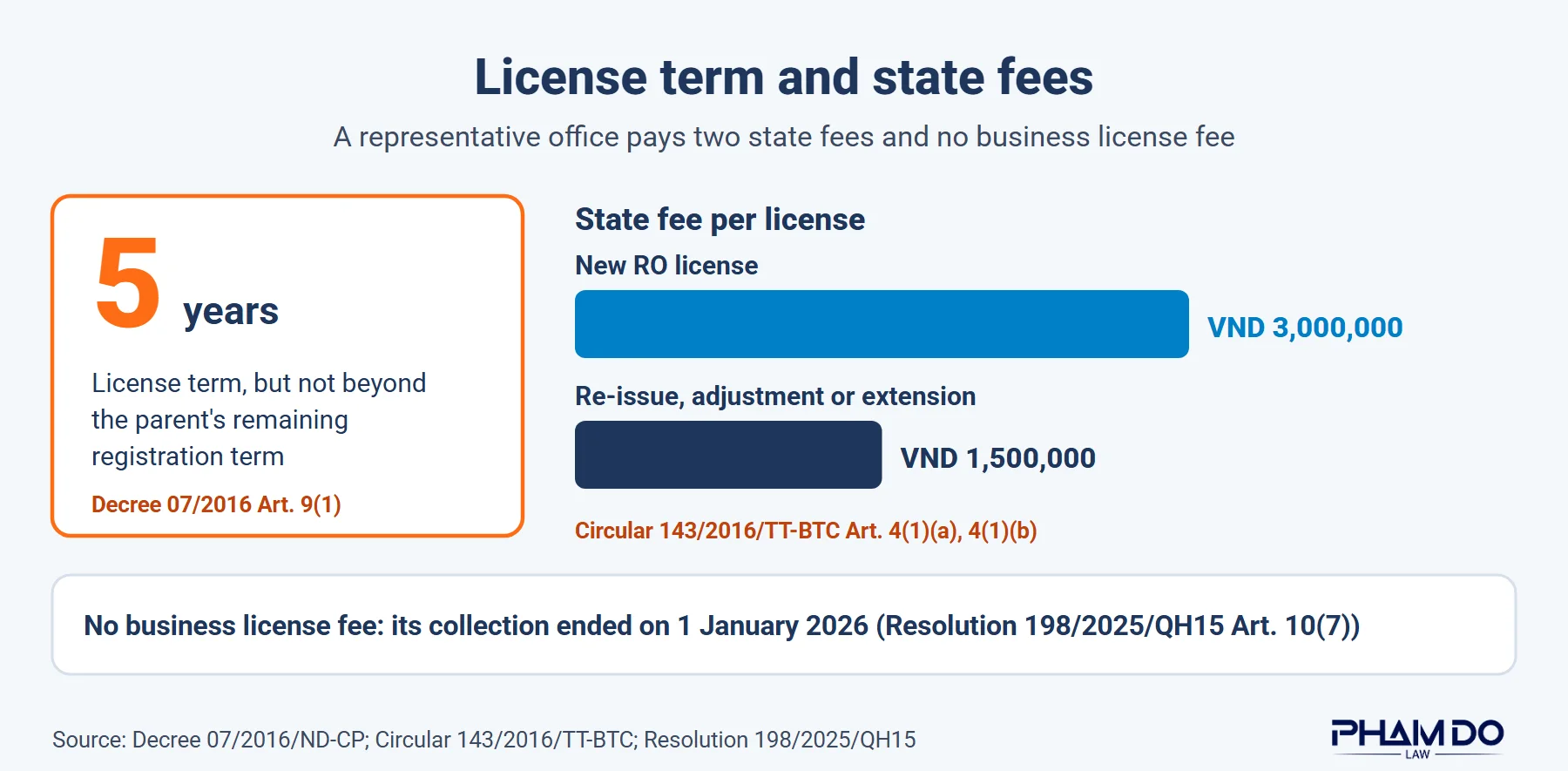
Under Article 9(1) of Decree 07/2016/ND-CP, the license lasts 5 years but not beyond the remaining term of the parent’s registration, if it has one. A re-issued license keeps the term of the earlier one (Article 9(2)). An extension follows the same 5-year rule (Article 9(3)).
| Procedure | State fee | Basis |
|---|---|---|
| New RO license | VND 3,000,000 per license | Article 4(1)(a) of Circular 143/2016/TT-BTC |
| Re-issue, adjustment or extension | VND 1,500,000 per license | Article 4(1)(b) |
No business license fee applies: its collection ended on 1 January 2026 (Article 10(7) of Resolution 198/2025/QH15).
Office premises and sign
The office site must meet Vietnamese rules on security, order, labor safety and hygiene, and other legal conditions (Article 28(1) of Decree 07/2016/ND-CP). The RO may not lend or sublet it (Article 28(2)). Its name uses the Vietnamese alphabet plus F, J, Z and W, combines the parent’s name with the words “Văn phòng đại diện”, and is displayed at the office (Article 29).

Pham Do Law Firm recommends against a virtual office. In Pham Do Law Firm’s experience, to meet the conditions in Article 28, the RO should rent an office separate from other businesses, put up its RO sign and have someone regularly at the office. If the authorities inspect and find the RO has not operated for one year, the license may be revoked. Article 44(1) sets that ground: one year inactive with no transaction with the licensing office.
Steps after the license
Three steps follow the license, then the bank account (Article 17(4) of the Commercial Law).
| Step | Rule | Basis |
|---|---|---|
| Seal-sample registration | 3 working days from a complete, valid file; filed in person, by post, or online through the National Public Service Portal or VNeID | Article 11(1) and (7) of Decree 99/2016/ND-CP, as amended by Article 19 of Decree 392/2026/ND-CP from 15 November 2026 |
| First tax registration of the RO | Within 10 working days of the license date | Article 6(3)(a) of Decree 252/2026/ND-CP |
| Publication of the RO’s details | The licensing office publishes them on its website within 15 days | Article 25 of Decree 07/2016/ND-CP |
In Pham Do Law Firm’s experience, the account is only for the RO’s reasonable expenses, such as staff salaries, office equipment, stationery and office rent. It may not be used for other purposes, such as buying samples or product materials, or receiving payments from third parties.
In Pham Do Law Firm’s experience, the chief representative is paid by the foreign company and earns income in Vietnam, so the chief needs a personal income tax (PIT) code to declare and pay PIT.
The chief representative
Article 33 of Decree 07/2016/ND-CP governs the head of the RO, called the chief representative. The chief answers to the parent within the authority given, and personally for acts outside it (Article 33(1) and (2)).

- Leaving Vietnam: the chief authorizes another person in writing, with the parent’s consent (Article 33(3)).
- Absence over 30 days without that authorization: the parent must appoint a new chief (Article 33(5)).
- Banned dual roles: head of a branch of any foreign trader, legal representative of any foreign trader, or legal representative of a Vietnamese economic organization (Article 33(6)).
On nationality, in Pham Do Law Firm’s experience, Vietnamese law does not restrict a chief whose nationality differs from the parent’s, as long as the parent company lawfully hires the chief representative and signs an appointment for the post in Vietnam. Decree 07 sets no residence condition for the chief either.
Work permit for a foreign chief representative
Decree 219/2025/ND-CP governs foreign workers until 4 December 2026. From 5 December 2026, Decree 393/2026/ND-CP takes effect (Article 36(1)) and replaces it. Both decrees classify the head of an RO as an executive director (Article 3(2)(a) of Decree 219, Article 4(2)(a) of Decree 393), and Decree 393 treats the RO as a commercial presence of the foreign company (Article 3(2)). Both exempt from the work permit a worker responsible for establishing a commercial presence (Article 7(10) of Decree 219, Article 8(10) of Decree 393). That worker needs no confirmation of exemption, only a notice to the authority at least 3 working days before work starts (Article 9(4) of Decree 219, Article 10(4) of Decree 393). Neither decree says whether a chief representative appointed to run the office counts as that worker, so settle the point before the chief starts work.
See the firm’s work permit service and business visa and temporary residence card service.
Staff, tax and annual reporting
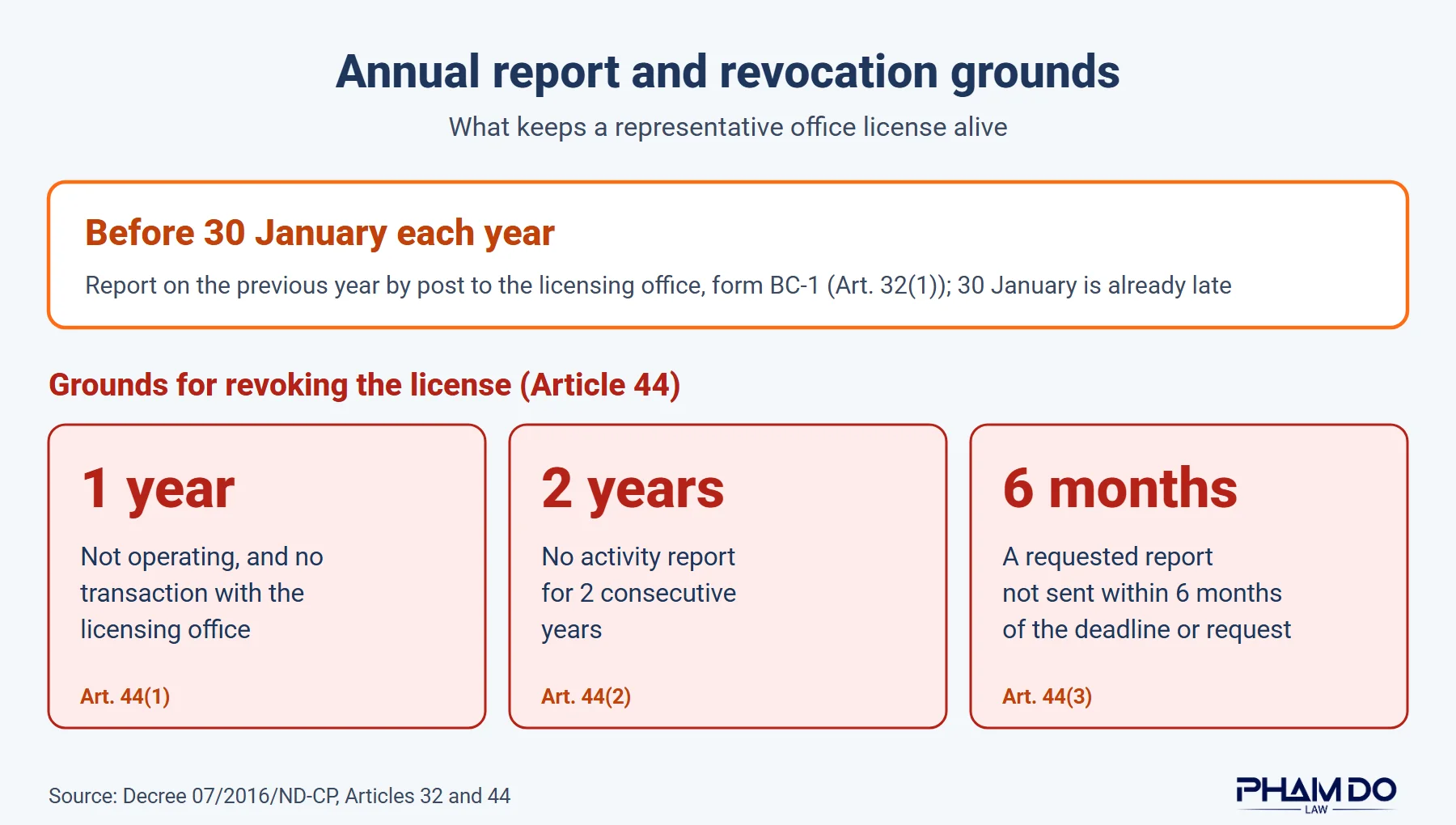
Under Article 32(1) of Decree 07/2016/ND-CP, the RO sends a report on the previous year by post to the licensing office before 30 January each year, on form BC-1. It must also report when an authority asks (Article 32(2)). A report sent on 30 January is already late.
Article 44 lists the grounds for revocation:
- The RO has not operated for one year and has had no transaction with the licensing office (Article 44(1)).
- It has not reported on its activity for 2 consecutive years (Article 44(2)).
- It has not sent a requested report within 6 months of the deadline or of the written request (Article 44(3)).
- Other cases under the law (Article 44(4)).
Article 17(3) of the Commercial Law lets the RO hire Vietnamese and foreign staff and sets no headcount. Those staff work under the Labour Code (No. 45/2019/QH14).
The chief representative and staff are paid for their work in Vietnam, so personal income tax is part of the RO’s routine. Pham Do Law Firm recommends this routine:
- Keep a cash book and a bank book recording every receipt and payment of the RO.
- Each year, the parent company should confirm, on a set form, the salary and income of the chief representative and RO staff.
- When paying tax, keep every tax return and the authority’s tax receipts, and finalize PIT each year.
The firm’s tax and accounting service covers these filings.
Changing, extending or moving the office
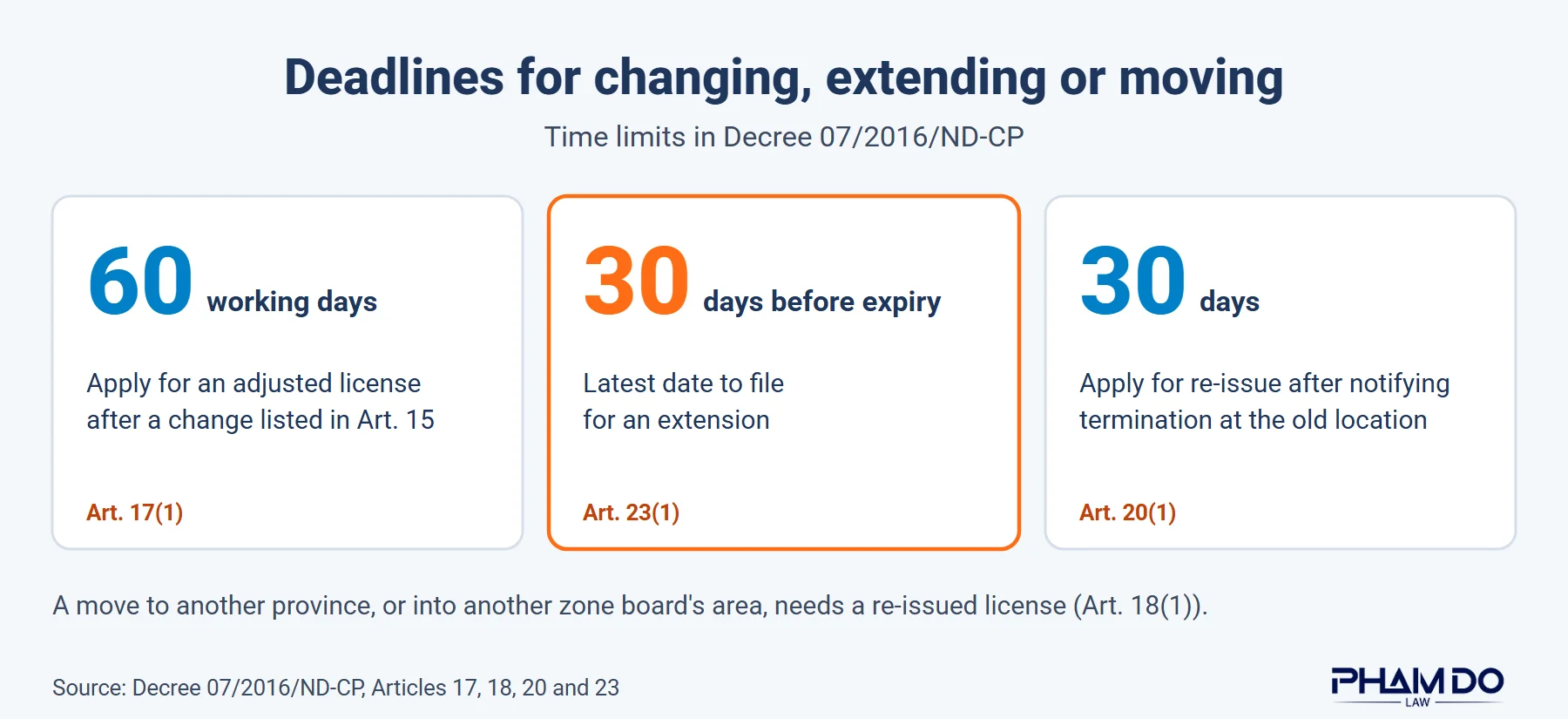
Article 15 of Decree 07/2016/ND-CP lists the changes that require an adjusted license, such as a new parent name or address, a new chief representative, a new RO name or activities, or a move within the same province or zone. Under Article 17(1), the parent must apply within 60 working days of the change.
An extension is filed at least 30 days before the license expires (Article 23(1)). It is available unless the RO has a violation that is a revocation ground under Article 44 (Article 21). In Pham Do Law Firm’s experience, Vietnamese law currently sets no limit on how many times an RO license can be extended. As long as the parent company and the RO still meet the extension conditions, the RO can keep operating in Vietnam.
A move to another province, or into the area of another zone board, needs a re-issued license (Article 18(1)). The parent notifies termination at the old location, then applies for re-issue within 30 days of that notice; after that, it must apply for a new license (Article 20(1)). Pham Do Law Firm advises against moving the RO in a way that requires a re-issued license, because that procedure costs quite a lot of time and money. Only do it when there is no other option.
In Pham Do Law Firm’s experience, to save costs, the foreign company can apply to change the chief representative together with other changes, such as the parent’s name and address, the RO address or the extension.
How do you close a representative office in Vietnam?
Article 35 of Decree 07/2016/ND-CP lists when an RO ends, such as at the parent’s request or on revocation. Articles 36 to 38 set the closure file, procedure and remaining duties. Circular 143/2016/TT-BTC lists fees only for a new license, re-issue, adjustment and extension, and none for closure (Article 4).
Records kept from the first day make the tax finalization easier to assemble. In Pham Do Law Firm’s experience, when the tax office finalizes the RO, it often asks for extra documents:
- a salary letter from the parent company confirming the foreign chief representative’s worldwide income;
- the passport with visa pages showing days in Vietnam, listed in a table;
- a salary, PIT and social insurance calculation sheet;
- tax and social insurance payment receipts;
- tax returns and social insurance declarations, if any;
- the office lease;
- a certified copy of the chief representative’s passport.
Frequently asked questions
Can a representative office earn revenue?
Pham Do Law Firm’s answer: Not from sales. An RO may not carry out direct profit-making activity in Vietnam (Article 18(1) of the Commercial Law). Its functions are liaison, market research and promoting the parent’s investment and business opportunities (Article 30 of Decree 07/2016/ND-CP), so it has no sales to invoice. Its account may be used only for the RO’s own activity (Article 17(4)).
Should a foreign company open a branch or a representative office?
Pham Do Law Firm’s answer: An RO suits market research and promotion; a branch carries out commercial activities. Both depend on the foreign trader (Article 3(6) and (7) of the Commercial Law).
Can I use a virtual office for a representative office?
Pham Do Law Firm’s answer: Pham Do Law Firm advises against it. The RO should have its own staffed office with its sign. One inactive for a year, with no dealings with the licensing office, may lose its license (Article 44(1) of Decree 07/2016/ND-CP).
Can a representative office import goods?
Pham Do Law Firm’s answer: Not to trade. An RO may not carry out direct profit-making activity (Article 18(1) of the Commercial Law), so it cannot import goods for sale. It may rent or buy the equipment and supplies its own work needs (Article 17(2)).
Can a representative office be converted into a company?
Pham Do Law Firm’s answer: No. An RO is a dependent unit (Article 3(6) of the Commercial Law) with no legal personality, and Vietnamese law has no conversion route. The parent sets up a company separately.
Which rules govern the chief representative’s work permit?
Pham Do Law Firm’s answer: Decree 219/2025/ND-CP applies until 4 December 2026 and Decree 393/2026/ND-CP from 5 December 2026. Both classify the head of an RO as an executive director (Article 3(2)(a) of Decree 219, Article 4(2)(a) of Decree 393). Both exempt a worker responsible for establishing a commercial presence (Article 7(10) of Decree 219, Article 8(10) of Decree 393), who needs only a notice at least 3 working days before work starts (Article 9(4) of Decree 219, Article 10(4) of Decree 393). Neither decree says whether an appointed chief representative counts as that worker, so settle the point before the chief starts work.
How many times can the license be extended?
Pham Do Law Firm’s answer: Vietnamese law currently sets no limit on the number of extensions. An extension is refused if the RO has a violation that is a revocation ground under Article 44 (Article 21). Each extension lasts up to 5 years, capped by the parent’s registration, and is filed at least 30 days before expiry (Articles 9(3) and 23(1) of Decree 07/2016/ND-CP).
Legal basis
| Instrument | Articles used | Status on 15 November 2026 |
|---|---|---|
| Commercial Law (No. 36/2005/QH11) | 3(6), 3(7), 16, 17, 18 | In force; amendment passed 13 November 2026, reported effective 1 July 2027, some repeals from 1 January 2028 |
| Decree 07/2016/ND-CP | 1, 3, 5, 7, 9 to 11, 15, 17, 18, 20, 21, 23, 25, 28 to 33, 35 to 38, 44 | In force for ROs |
| Circular 11/2016/TT-BCT | Forms MĐ-1 and BC-1 | In force, as amended |
| Circular 143/2016/TT-BTC | 4 | In force |
| Decree 293/2026/ND-CP | 5, 26, 27, 36 | In force from 11 September 2026 |
| Decree 99/2016/ND-CP, as amended by Decree 392/2026/ND-CP | 11; Article 19 of Decree 392/2026/ND-CP | Amendment in force from 15 November 2026 |
| Decree 252/2026/ND-CP | 6(3)(a) | In force |
| Labour Code (No. 45/2019/QH14) | Staff employment | In force |
| Resolution 198/2025/QH15 | 10(7) | In force |
| Decree 219/2025/ND-CP | 3(2)(a), 7(10), 9(4) | In force until 4 December 2026 |
| Decree 393/2026/ND-CP | 3(2), 4(2)(a), 8(10), 10(4), 36 | In force from 5 December 2026 |
Representative office licensing with Pham Do Law Firm
Pham Do Law Firm advises foreign companies on opening and running an RO in Vietnam.
- We check the parent’s conditions and documents, file the application and complete the seal and tax steps.
- We handle later adjustments, extensions, moves and closure.
The authority decides the license; issuance is not guaranteed. This is Pham Do Law Firm’s advice on how to set up a representative office in Vietnam as of 16 November 2026. Contact Pham Do Law Firm for advice on your specific situation.