

A trademark in Vietnam goes to the first valid filer, so a foreign company should register before entering the market, through a licensed Vietnamese IP agent if it has no establishment here. Under Article 90(2) of the Law on Intellectual Property (No. 50/2005/QH11), as amended, including by Law No. 131/2025/QH15, the protection title goes to the valid application with the earliest filing or priority date.
For applications filed since 1 April 2026, the procedure follows the amended law and Circular 10/2026/TT-BKHCN. The official charges, including the filing and grant charges, are at half rate until 31 December 2026.
Vietnam is first to file, so register before you enter the market
Among conflicting applications, the protection title goes to the valid one with the earliest filing or priority date (Article 90(2) of the Law on Intellectual Property), because rights come from registration, not from use. Under Article 6(3)(a), the right is established by the decision granting the protection title, or by recognition of an international registration. Only a well-known mark gains rights through use alone.
Therefore, a brand that sells well abroad has no automatic right in Vietnam. A distributor or former partner who files first can end up holding the registration, leaving the owner with slower opposition or invalidation.
The law does protect against bad-faith filers. An application filed in bad faith can be refused (Article 117(1)(b)), and invalidation of a registration obtained in bad faith can be requested throughout its term of protection (Articles 96(1)(a) and 96(4)). A mark that conflicts with a mark already well known before the filing date fails the protection conditions (Article 74(2)(i)), so the application can be refused (Article 117(1)(a)). On that ground, invalidation of a registration can be requested only within five years from grant, or from the date an international registration takes effect in Vietnam (Articles 96(2)(b) and 96(4)). The grounds for invalidating a registration are those of the law that applied to its examination, so an older registration may be judged under earlier rules (Article 3(4) of Law No. 131/2025/QH15). Proving bad faith or fame takes evidence and time, so filing early remains the safer course.
Article 87(7) covers a mark protected in a country that belongs to a treaty, also joined by Vietnam, that bars the owner’s agent or representative from registering it. Such an agent or representative may not register the mark without the owner’s consent, unless it has a good reason. A filing made without that consent can be opposed or refused for lack of the right to register (Article 117(1)(b)). Invalidation on that ground must be requested within five years from grant, or from the date an international registration takes effect in Vietnam (Articles 96(2)(a) and 96(4)).
Pham Do Law Firm recommends filing before the first shipment or launch, in line with the other steps of starting a business in Vietnam as a foreigner.
Why a registration matters before launch
A registration gives the owner:
- A right to the mark for the goods and services in the certificate, established by the grant (Article 6(3)(a)).
- A basis for civil, administrative or criminal action against infringers (Article 199(1)), and for asking customs to suspend clearance of suspected goods (Article 216).
- An asset the owner can assign, or license to a distributor or franchisee (Article 148).
What counts as a trademark in Vietnam
A trademark is a sign that tells one company’s goods or services apart from those of others. Under Article 72 of the Law on Intellectual Property, it must be visible, as letters, words, drawings, images, three-dimensional shapes or a combination, in one or more colors, or be a sound shown graphically. It must also be distinctive.
A service mark is registered the same way. The law also has collective marks and certification marks, which need regulations on their use filed with the application (Article 68(3) of Circular 10/2026/TT-BKHCN).
Signs that cannot be registered
Under Article 74(2) of the Law on Intellectual Property, signs that lack distinctiveness are refused:
- Simple shapes, numerals, letters and words in uncommon languages, unless widely used and recognized as a mark before filing.
- Signs describing the time, place, method of production, kind, quantity, quality, ingredients, use or value of the goods or services.
- Signs describing the legal form or business field of the company, such as the words for an LLC or a joint stock company.
- Signs showing geographic origin, apart from the exceptions in the law.
Article 73 bars national flags and emblems, names or images of leaders and national heroes, and signs that mislead consumers about origin, quality or value. It also bars the names and emblems of Vietnamese state bodies, political and social organizations and of international organizations, unless they consent. Example: “Fresh Milk” for dairy products describes the goods, so it is likely to be refused, while an invented word for the same goods has a far better chance. A sign can also conflict with someone else’s earlier right, which is what the search below checks.
Well-known marks
A well-known mark is protected without registration (Article 6(3)(a)). Article 75 lets the authority weigh criteria such as the number of consumers who know the mark, the territory and sales, the length of continuous use, and the number of countries that protect it or recognize it as well known.
Which law governs trademarks in Vietnam?
The Law on Intellectual Property governs trademarks, as amended by Law No. 131/2025/QH15. Decree 65/2023/ND-CP (consolidated text No. 04/VBHN-BKHCN) and Circular 10/2026/TT-BKHCN, as amended by Circular 20/2026/TT-BKHCN (consolidated text No. 06/VBHN-BKHCN) set the detailed rules, and Circular 263/2016/TT-BTC, as amended by Circular 31/2020/TT-BTC, sets the fees.
Who can file, and when does a foreign company need a Vietnamese IP agent?
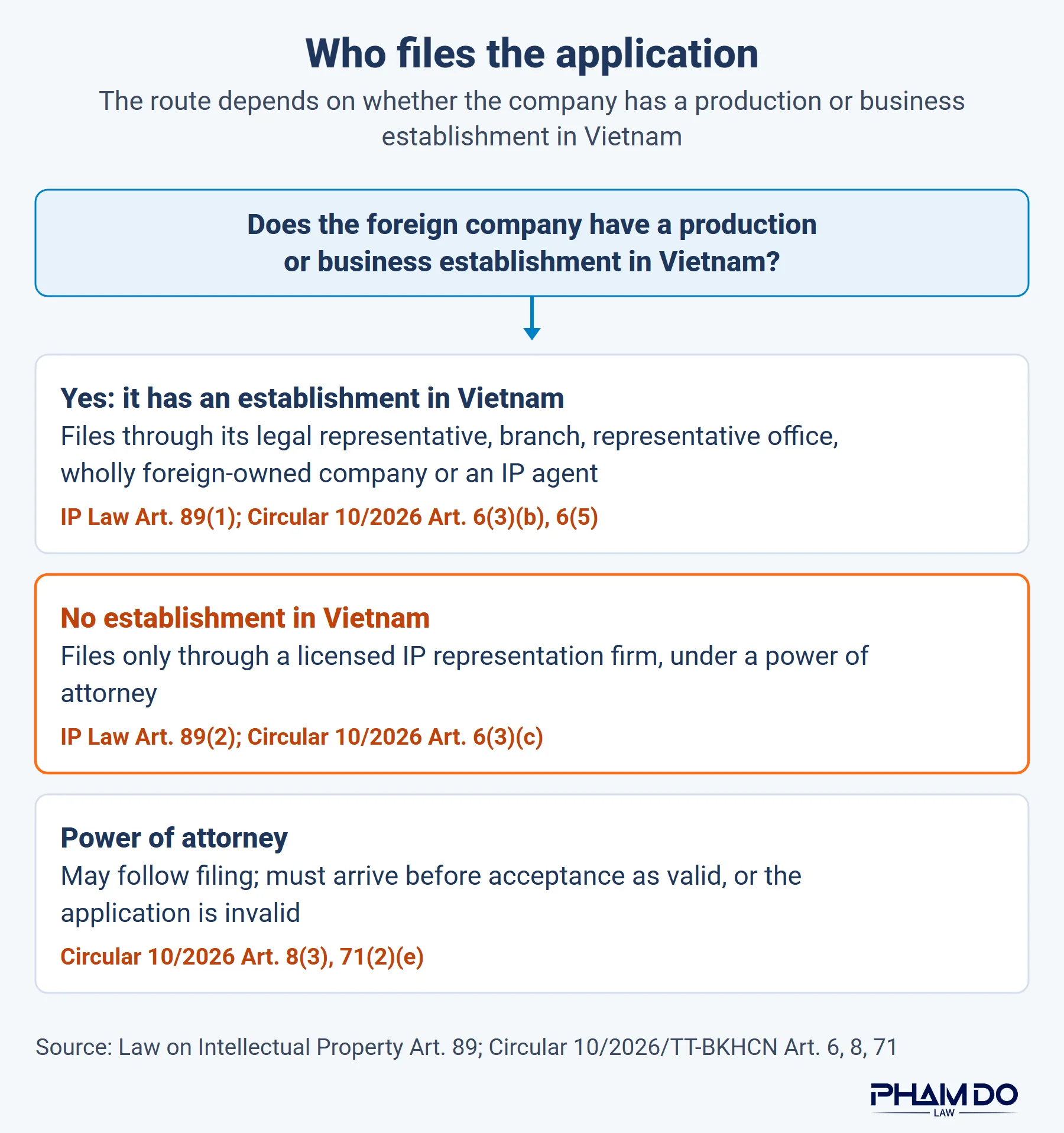
Any company or individual may file for goods it makes or services it provides, but a foreign company with no establishment in Vietnam must file through a licensed IP agent. A trader may also register a mark for goods made by others, if the maker does not use that mark and does not object (Article 87 of the Law).
Under Article 89(2) of the Law, a foreign company with no production or business establishment in Vietnam files through a lawful representative in Vietnam. Article 6(3)(c) of Circular 10/2026/TT-BKHCN narrows this to one option: an industrial property representation service organization acting under a power of attorney.
A foreign company with an establishment here may file itself, through its legal representative or a person within the company whom that representative authorizes (Article 89(1) of the Law; Article 6(5) of the Circular). It may also file through its representative office or branch, its 100% foreign-invested company, or an IP agent (Article 6(3)(b)). An investor still choosing its vehicle can read the guides to foreign direct investment in Vietnam and how to set up a company in Vietnam.
Who may act as the IP agent
Under Article 154 of the Law, an IP agent is a company, cooperative, law practice or science and technology service organization with at least one holder of an industrial property representation practice certificate. That person must be a Vietnamese citizen permanently residing in Vietnam (Article 155(2)). A foreign law firm practicing in Vietnam may not provide this service (Article 154(2)).
Power of attorney, language and signing
The power of attorney may arrive after the filing date, as long as it comes before the application is accepted as valid (Article 8(3) of the Circular). The Circular sets no fixed number of days, only that cut-off. Without a valid power of attorney, an application filed through an agent is invalid (Article 71(2)(e)).
Filings are in Vietnamese, though some documents, including the power of attorney, priority documents and documents proving the right to register, may be in another language and translated on request (Article 69(1)(e)). Documents are confirmed by the applicant’s signature and seal, if any, and notarization or certification applies only where a law requires it (Article 9(1)(a)).
How to run a Vietnam trademark search before filing
A Vietnam trademark search checks whether an earlier right already blocks the mark, and it is worth doing before any fee is paid. Under Articles 134 and 135 of Circular 10/2026/TT-BKHCN, an applicant may search the public databases of the Intellectual Property Office of Vietnam itself, or pay the office for a search. The office’s website, ipvietnam.gov.vn, links to its Vietnamese trademark database on WIPO Publish.
Under Article 74(2) of the Law, the earlier rights that block a mark include confusingly similar marks filed earlier for similar goods or services, trade names in use, protected geographical indications, other people’s industrial designs, and widely known characters from protected works.
Search the exact mark, then spelling variants, words that sound alike and each logo element, in related classes too. Also check how the mark reads in Vietnamese, since an awkward meaning can hurt sales.
Reading the results
A clean result does not guarantee a grant, because an application can also be refused for failing the protection conditions or for bad faith (Article 117(1) of the Law). A pending application is not yet a right, but if granted it will rank by its earlier date, so it counts as an obstacle. Example: a company plans to sell coffee as “Lumora” and finds “Lumorra” registered for tea. The two sound the same and tea is close to coffee, so the office may treat them as confusingly similar.
Keep a record of each search: the date, the terms, the numbers found, their owners and their status.
A company name is not a trademark
A registered company name gives no trademark right. An Enterprise Registration Certificate records the name, while a trademark right arises from the office’s grant or its recognition of an international registration, or, for a well-known mark, from use (Article 6(3)(a)). A domain name or a social media page creates no trademark right either.
The business lines on that certificate are also not the same as Nice classes. Pham Do Law Firm recommends keeping the trade name, the trademark, the domain name and the copyright in the logo consistent, and securing them in the same period.
National or Madrid filing for a Vietnam trademark
A foreign company can protect its mark in Vietnam by a national application, by a national application claiming Paris Convention priority, or by designating Vietnam in an international registration under the Madrid system. A Vietnamese protection title is valid throughout Vietnam (Article 93(1) of the Law).
To claim priority, the application must state the claim and include a copy of the first application certified by the receiving office, and be filed within the treaty period (Article 91(1) of the Law). For trademarks, Article 4C of the Paris Convention sets that period at 6 months from the filing date of the first application. The priority date is the filing date of the first application (Article 91(3)). Priority documents may follow within 3 months of filing (Article 70(4) of the Circular).
For a Madrid designation, the IP Office decides on protectability within 12 months of the WIPO notification (Article 91(1) of the Circular). The designation takes effect from the acceptance decision, or from the day after that 12-month period ends, whichever is earlier (Article 93(8) of the Law). After a provisional refusal, the holder has 3 months from the date the IP Office sends it to reply under the national procedure (Article 91(5) of the Circular). A holder with no establishment in Vietnam replies through a Vietnamese IP agent.
How does trademark registration in Vietnam work?
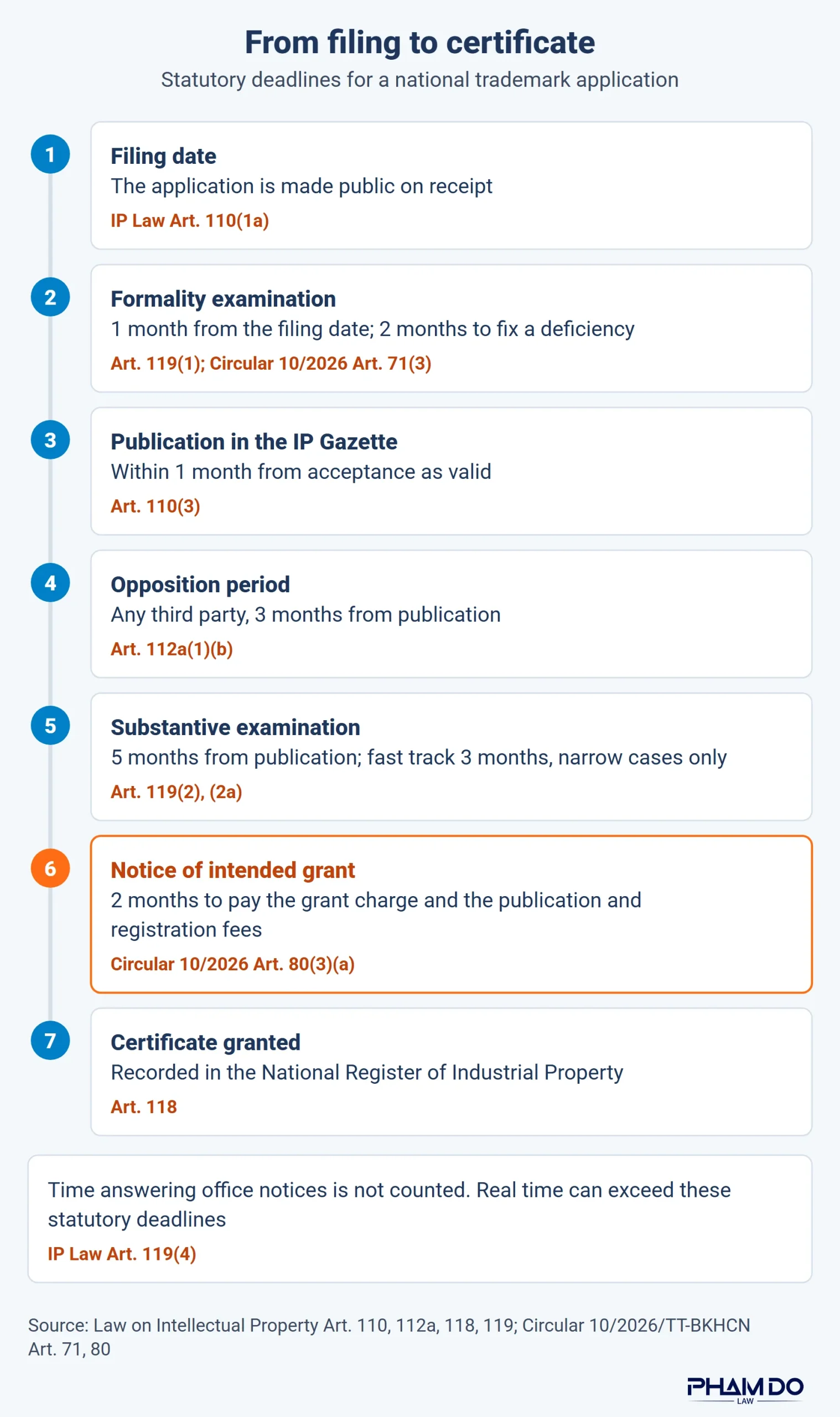
A trademark application is checked for form within 1 month of filing, published within 1 month of acceptance as valid, open to opposition for 3 months and examined within 5 months of publication.
| Stage | Deadline | Basis |
|---|---|---|
| Formality examination | 1 month from the filing date | Article 119(1) of the Law |
| Publication in the IP Gazette | Within 1 month from acceptance as valid | Article 110(3) of the Law |
| Third-party opposition | Within 3 months from publication | Article 112a(1)(b) of the Law |
| Substantive examination | Within 5 months from publication | Article 119(2)(b) of the Law |
| Payment of the grant charge and fees | 2 months from the notice of intended grant | Article 80(3)(a) of the Circular |
Opposition and substantive examination both run from publication, so they overlap and do not add up. Time the applicant spends answering an office notice is not counted in the office’s deadlines (Article 119(4) of the Law; Article 5(2) of the Circular). The law sets only statutory deadlines, and the real time can be longer.
Preparing the application file
Article 68 of Circular 10/2026/TT-BKHCN lists the documents:
| Document | When required |
|---|---|
| Declaration, Form No. 04 in Annex I | Always |
| Mark specimen, 5 copies for a paper filing | Always |
| Regulations on use of the mark | Collective and certification marks |
| Power of attorney | Filing through an agent |
| Proof of the right to file | Right taken over from another person |
| Proof of the priority right | Priority claimed |
Under Article 69(4) of the Circular, each element of the specimen measures between 8 mm and 80 mm, and the whole mark fits inside an 80 mm by 80 mm box. It is in black and white unless colors are claimed. A sound mark is filed as an MP3 file of up to 5 MB with a graphic form on a five-line stave.
The description must give the pronunciation of foreign words and, if they have a meaning, a Vietnamese translation (Article 69(3)(c1)). A foreign applicant’s name and address stay in Latin script, without translation (Article 69(3)(đ)).
Choosing Nice classes
Goods and services must be classified under the Nice Classification as published by the IP Office (Article 69(3)(e) of the Circular). The Nice Classification has 45 classes: 1 to 34 for goods and 35 to 45 for services. If the applicant does not classify them, or classifies them wrongly, the office reclassifies the list and charges a classification fee.
Choose a class for every product or service the mark will actually cover, because fees are charged per class. Describe items concretely: “roasted coffee beans; ground coffee” tells the examiner what is covered, while “food products” is too vague. More than 6 items in one class adds a fee for each extra item.
Where and how to file
The application goes to the IP Office, on paper or through the electronic filing system (Article 7(1) of the Circular). Applications are received at the One-Stop desk of the Ministry of Science and Technology (Article 7(3)). The filing date is the day the office receives the application (Article 108(1) of the Law), and an online filing after hours or on a holiday takes the next working day (Article 71(5) of the Circular).
The application is made public as soon as it is received (Article 110(1a) of the Law). That is separate from publication in the IP Gazette, which follows acceptance.
Formality examination
If the file is deficient, the office sets 2 months from its notice for the applicant to fix it (Article 71(3)(a) of the Circular). If the applicant does not, the office refuses within 15 working days after that period ends (Article 71(3)(b)).
Publication and opposition
Under Article 82(1) of the Circular, any third party may oppose the grant within 3 months from publication, in writing in Vietnamese and with the fee. The applicant is usually given 1 month from the office’s notice to reply, while clear-cut oppositions are folded into substantive examination (Article 82(2)(a)).
An opposition about the right to register generally goes to court (Article 82(3)(a)). It stays within examination where there is a clear basis that the applicant has no right to register under Article 87(2) or 87(7) of the Law, or where the opposition is not backed by documents sufficient to show that (Article 82(3)(a1) and (a3)). The same applies to an opposition about the right to file a mark that is or contains a place name or other sign indicating the geographical origin of a Vietnamese local specialty (Article 82(3)(a2) and Article 87(3) and (4) of the Law).
In other right-to-register cases, the opposer has 2 months from the office’s notice to send a copy of the court’s notice accepting the case; if it does not, the opposition is treated as withdrawn and the application proceeds as if unopposed (Article 82(3)(a) and (b)). If the court notice arrives in time, the office suspends the application, unless it has been withdrawn, and resumes as soon as it receives the court judgment or decision that has taken legal effect (Article 82(3)(c)).
Substantive examination, fast track and refusal
Under Article 117(1) of the Law, grounds for refusal include a mark that fails the protection conditions, an applicant with no right to register or acting in bad faith, an application that is not the earliest, and an amendment that broadens its scope.
Fast-track examination is done within 3 months from publication of the application (Articles 119(2a) and 119(2)(b) of the Law), but only narrow cases qualify. Under Article 14a of Decree 65/2023/ND-CP, these are marks on goods made under a strategic-technology or emergency invention, or marks whose certificate is a mandatory document or condition for registering or licensing a production or business activity. Where the application covers several goods or services, each must meet one of these cases.
Only national filings qualify; collective, certification, three-dimensional and sound marks are excluded. The request is filed together with the application, and the decree requires a fast-track fee “as prescribed”. The normal deadlines apply again in the cases listed in Article 14a(4), which include an opposition, complaint or dispute and an amendment or division by the applicant.
If the office intends to refuse, it sets 2 months from its notice for a response (Article 80(3)(b) of the Circular). Before grant or refusal, the applicant may amend, divide or assign the application, or record a change of name or address (Article 115(1) of the Law). A refusal can be challenged by a complaint within the limitation period in Articles 9 and 33 of the Law on Complaints, under Article 116(4) of the Circular, or in court (Article 119a(1) of the Law).
Points that are easy to miss during examination:
- Missing the 2-month reply deadline leads to refusal within 15 working days (Article 80(3)(c) of the Circular).
- An amendment that broadens the application, such as adding goods, is a ground for refusal (Article 117(1)(đ) of the Law).
Grant and the registration certificate
After a notice of intended grant, the applicant has 2 months to pay the grant charge, the publication fee and the registration fee (Article 80(3)(a) of the Circular). If they are not paid in full within that time, the office refuses the certificate within 15 working days after that period ends (Article 80(3)(h) of the Circular). Once they are paid, the office grants the trademark registration certificate and records it in the National Register of Industrial Property (Article 118 of the Law).
How much does trademark registration in Vietnam cost?
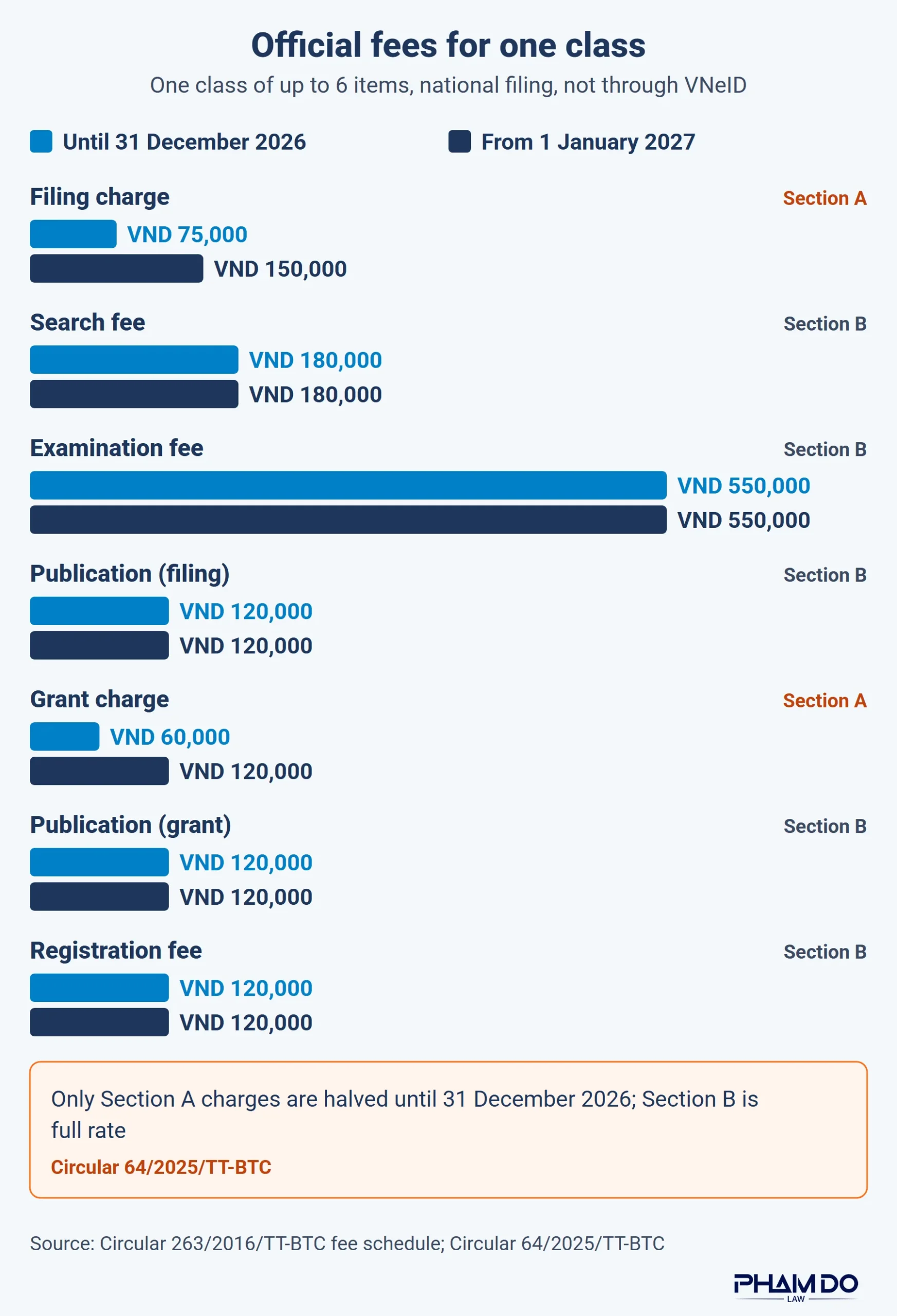
For one class of up to 6 items, the official fees and charges total VND 1,360,000, or VND 1,225,000 where the half rate applies to every charge. They start with a VND 150,000 filing charge under Circular 263/2016/TT-BTC, which is VND 75,000 until 31 December 2026. Under Circular 64/2025/TT-BTC, the charges in Section A are at 50% from 1 July 2025 to 31 December 2026, and at the full rate from 1 January 2027, unless the fee schedule changes. The fees in Section B stay at the full rate. The grant charge is paid after the notice of intended grant, which can come after 31 December 2026 (see the note below the tables).
| Item, one class | Section | Until 31 December 2026 | From 1 January 2027 |
|---|---|---|---|
| Filing charge, per application | A | VND 75,000 | VND 150,000 |
| Search fee for examination, per class | B | VND 180,000 | VND 180,000 |
| Examination fee, per class of up to 6 items | B | VND 550,000 | VND 550,000 |
| Publication of the application, paid at filing | B | VND 120,000 | VND 120,000 |
| Grant charge | A | VND 60,000 | VND 120,000 |
| Publication of the grant decision, paid at grant | B | VND 120,000 | VND 120,000 |
| Registration fee | B | VND 120,000 | VND 120,000 |
For a grant charge paid after 31 December 2026, see the note below the tables. Each extra class adds a grant charge of VND 100,000 (VND 50,000 until 31 December 2026) plus that class’s search and examination fees. Each item beyond 6 in a class adds VND 120,000 for examination and VND 30,000 for the search. The fee for use of the protection title, VND 700,000 per class for 10 years, is paid on renewal with the other renewal fees (Article 108(2) of Circular 10/2026/TT-BKHCN).
| Other item | Amount at full rate |
|---|---|
| Priority claim, per application | VND 600,000 |
| Classification, only if the office reclassifies, per class | VND 100,000, plus VND 20,000 per item beyond 6 |
| Extension of a reply deadline, each time (Section A) | VND 120,000 (VND 60,000 until 31 December 2026) |
| Opposition, per class | VND 550,000 |
| Renewal charge, per class for 10 years (Section A) | VND 100,000 (VND 50,000 until 31 December 2026), plus 10% for each late month |
| Amendment, assignment of the application, renewal examination | VND 160,000 each |
| Termination request | VND 180,000, plus a request charge of VND 50,000 (Section A, VND 25,000 until 31 December 2026) and the registration and publication fees for the decision (Article 111(1) of the Circular) |
| Invalidation request | VND 390,000, plus a request charge of VND 50,000 (Section A, VND 25,000 until 31 December 2026) and the registration and publication fees for the decision (Article 112(1) of the Circular) |
| Individual fee for a Madrid designation of Vietnam, per class | VND 3,600,000 for examination; VND 3,200,000 for renewal |
Under Article 2(1)(a) of Circular 29/2026/TT-BTC, the filing and grant charges are waived for services carried out on the VNeID application from 1 April 2026 to 31 December 2026. Circular 29/2026 does not say who may file an industrial property application through VNeID.
Note: both circulars state only the period their rates apply, not whether it is judged by the filing date or the payment date. That matters for a grant charge paid after 31 December 2026. Decree 65/2023/ND-CP refers to a fast-track fee, but the fee schedule has no line for it.
Renewal, use and enforcement of a Vietnam trademark
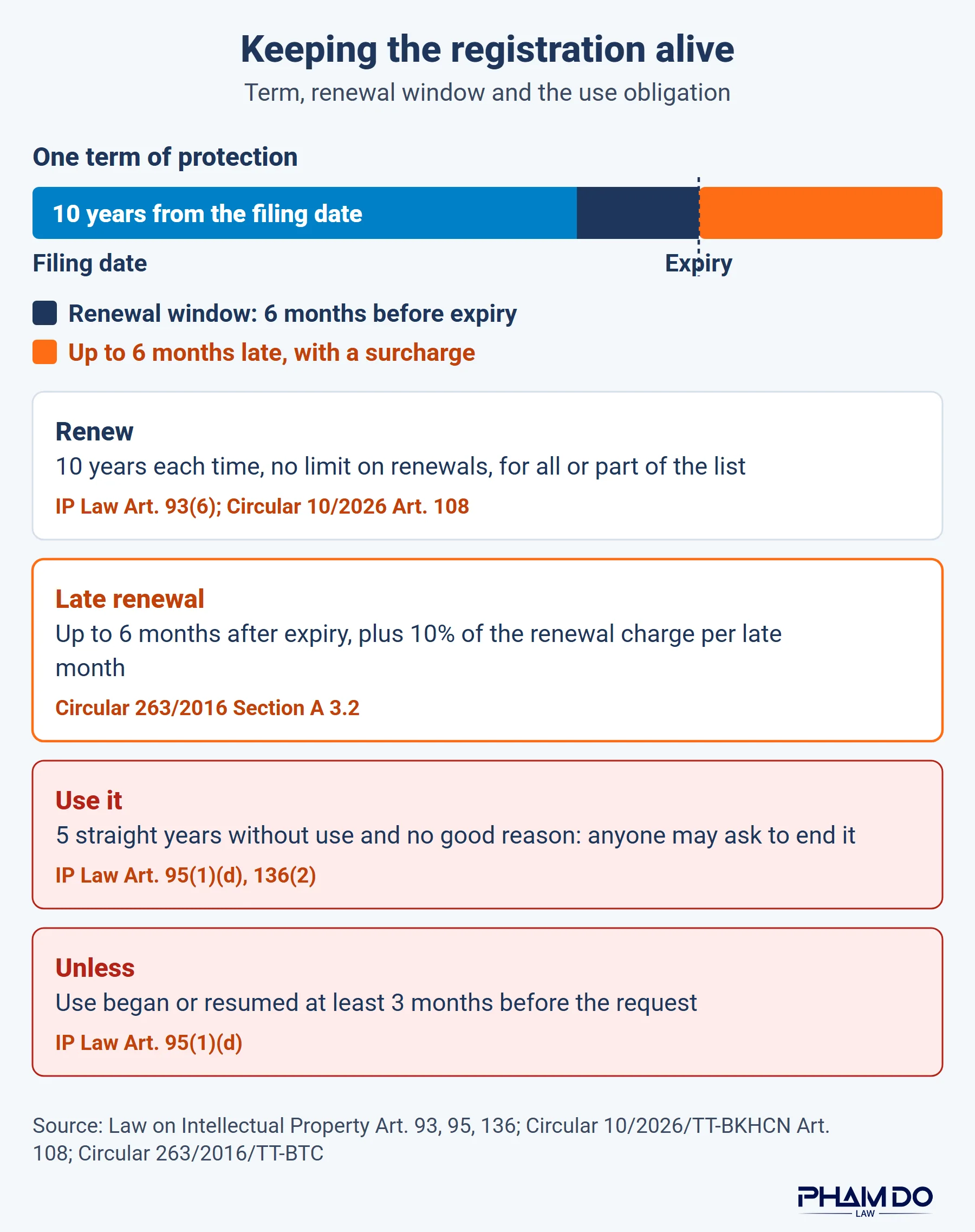
A registration lasts 10 years from the filing date and can be renewed without limit, but it can be lost through non-use. Under Article 93(6) of the Law, the certificate is valid from grant until 10 years from filing, renewable for 10 years at a time.
Renewing the registration
Under Article 108(2) of Circular 10/2026/TT-BKHCN, as amended, the owner files within 6 months before expiry, or up to 6 months late with a surcharge for each late month. Renewal may cover all or part of the goods and services (Article 108(3)). It uses Form No. 01 in Annex II (Article 108(1)(a)).
With the request, the owner pays the renewal examination fee and the renewal charge per class (see the fees section). The owner also pays the fee for use of the protection title of VND 700,000 per class, the registration fee of VND 120,000 and the publication fee of VND 120,000 (Article 108(2)). A request with fees short is invalid (Article 108(4)(c)).
Use the mark or risk cancellation
The owner must use the mark continuously (Article 136(2) of the Law). Under Article 95(1)(d), after 5 consecutive years of non-use without good reason, anyone may request termination, unless use began or resumed at least 3 months before the request.
Token use does not count. Article 111(2) of the Circular excludes use only to prepare, research or test without commercial transactions, internal use, and use only in documents, on websites or in advertising without the goods or services. A third party’s request is decided within 5 months, or up to 7 months in complex or contested cases (Article 111(5)). Keep invoices and dated photos of goods on sale as proof of use.
Assignment and licensing
Under Article 148(1) of the Law, an assignment contract takes effect only once registered with the IP Office. A license contract takes effect as the parties agree, and a trademark license, unlike other licenses, needs no registration to bind third parties (Article 148(2) and (3)). A pending application can also be assigned (Article 115(1)(d)). These transfers are made by license and assignment contracts.
Enforcement when someone copies the mark
Infringement can be handled by civil, administrative or criminal measures (Article 199(1) of the Law), and courts apply the civil and criminal ones (Article 200(2)). At the owner’s request, customs may suspend clearance of suspected infringing goods (Article 216(1)(a) and (2)(a)). Selling counterfeit trademark goods is an administrative violation with fines set by the Government, and an infringement that meets all the elements of a crime is prosecuted as one (Articles 211 and 212).
Before acting, collect samples of the copied goods, invoices and photos of where they are offered for sale. Watching the IP Gazette, which the office publishes in print or electronic form (Article 123(2) of the Circular), catches confusing filings while opposition is still open. For court proceedings, see dispute resolution in Vietnam.
Patents and industrial designs in brief
An invention patent lasts 20 years from filing and an industrial design 5 years, renewable twice, both registered with the same IP Office under their own conditions.
| Right | Conditions | Term |
|---|---|---|
| Invention patent | Novelty, inventive step and industrial applicability (Article 58(1)) | 20 years from filing (Article 93(2)) |
| Industrial design | Novelty, creativity and industrial applicability (Article 63) | 5 years from filing, renewable twice for 5 years each (Article 93(4)) |
An invention loses novelty if it was disclosed publicly, in Vietnam or abroad, before the filing date (Article 60(1)(a)), and a design must differ significantly from designs disclosed anywhere before filing (Article 65(1)). Therefore, a patent search should cover foreign publications, and the invention should stay confidential until filed.
Legal basis for trademark registration in Vietnam
- Law on Intellectual Property No. 50/2005/QH11, as amended, including by Law No. 131/2025/QH15, in force from 1 April 2026.
- Paris Convention for the Protection of Industrial Property, Article 4C, for the priority period.
- Decree 65/2023/ND-CP, as amended, in consolidated text No. 04/VBHN-BKHCN.
- Circular 10/2026/TT-BKHCN, in force from 1 April 2026, as amended by Circular 20/2026/TT-BKHCN, in consolidated text No. 06/VBHN-BKHCN.
- Circular 263/2016/TT-BTC on industrial property fees, as amended by Circular 31/2020/TT-BTC.
- Circular 64/2025/TT-BTC, 50% charges until 31 December 2026.
- Circular 29/2026/TT-BTC, VNeID waiver from 1 April 2026 to 31 December 2026.
- Law on Complaints 02/2011/QH13.
Frequently asked questions
Can I file before my product is on the market in Vietnam?
Pham Do Law Firm’s answer: Yes. Rights come from registration, not from use, and the earliest valid filing wins (Article 90(2) of the Law on Intellectual Property).
Can I change my logo or add goods after filing?
Pham Do Law Firm’s answer: Only within the original scope. The applicant may amend before grant (Article 115(1) of the Law), but an amendment that broadens the application is a ground for refusal (Article 117(1)(đ)). Pham Do Law Firm therefore recommends a new application for new goods or a new logo design.
What can I do if someone filed my mark first?
Pham Do Law Firm’s answer: Oppose it within 3 months of publication, or request invalidation after grant. Grounds include bad faith, conflict with a mark well known before the filing date and, where Article 87(7) applies, a filing by your agent or representative without consent, unless it has a good reason (Articles 74(2)(i), 87(7), 96 and 117(1) of the Law). The time limits for each ground are in the first-to-file section above.
Should I file the word and the logo in one application or separately?
Pham Do Law Firm’s answer: One application covers one mark, as shown in its specimen. To hold the word and the logo as separate registrations, each needs its own application, with its own filing charge, publication fee and per-class search and examination fees (Article 100(3) and (6) of the Law; Article 69(2) of Circular 10/2026/TT-BKHCN; Circular 263/2016/TT-BTC).
Do the new 2026 rules apply to an application filed before 1 April 2026?
Pham Do Law Firm’s answer: Mostly not. Under Article 3(1) of Law No. 131/2025/QH15, such an application follows the law in force at its filing date. Three points follow the new law: formality examination if the application was not yet accepted, and the opposition window and substantive examination period if it is published from 1 April 2026.
Trademark registration with Pham Do Law Firm
Pham Do Law Firm advises foreign companies on trademark registration in Vietnam. A company entering Vietnam can also read about the business license its sector may need and how to set up a company in Vietnam. The IP Office decides each application, and registration is not guaranteed.
This is Pham Do Law Firm’s advice on trademark registration in Vietnam as of 17 November 2026. Contact Pham Do Law Firm for advice on your specific situation.