

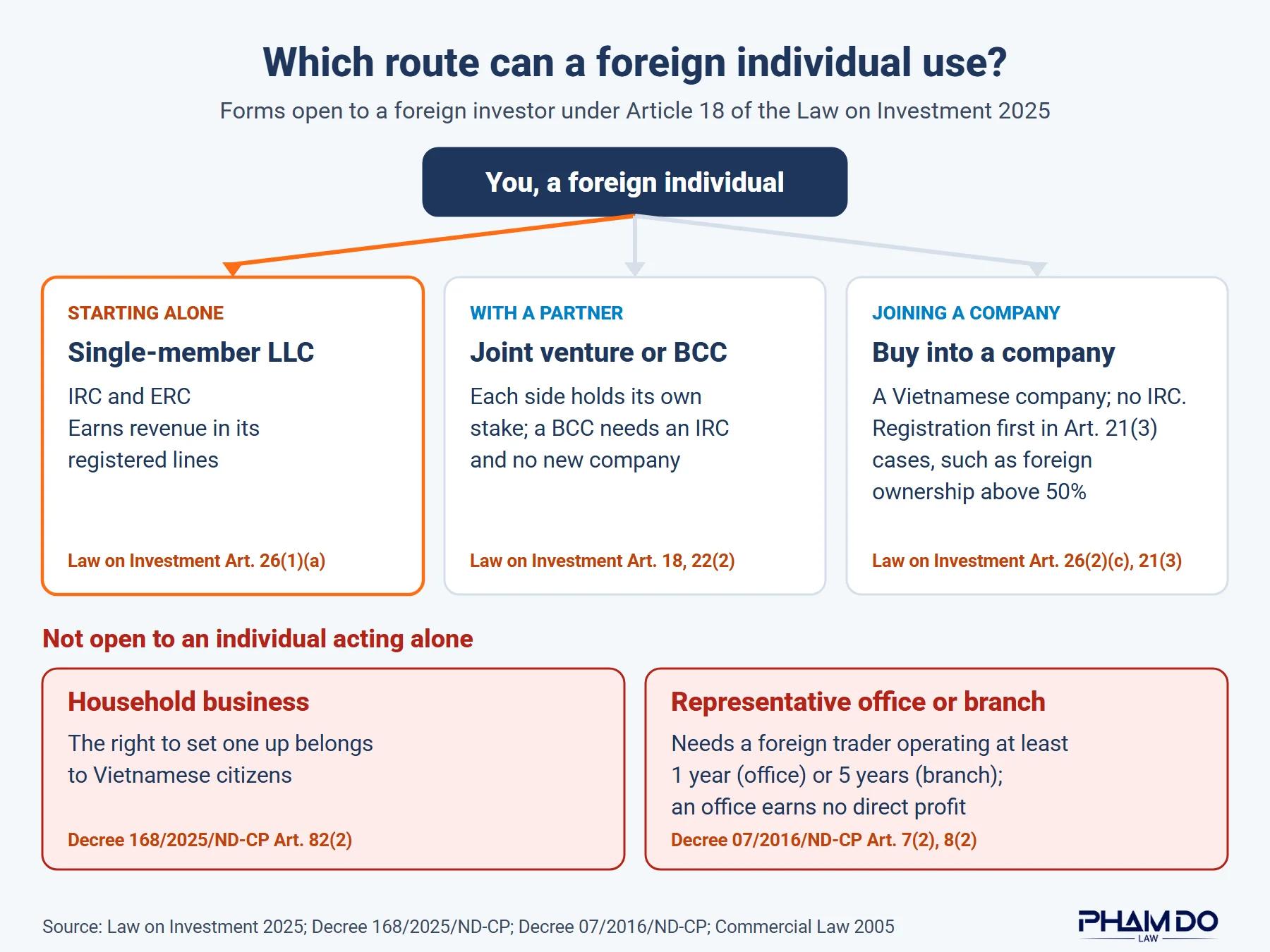
Starting a business in Vietnam as a foreigner is possible through a company or another form open to foreign investors, but not as a household business. Under Article 82(2) of Decree 168/2025/ND-CP on enterprise registration, the right to set up a household business belongs to Vietnamese citizens, not to foreigners. A Vietnamese spouse may still register one in his or her own name, as its real owner. Pham Do Law Firm explains each step below.
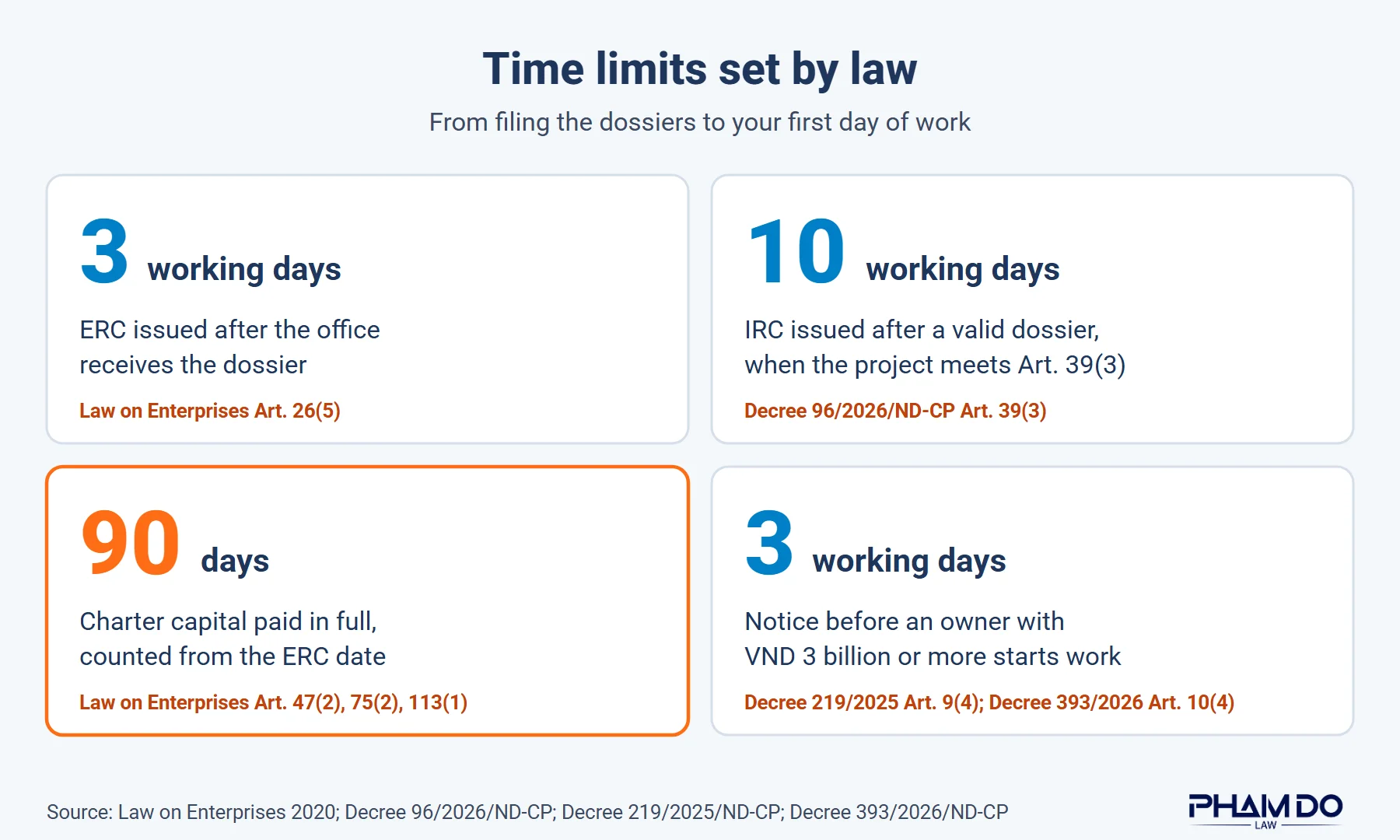
For one person with a small budget, this guide focuses on the single-member limited liability company, the form one person can own alone. The capital you contribute decides whether you need a work permit and which investor visa you can hold. The filing steps are in our full setup guide. By law, the ERC is issued within 3 working days of receipt of the dossier (Article 26(5) of the Law on Enterprises), and the IRC within 10 working days of a valid dossier when the project meets Article 39(3) of Decree 96/2026/ND-CP.
Can a foreigner open a small business in Vietnam?
Yes. Under Article 18 of the Law on Investment 2025 (No. 143/2025/QH15), a foreign investor may set up a company, invest by capital contribution or share purchase, or sign a business cooperation contract (BCC). A foreign investor includes an individual of foreign nationality (Article 3(19)), so you do not need a company abroad to invest.
The household business is the form the law keeps for Vietnamese citizens. Article 82(2) of Decree 168/2025/ND-CP gives the right to set one up to Vietnamese citizens with full civil capacity, as individuals or household members. A foreigner who wants to own a café or shop therefore uses one of the forms in Article 18 of the Law on Investment 2025, usually a company.

The business line must also be open to foreign investors. Appendix I of Decree 96/2026/ND-CP lists lines not yet open to foreign investors (23 when the decree was issued) and lines open on conditions (62). Outside that list, a foreign investor has the same market access as a Vietnamese investor (Article 17(1)), and the company can be 100% foreign-owned. Our setup guide shows how to check market access for your lines.
Which business vehicle fits one person?
A new company owned by a foreigner needs an Investment Registration Certificate (IRC) for its project and an Enterprise Registration Certificate (ERC). The table compares five vehicles. The last two need a foreign parent company, so an individual acting alone cannot use them.
| Vehicle | Who can use it | What it needs | Can it earn revenue? |
|---|---|---|---|
| Single-member limited liability company (LLC) | Any foreign individual or organization | IRC for a foreign investor’s new project (Article 26(1)(a) of the Law on Investment 2025) and the ERC; the company may be set up before the IRC procedure (Article 19(2)), see the two routes | Yes, in its registered lines |
| Buying into a Vietnamese company | Any foreign investor | No IRC (Article 26(2)(c)); registration first in the cases of Article 21(3), such as foreign ownership above 50% | Yes, through the existing company |
| BCC | A foreign investor with a Vietnamese or a foreign partner | IRC (Article 22(2)); no new company | Yes, under the contract |
| Representative office | A foreign trader that has operated for at least 1 year (Article 7(2) of Decree 07/2016/ND-CP) | An establishment license | No direct profit-making activity (Article 18(1) of the Commercial Law (No. 36/2005/QH11)) |
| Branch | A foreign trader that has operated for at least 5 years (Article 8(2) of Decree 07/2016/ND-CP) | An establishment license | Yes, within its license |
A representative office or branch belongs to a foreign trader. An individual without a qualifying parent company cannot open either, and a representative office may only act as a liaison office, do market research and promote business opportunities (Article 30 of Decree 07/2016/ND-CP).
For an individual who wants a new business owned alone, that leaves the single-member LLC. A foreign company that only wants to study the market can open a representative office in Vietnam instead. If partners may join later, compare the two company forms in LLC vs JSC in Vietnam. Buying shares has its own registration step, explained in share purchase registration.
Can you open a business with a Vietnamese partner or spouse?
One shortcut to avoid is registering the business in the name of a Vietnamese spouse, partner or friend. Under Article 4(1) of Decree 168/2025/ND-CP, as amended by Decree 296/2026/ND-CP from 23 July 2026, owners, members and shareholders must not stand in for another person when contributing capital. On the register, the capital belongs to the nominee, not to you.
Your spouse may still set up a household business in his or her own name (Article 82(2) of Decree 168/2025/ND-CP) and run it as its real owner. The ban in Decree 296/2026/ND-CP covers company owners, members and shareholders who stand in for another person when contributing capital.

The lawful version of a Vietnamese partner is a real joint venture, in which each side contributes and holds its own stake. If foreign investors hold more than 50% of the charter capital, the company follows the procedures for foreign investors when it later invests (Article 20(1) of the Law on Investment 2025). See joint ventures and keeping control in our foreign direct investment guide.
Common small ventures and what each needs
The ventures below assume you run them through your own company. Its sector rules may then add a license or a notice, summarized here and set out in our guide to the license for your sector.
Café or restaurant

A café or restaurant needs a food safety certificate under the Law on Food Safety (Consolidated Text 61/VBHN-VPQH), unless it is exempt. The certificate is valid for 3 years (Article 37). Decree 15/2018/ND-CP still applies, because Resolution 15/2026/NQ-CP suspended the newer decree.
Alcohol works differently. Resolution 66.18/2026/NQ-CP suspends the alcohol trading licenses from 1 July 2026 to 28 February 2027. Decree 105/2017/ND-CP stays formally in force, so a bar should check its position again before 1 March 2027.
Pham Do Law Firm recommends having a lawyer or adviser check the legal side of the business premises before you sign any contract or agreement with the landlord. Even if state zoning does not affect you, you can still run into the landlord’s own problems, such as fire safety or the personal income tax due on the rent.
Retail shop
A foreign-invested company that retails goods needs a Business License under Decree 342/2026/ND-CP, in force since 18 October 2026. The provincial People’s Committee of the head office issues it (Articles 5(1) and 8). The premises check recommended in the café section applies to a shop too.
Each retail outlet also needs its own license. From the second outlet, an economic needs test applies to investors from countries without a treaty commitment abolishing it. The test does not apply to an outlet under 500 m², inside a shopping mall, that is not a convenience store, mini-supermarket or supermarket (Article 22(1)).
Language center
A language center follows Decree 360/2026/ND-CP, in force since 17 September 2026. The Director of the Department of Education and Training issues a decision permitting its establishment within 10 working days (Article 40(2)). No separate operating license follows.
Consulting or IT services
Software development and ordinary computer services have no sector license. Two IT activities do need one: cybersecurity products and services need a license from the Ministry of Public Security (Decree 332/2026/ND-CP), and personal data processing services need a certificate from the same ministry (Decree 356/2025/ND-CP). For software and management consulting, check the exact line against Appendix I of Decree 96/2026/ND-CP before you file. The company still needs a head office in Vietnam, and our setup guide covers the registered address and virtual offices.
Online store
The Law on E-commerce (No. 122/2025/QH15) and Decree 248/2026/ND-CP apply from 1 July 2026. A company whose own website or app lets customers order online notifies the provincial People’s Committee before operating (Articles 23(1) and 24(5) of the decree).
How much capital do you need?
Neither the Law on Enterprises nor the Law on Investment 2025 sets a general minimum charter capital; only some sectors have one. The capital you contribute later decides your work permit and visa position.
Charter capital must be paid within 90 days from the date of the ERC (Articles 47(2), 75(2) and 113(1) of the Law on Enterprises).
Do you need a work permit or visa for your own company?
Owning a company does not by itself give a right to stay. Under Article 8(7a) to (7d) of Law No. 47/2014/QH13 on the entry, exit and residence of foreigners, as last amended by Law No. 118/2025/QH15, your investor visa category depends on the capital contributed. For a small owner, the line falls at VND 3 billion.
- Under VND 3 billion. You can hold a ĐT4 investor visa for up to 1 year, but no investor temporary residence card. To work in your own company, you need a work permit with the company as your employer.
- VND 3 billion to under 50 billion. You can hold a ĐT3 visa and a temporary residence card for up to 3 years each. As an LLC owner or member, or a JSC chair or board member, at this level you need no work permit and no exemption certificate. The company must notify the authority at least 3 working days before you start work.
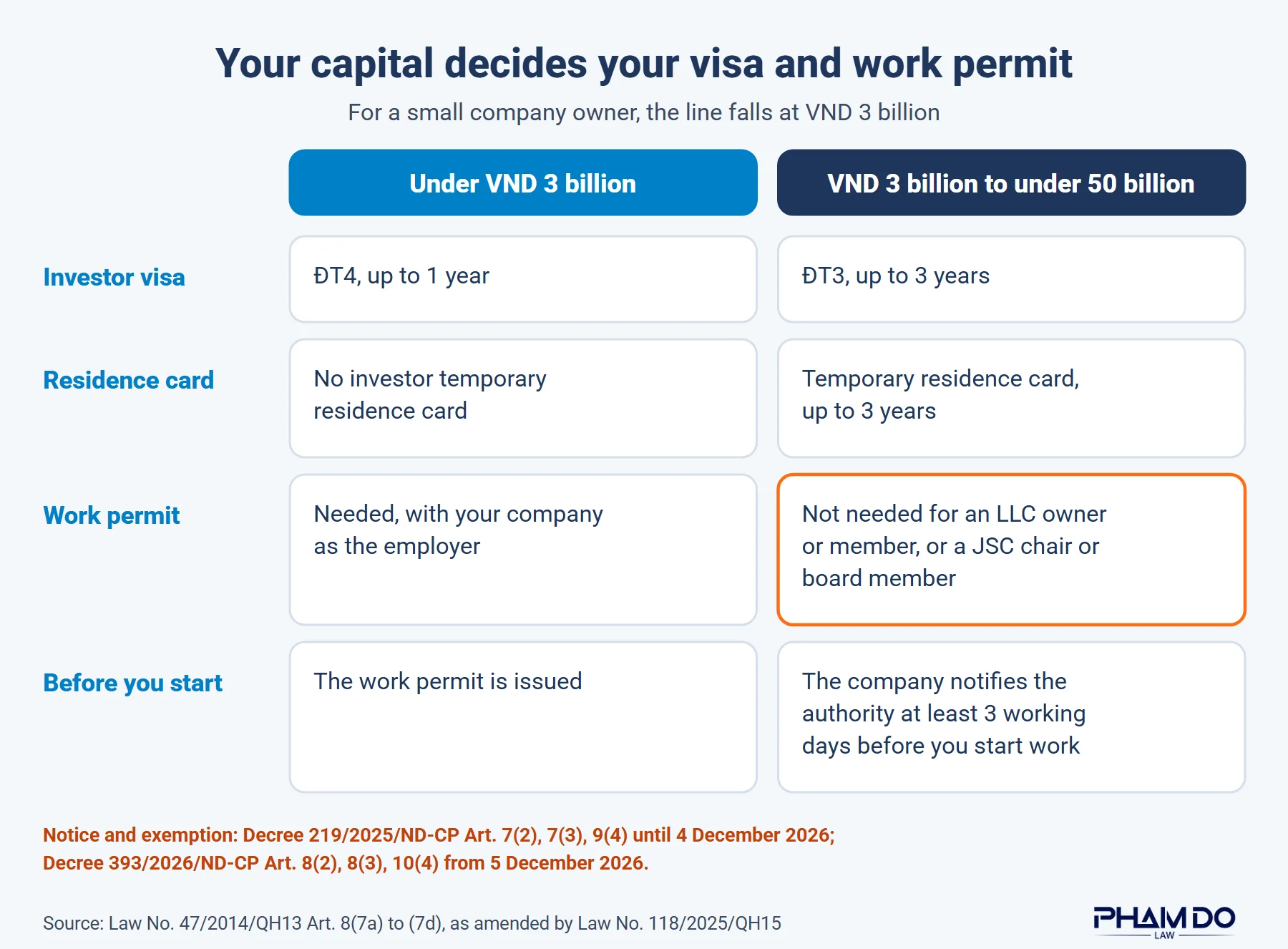
Until 4 December 2026, that exemption is in Articles 7(2), 7(3) and 9(4) of Decree 219/2025/ND-CP. From 5 December 2026, Decree 393/2026/ND-CP replaces it, with the exemption in Articles 8(2) and 8(3) and the notice in Article 10(4). Article 2(1)(l) of that decree lists an owner contributing under VND 3 billion among foreign workers, and no exemption in Article 8 covers that owner, so a work permit is needed below that line.
The company must also always have at least one legal representative residing in Vietnam (Article 12(3) of the Law on Enterprises). If that person is you, you need a lawful basis to reside in Vietnam. Pham Do Law Firm handles both sides through its work permit service and its business visa and temporary residence card service.
How much do tax and state fees cost a small company?
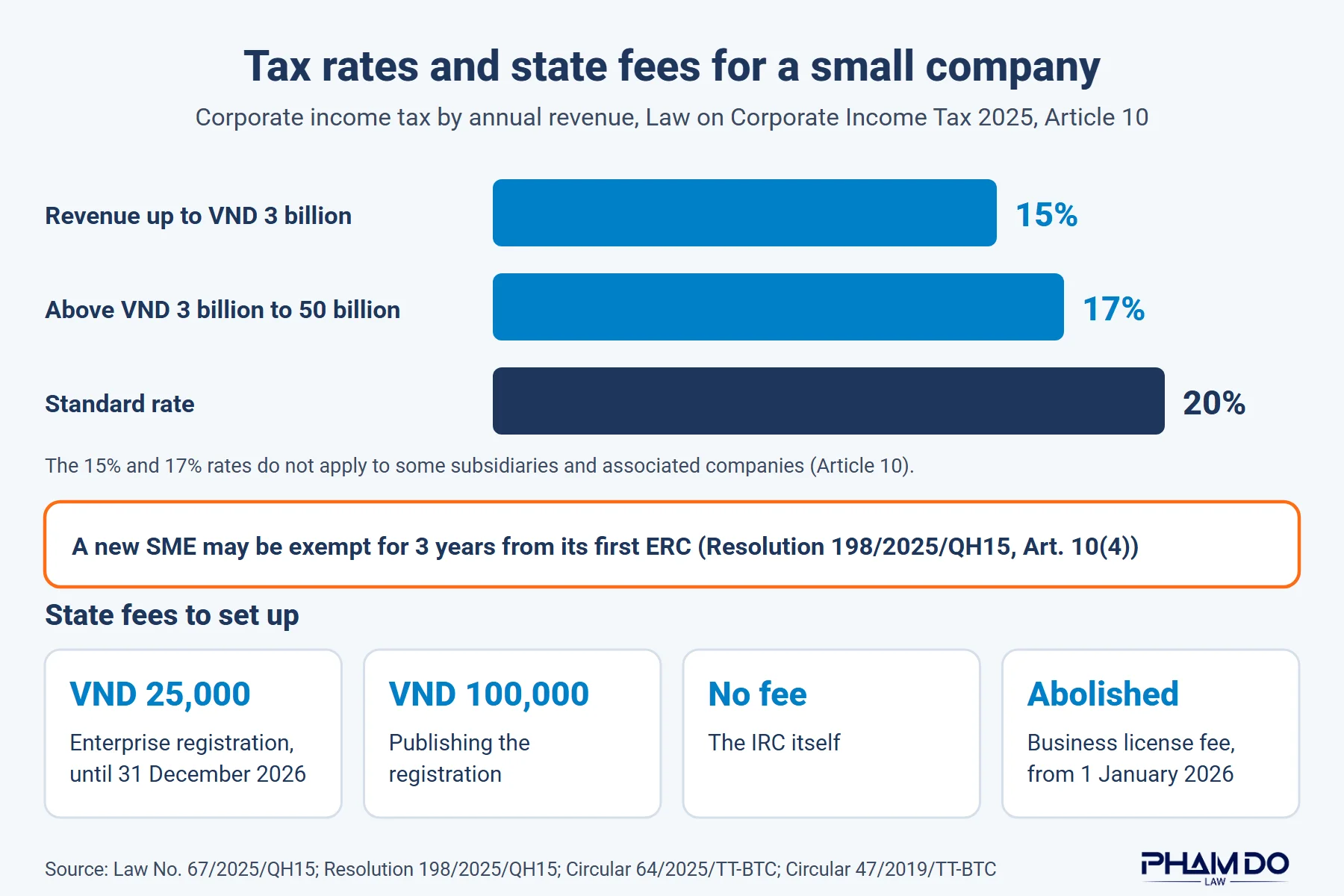
Under Article 10 of the Law on Corporate Income Tax 2025 (No. 67/2025/QH15), a company with annual revenue up to VND 3 billion pays corporate income tax at 15%. The rate is 17% for revenue above VND 3 billion up to VND 50 billion, and the standard rate is 20%. The 15% and 17% rates do not apply to a subsidiary or an associated company when an enterprise it is associated with does not meet the conditions for those rates (Article 18(4)).

A newly registered small or medium-sized enterprise may be exempt from corporate income tax for 3 years from its first ERC (Article 10(4) of Resolution 198/2025/QH15). Foreign ownership does not exclude a company from it, as the Tax Department confirmed in Official Letter 3896/CT-CS of 11 June 2026. An SME has no more than 200 employees with social insurance on annual average. It must also have total capital of no more than VND 100 billion or prior-year revenue of no more than VND 300 billion (Article 4(1) of the Law on Support for Small and Medium-sized Enterprises, No. 04/2017/QH14). The Government sets the exact limits for each sector (Article 4(2)), so check your sector before relying on the exemption. The exclusions under Article 7(3) of Decree 20/2026/ND-CP are set out in what a foreign-owned company pays in tax.
The business license fee was abolished from 1 January 2026 (Article 10(7) of Resolution 198/2025/QH15). State fees for setting up are small. Enterprise registration costs VND 25,000 per filing until 31 December 2026, and publishing the registration costs VND 100,000 (Article 1 of Circular 64/2025/TT-BTC; schedule of Circular 47/2019/TT-BTC). The IRC itself carries no fee.
The recurring cost to plan for is compliance. A foreign-invested company must have its annual financial statements audited by an independent auditor (Article 37(1)(a) of the Law on Independent Audit (No. 67/2011/QH12)). Bookkeeping and tax filings are covered by our tax and accounting service.
Mistakes to avoid as a small foreign owner
The first mistake is the nominee. Registering the business in a Vietnamese name leaves the capital with that person on the register, and Decree 296/2026/ND-CP bans standing in for another person’s capital.
The second is signing a lease before anyone has checked the legal side of the premises, the check recommended in the café section above.
The third is planning to trade through a representative office. A representative office may not carry out direct profit-making activity, and only a foreign trader that has operated for at least 1 year can open one.
The fourth concerns capital. Capital declared at VND 3 billion or more must still be paid in full within 90 days of the ERC.
Finally, starting work before the work permit is issued, or before the company has sent the 3-working-day notice, means working without the basis the law requires.
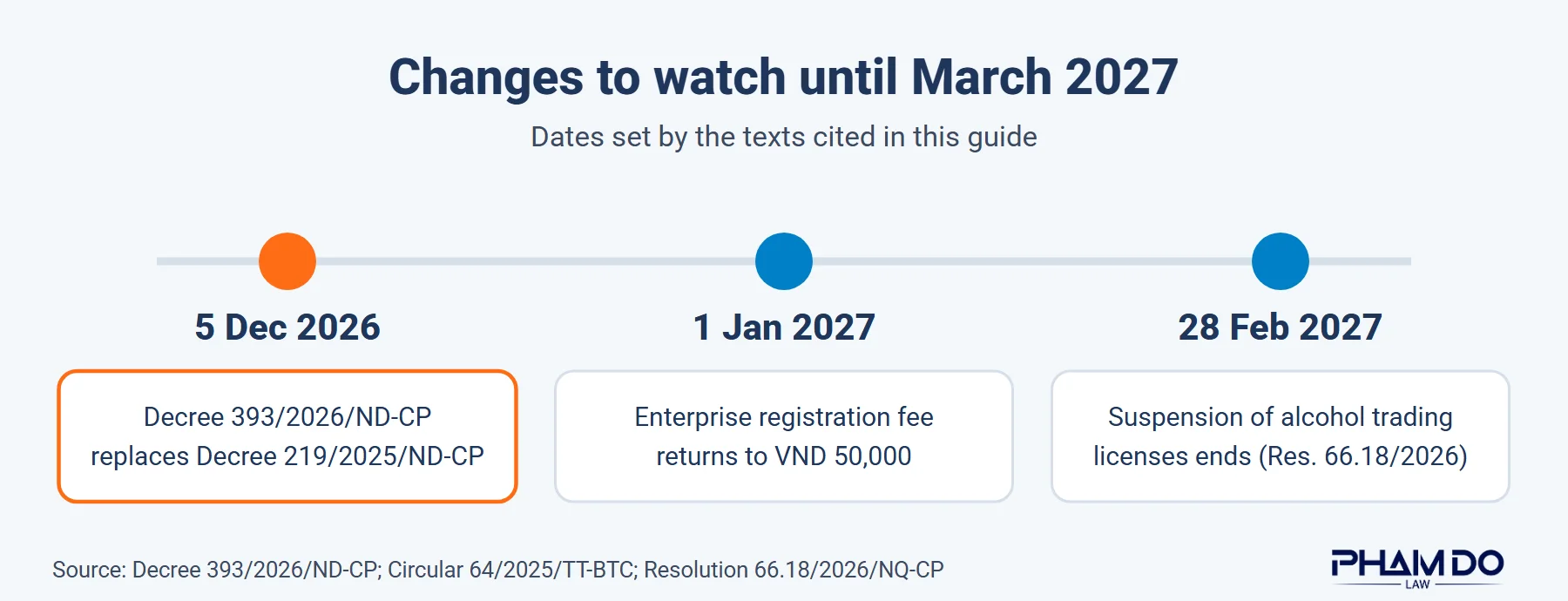
Changes to watch until March 2027
- 5 December 2026. Decree 393/2026/ND-CP replaces Decree 219/2025/ND-CP. The owner exemption moves to Articles 8(2), 8(3) and 10(4).
- 1 January 2027. The enterprise registration fee returns to VND 50,000 per filing.
- 28 February 2027. The suspension of alcohol trading licenses under Resolution 66.18/2026/NQ-CP ends.
Frequently asked questions
Can a foreigner own 100% of a business in Vietnam?
Pham Do Law Firm’s answer: Yes, in most business lines, through a company. Lines in Appendix I are closed to foreign investors or open on conditions, which may include an ownership cap (Article 17(1) of Decree 96/2026/ND-CP).
Can I open a business in my Vietnamese spouse’s name?
Pham Do Law Firm’s answer: Not as a hidden owner. Your spouse may own a business as its real owner, but a company’s owners, members and shareholders may not stand in for another person when contributing capital (Article 4(1) of Decree 168/2025/ND-CP, as amended by Decree 296/2026/ND-CP).
Can a foreigner open a household business?
Pham Do Law Firm’s answer: No. Only Vietnamese citizens may set up a household business (Article 82(2) of Decree 168/2025/ND-CP). A foreigner uses one of the forms open to foreign investors instead, usually a company.
What is the cheapest legal way to start a business in Vietnam?
Pham Do Law Firm’s answer: For one person without a parent company abroad or a partner, the route that needs neither is a single-member LLC in your own name. A representative office or branch needs a foreign trader that has operated for at least 1 or 5 years (Articles 7(2) and 8(2) of Decree 07/2016/ND-CP).
How much does it cost to start a business in Vietnam?
Pham Do Law Firm’s answer: In state fees, very little. Enterprise registration costs VND 25,000 until 31 December 2026, and publication costs VND 100,000 (Article 1 of Circular 64/2025/TT-BTC; schedule of Circular 47/2019/TT-BTC). The IRC carries no fee. Translation, legalization or an apostille for foreign documents (see apostille in Vietnam), the office and professional fees cost more.
Do I need a work permit to run my own company?
Pham Do Law Firm’s answer: Yes, if you contribute less than VND 3 billion. At VND 3 billion or more, an LLC owner or member, or a JSC chair or board member, needs no work permit, but the company must notify the authority at least 3 working days before you start. Until 4 December 2026 the rule is in Articles 7(2), 7(3) and 9(4) of Decree 219/2025/ND-CP. From 5 December 2026 it is in Articles 8(2), 8(3) and 10(4) of Decree 393/2026/ND-CP.
Legal basis
- Law on Investment 2025 (No. 143/2025/QH15), effective 1 March 2026; Decree 96/2026/ND-CP, effective 31 March 2026;
- Law on Enterprises 2020 (No. 59/2020/QH14), as amended by Law No. 76/2025/QH15 (Consolidated Text 67/VBHN-VPQH);
- Decree 168/2025/ND-CP, effective 1 July 2025, as amended by Decree 296/2026/ND-CP from 23 July 2026;
- Decree 07/2016/ND-CP on representative offices and branches of foreign traders; Commercial Law (No. 36/2005/QH11);
- Law No. 47/2014/QH13, as last amended by Law No. 118/2025/QH15;
- Decree 219/2025/ND-CP until 4 December 2026; Decree 393/2026/ND-CP from 5 December 2026;
- Law on Corporate Income Tax 2025 (No. 67/2025/QH15); Resolution 198/2025/QH15; Decree 20/2026/ND-CP; Official Letter 3896/CT-CS of 11 June 2026;
- Circular 47/2019/TT-BTC; Circular 64/2025/TT-BTC; Law on Independent Audit (No. 67/2011/QH12);
- Sector rules: Consolidated Text 61/VBHN-VPQH on food safety; Decree 15/2018/ND-CP; Resolution 15/2026/NQ-CP; Decree 342/2026/ND-CP; Decree 360/2026/ND-CP; Decree 248/2026/ND-CP and the Law on E-commerce (No. 122/2025/QH15); Resolution 66.18/2026/NQ-CP; Decree 105/2017/ND-CP.
Starting your business with Pham Do Law Firm
Pham Do Law Firm sets up foreign-owned small companies within its company incorporation service.
- We check your business lines against the market access conditions and the sector license your venture needs.
- We prepare and file the IRC and ERC dossiers, then the work permit or the exemption notice and your visa or temporary residence card.
Issuance of each certificate and permit is decided by the authority and is not guaranteed. This is Pham Do Law Firm’s advice on starting a small business in Vietnam as a foreigner as of 16 November 2026. Contact Pham Do Law Firm for advice on your specific situation.