
A foreign investor that wants a factory in an industrial park in Vietnam needs an investment registration certificate (IRC) and a site. Under Article 27(1) of the Law on Investment 2025 (Law No. 143/2025/QH15), the zone management board issues the IRC for a project inside a park. Pham Do Law Firm explains each step below.
Our guide to foreign direct investment in Vietnam covers the wider routes, approvals and incentives.
Legal basis for industrial parks in Vietnam
- Law on Investment No. 143/2025/QH15, in force from 1 March 2026.
- Decree 96/2026/ND-CP guiding the Law on Investment, in force from 31 March 2026.
- Decree 35/2022/ND-CP on the management of industrial parks and economic zones, in force from 15 July 2022.
- Land Law No. 31/2024/QH15, consolidated as VBHN 44/VBHN-VPQH, in force from 1 August 2024.
- Resolution 254/2025/QH15 on implementing the Land Law, in force from 1 January 2026.
- Law on Environmental Protection No. 72/2020/QH14, consolidated as VBHN 98/VBHN-VPQH.
- Law on Construction No. 135/2025/QH15, its Article 43(2) in force from 1 January 2026.
- Commercial Law No. 36/2005/QH11, as amended, whose Articles 178 to 184 cover contract manufacturing.
- Law on Foreign Trade Management No. 05/2017/QH14, whose Article 51 covers contract manufacturing for foreign traders.
- Decree 134/2016/ND-CP and its Article 28a added by Decree 18/2021/ND-CP, in force from 25 April 2021.
- Resolution 66.16/2026/NQ-CP cutting administrative procedures, from 15 April 2026 to 28 February 2027.
- Resolution 66.25/2026/NQ-CP on state management of industrial parks, from 15 September 2026 to 28 February 2027.
- Law on Corporate Income Tax No. 67/2025/QH15, in force from 1 October 2025.
- Decree 320/2025/ND-CP guiding the Law on Corporate Income Tax, in force from 15 December 2025.
Industrial parks, export processing zones and economic zones in Vietnam
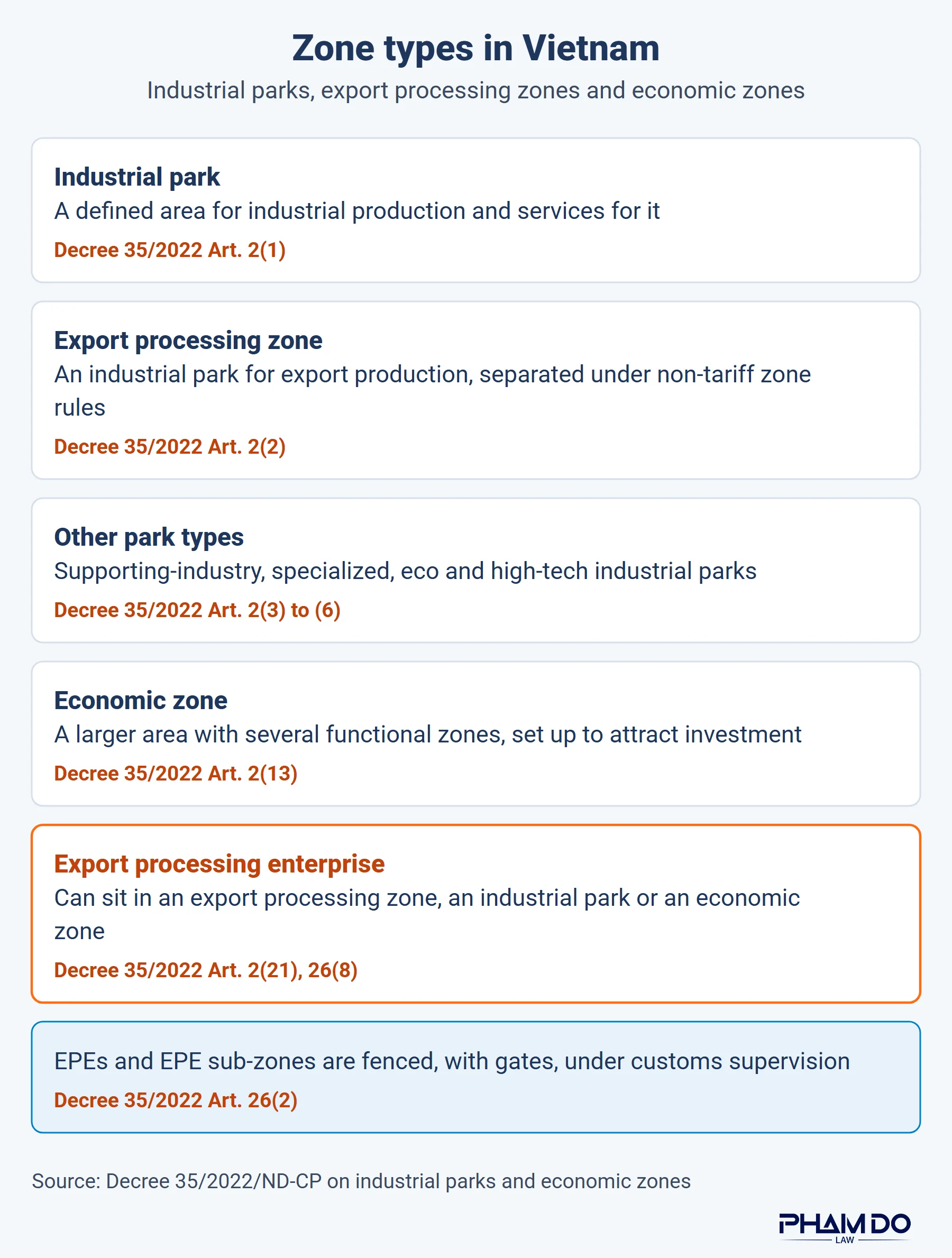
An industrial park is a bounded area that specializes in industrial production and services for it, under Article 2(1) of Decree 35/2022/ND-CP.
Decree 35 defines several kinds of zone:
| Zone type | What Decree 35 says | Basis |
|---|---|---|
| Export processing zone (EPZ) | Industrial park for export production, separated from the rest of Vietnam under non-tariff zone rules. | Decree 35 Article 2(2) |
| Supporting-industry park | Makes supporting-industry products, with at least 60% of its industrial land used for them. | Decree 35 Article 2(3) |
| Specialized park | Serves one specific sector, with at least 60% of its industrial land used for it. | Decree 35 Article 2(4) |
| Eco-industrial park | Its enterprises take part in cleaner production. | Decree 35 Article 2(5) |
| High-tech industrial park | At least 30% of its industrial land is used to attract the projects it targets. | Decree 35 Article 2(6) |
| Economic zone | Larger area with several functional zones, set up to attract investment. | Decree 35 Article 2(13) |
Export processing sub-zones
Under Decree 35 Article 26(2), a park may hold a sub-zone for EPEs, fenced off with gates so that customs can inspect and supervise it.
Economic zones and other park types
The other park types in the table are industrial parks with a set purpose or land share; an economic zone is also set up to protect national defense and security.
Should a foreign investor build or rent a factory in an industrial park?
A foreign investor can sub-lease prepared land in a park and build its own factory, or rent or buy a ready-built one (Decree 96 Article 71). Either way, the project needs an IRC under Article 26(1)(a) of Law 143. A company that only needs goods made can instead hire a Vietnamese manufacturer to make them under a contract manufacturing agreement (Commercial Law Article 178).
Build on sub-leased land or rent a ready-built factory
Article 71 of Decree 96/2026/ND-CP sets out both options:
| Option | What the tenant does | Basis |
|---|---|---|
| Ready-built factory | Rents or buys a factory, office or warehouse the developer has built. | Decree 96 Article 71(1); Decree 96 Article 70(3)(a) |
| Own factory | Sub-leases land with infrastructure and builds a factory, office and other works on it. | Decree 96 Article 71(3) |
| Both options | Pays infrastructure fees for roads, power, water, drainage, telecoms, and wastewater and waste treatment. | Decree 96 Article 71(2) |
A tenant that builds its own factory on a sub-leased plot may later lease that factory out (Decree 96 Article 71(4)). Our contract review can cover sub-leases and factory leases.
Contract manufacturing instead of your own factory
A foreign company that only needs goods made can hire a Vietnamese manufacturer instead of running its own factory in a park. Under Article 178 of the Commercial Law (Law No. 36/2005/QH11), in contract manufacturing the manufacturer uses some or all of the ordering company’s materials to carry out production stages to its order, for a fee. The contract must be in writing or another form of equivalent legal effect (Article 179). The ordering company may send staff to supervise the work and check quality at the manufacturer’s premises, as the contract agrees (Article 181(4)).
Where the ordering company is foreign, parts of Articles 182 to 184 add rules on temporarily imported machinery and materials, payment in goods and technology transfer. Contract manufacturing for a foreign trader also falls under the Law on Foreign Trade Management (Law No. 05/2017/QH14). Under its Article 51, the manufacturer may not take such work for goods banned or suspended from export or import, unless the Prime Minister permits such work for consumption abroad. For goods exported or imported under a license, it may sign the contract only after the Minister of Industry and Trade grants one. Have a lawyer check the contract and the goods against both laws before you sign.
How do you choose an industrial park in Vietnam?
Check the developer’s land and term, sector fit, wastewater, province thresholds, labor and the park’s stage of development.
- The developer’s land. Under Article 202(2) of the Land Law 2024 (Law No. 31/2024/QH15, consolidated as VBHN 44/VBHN-VPQH), the State leases the park land to the infrastructure developer. Ask to see the developer’s land documents and the date its land term ends.
- Sector fit. Ask the developer which sectors the park’s approved planning admits. A conditional line may also need its own business licenses.
- Wastewater capacity. Under Article 51(1)(a) of the Law on Environmental Protection (Law No. 72/2020/QH14, consolidated as VBHN 98/VBHN-VPQH), a park must have a central wastewater collection and treatment system. A park running before 1 January 2022 may instead hold a provincial exemption, and its tenants then need their own treatment system (Article 51(4a)). Ask the zone management board which case applies and whether the system can take your discharge.
- Province thresholds. Ask whether the province sets a minimum investment per area of land or a labor figure (Decree 96 Article 39(3)(d)).
- Labor. Ask the park developer or the zone management board about the local labor supply.
- Stage of development. Ask whether the park is new or largely filled, and when its roads, power and wastewater works will be complete.
Environmental law treats a park as a concentrated production zone (Law 72/2020 Article 3(37)). Where the park has a central system, a factory must connect its wastewater to it under the developer’s rules (Law 72/2020 Article 53(1)(a)). The developer also checks the environmental commitments a tenant makes when it registers in the park (Law 72/2020 Article 51(4)(h)).
Licensing a project through the zone management board
Inside a park, the zone management board issues, amends and revokes the IRC (Law 143 Article 27(1); Decree 96 Article 36(3)(b)).
Under Law 143 Article 27(3), a project in two or more provinces, partly outside a park, or in a park with no board goes to the investment registration authority where the investor places its executive office. The IRC file is covered in our guide to investment and enterprise registration certificates. Our guide to foreign direct investment in Vietnam explains the market-access conditions in Law 143 Article 8.
The standard IRC route
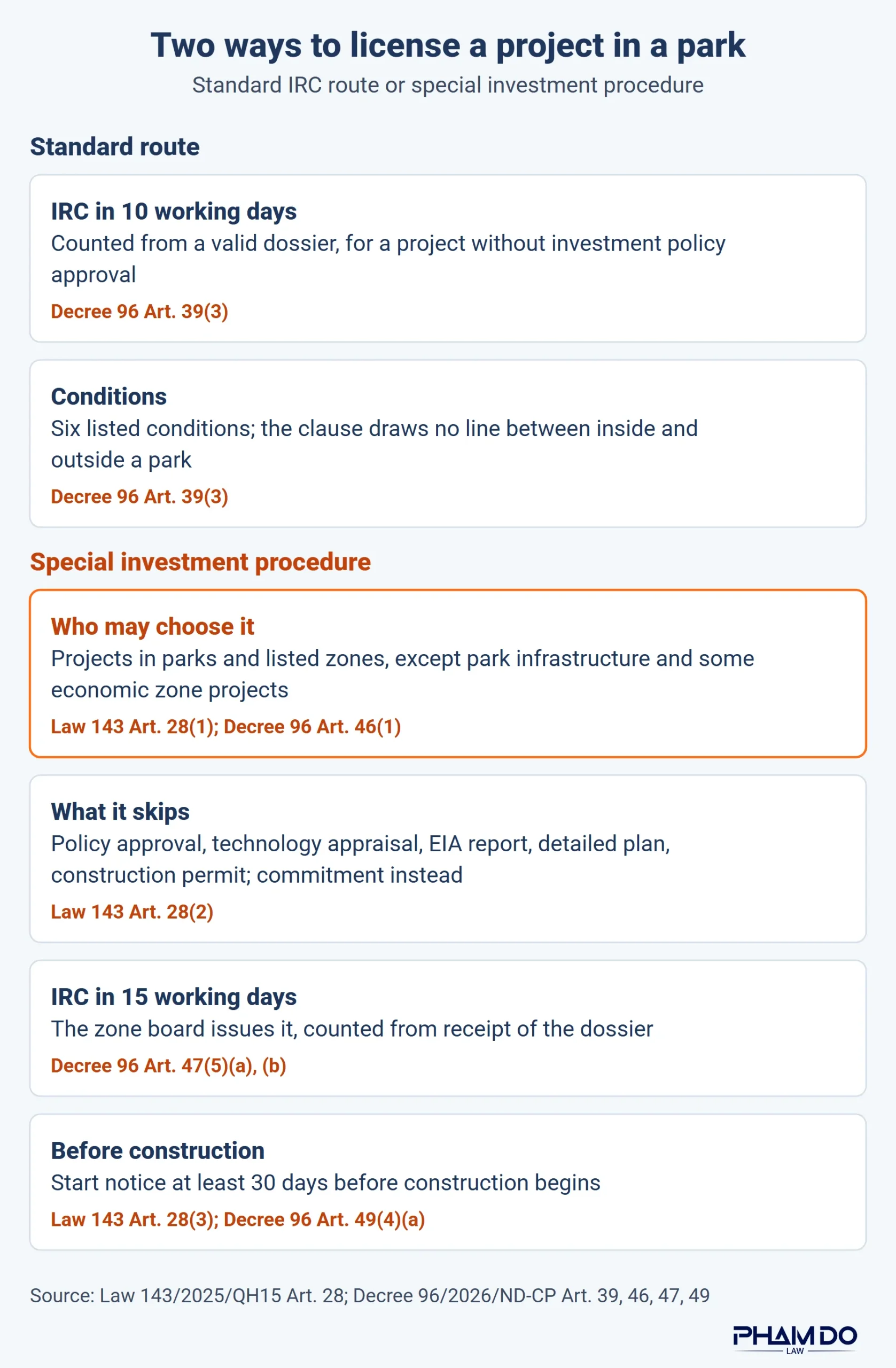
Under Decree 96 Article 39(3), for a project that does not need investment policy approval, the authority issues the IRC within 10 working days of receiving a valid dossier if the project:
- is not in a prohibited business line (point (a));
- has a site for the project (point (b));
- fits the planning (point (c));
- meets the provincial investment per area of land and labor figure, if any (point (d));
- meets the market-access conditions for foreign investors (point (đ));
- meets the conditions on the use of technology (point (e)).
Decree 96 Article 39(3)(b) accepts proof of the right to use the site, such as a valid copy of a lease agreement for the location, so that document should be ready before filing.
Group I and some group II projects also need an environmental impact assessment report (EIA), unless a law or National Assembly resolution exempts them (Law 72/2020 Article 30(1), (2)(b)).
The special investment procedure
Under Law 143 Article 28(1), an investor in an industrial park, EPZ, high-tech zone, digital technology zone, free trade zone, international financial center or functional zone of an economic zone may choose the special investment procedure. Law 143 leaves the exclusions to the Government, and Decree 96 Article 46(1) excludes only park, EPZ and digital technology zone infrastructure projects and some economic zone and free trade zone projects. Read as the Government’s full list, Decree 96 Article 46(1) does not exclude a park project that would otherwise need investment policy approval. Confirm with the zone management board before filing.
Under Law 143 Article 28(2), the project then does not go through investment policy approval, technology appraisal, an EIA report, a detailed plan, a construction permit or the construction and fire approvals. Instead, the investor signs a commitment to meet the construction, environmental and fire standards. It answers for them, and if the project falls short, the authority may fine, suspend or stop it, or take other action under the law (Decree 96 Article 49(1)).
The special procedure then runs as follows:
- The investor files one dossier with the zone management board (Decree 96 Article 47(5)(a)).
- The board issues the IRC within 15 working days of receiving the dossier (Decree 96 Article 47(5)(b)).
- If the project needs an environmental permit, the investor obtains it before construction starts (Decree 96 Article 49(2)(a)).
- At least 30 days before construction starts, the investor sends a start notice with the techno-economic report and its verification report to the local construction authority and the board (Law 143 Article 28(3); Decree 96 Article 49(4)(a)).
Under Article 43(2)(a) of the Law on Construction 2025 (Law No. 135/2025/QH15), works under the special procedure need no construction permit. Article 43(2) does not exempt every factory in a park as such.
Setting up the company before the IRC
Under Law 143 Article 19(2), a foreign investor may set up the company before the IRC procedure, and must meet the market-access conditions when it does so. Once set up, the company carries out the investment procedure for the project (Decree 96 Article 72(1)). Our guide on how to set up a company in Vietnam covers the company side.
Land lease in an industrial park and what to check in the contract
A foreign company in an industrial park sub-leases land or rents a factory from the park developer, and the contract should fix the term, fees and unused land. It does not own the land, and its rights depend on whether it pays rent once or yearly.
Foreign companies lease, they do not own land
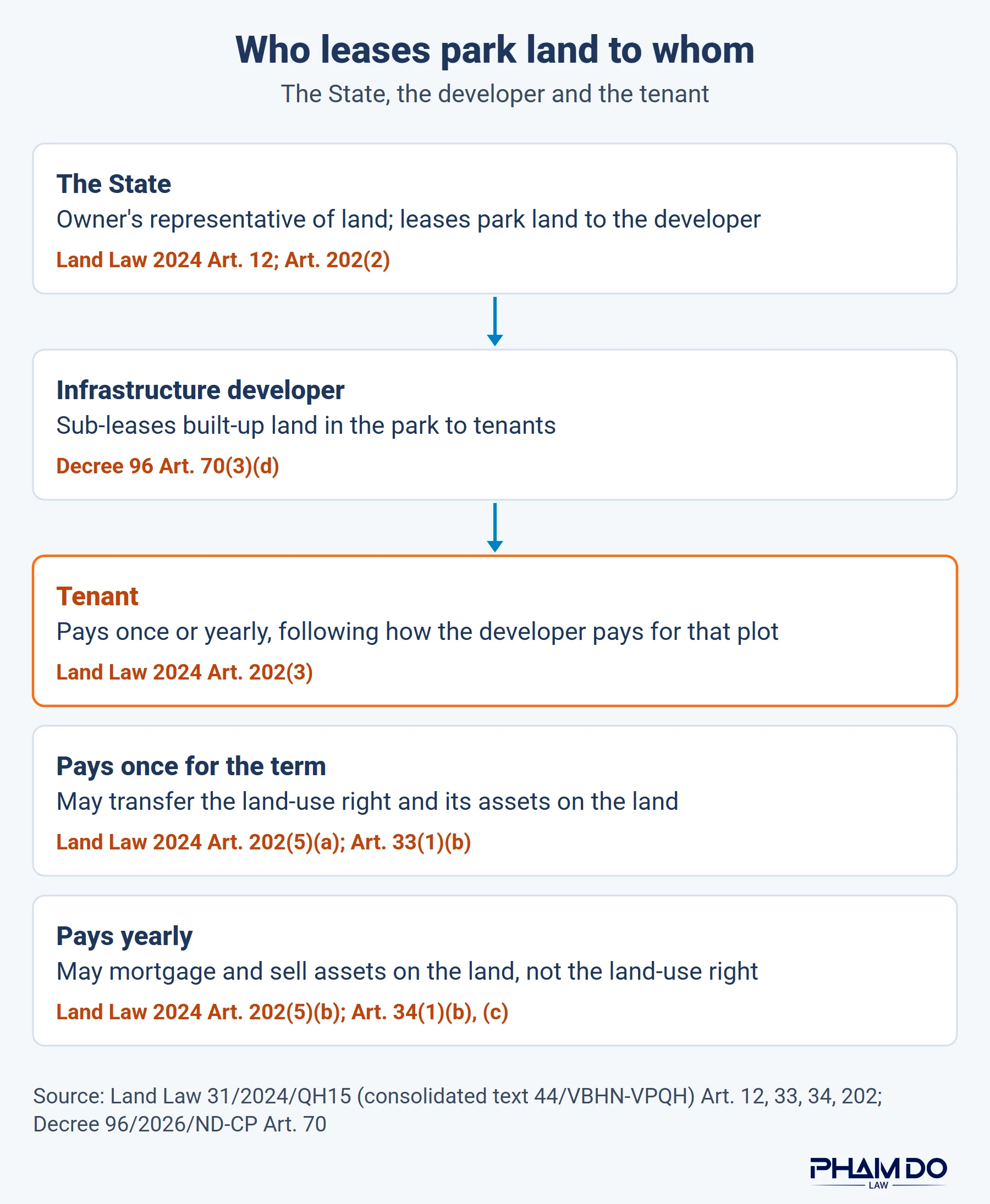
Under Land Law Article 12, land belongs to the entire people, with the State as the owner’s representative, and the State grants land-use rights to land users. In a park, the developer leases the land from the State and sub-leases built-up land to tenants (Land Law Article 202(3) and (5); Decree 96 Article 70(3)(d)).
One-off or annual rent
Under Land Law Article 202(3), the tenant’s payment mode follows how the developer pays the State for that plot. A developer that pays yearly sub-leases on yearly rent; one that paid once may sub-lease on either basis. A developer on yearly rent may switch to one-off payment, so ask whether it plans to.
| Tenant pays | Rights include | Basis |
|---|---|---|
| Once for the whole term | The rights in Land Law Article 33, such as transferring the land-use right and the assets it owns on the land. | Land Law Article 43(2)(a); Land Law Article 202(5)(a); Land Law Article 33(1)(b) |
| Yearly | The rights in Land Law Article 34, such as mortgaging and selling the assets it owns on the land, not the land-use right. | Land Law Article 43(2)(b); Land Law Article 202(5)(b); Land Law Article 34(1)(b), (c) |
What the sub-lease contract should name
- Term. Under Land Law Article 202(4), the land term of a project in a park follows the project term. If the project runs past the park’s remaining land term, an extension must be sought from the competent authority, capped at 70 years in total, with land use fees or rent paid for the added term.
- Price and fees. Under Decree 96 Article 70(3)(b), the developer sets sub-lease prices and infrastructure fees and registers its price frame and fees with the zone management board every 6 months or when they change. Ask for the registered frame and name each fee in the contract.
- Unused land. Under Land Law Article 81(8), land the State leased for a project that stays unused for 12 straight months, or runs 24 months behind schedule, gets at most a 24-month extension and is then recovered without compensation. That clause does not list sub-leased land, so the sub-lease should state what happens if the tenant leaves its plot unused.
On corporate income tax, under Article 9(2)(i)(i3) of Decree 320/2025/ND-CP, land rent and infrastructure costs paid to the park developer before the factory starts operating are deductible if they meet Decree 320 Article 9(1)(b) and (c). That land and infrastructure must be the company’s own production or business site.
Investors should have a lawyer or consultant check the legal status of the business location before signing any contract or agreement with the landlord. That is Pham Do Law Firm’s practice advice. Our contract review can cover leases.
What the industrial park will not do for you
The park developer leases land and runs shared infrastructure; the company’s IRC, capital, environmental permit and reports stay with the investor.
- Company and IRC. The investor files the IRC dossier, sets up the company and chooses its form. Our comparison of an LLC or JSC covers that choice.
- Capital. The company must contribute its capital as its charter and IRC state.
- Environmental permit. Under Law 72/2020 Article 39(1)(a), group I, II and III projects that discharge wastewater, dust or emissions needing treatment must hold an environmental permit.
- Reports. Under Decree 96 Article 94(1) to (3), the company reports to the investment registration authority and the local statistics agency quarterly, before the 10th of the first month of the next quarter, and yearly, before 31 March.
The board’s environmental unit takes part in permitting and inspects factories in the park (Law 72/2020 Article 51(2), (3)(b), (c)).
Is a factory outside an industrial park harder to license?
The legal texts do not call one site harder to license; they set specific differences in who issues the investment registration certificate, how land is obtained and which procedures are open.
Typically, manufacturing is planned into industrial parks and industrial clusters so that environmental and fire safety conditions are met. That is Pham Do Law Firm’s observation from practice. Industrial clusters are separate from industrial parks.
| Point | Inside a park | Outside a park | Basis |
|---|---|---|---|
| IRC issued by | Zone management board | Department of Finance of the province | Law 143 Article 27(1), (2) |
| IRC conditions | Decree 96 Article 39(3) lists six conditions and draws no line between the two sites. | Decree 96 Article 39(3) | |
| Special investment procedure | Open, except projects on the Decree 96 Article 46(1) list. Confirm with the zone management board. | Not listed for sites outside the named zones | Law 143 Article 28(1); Decree 96 Article 46(1) |
| Land | Sub-lease from the developer; payment mode follows the developer’s | Where the State leases the land, the user may choose one-off or yearly rent, except under Land Law Article 30(3) | Land Law Article 202(3); Resolution 254/2025/QH15 Article 4(2) |
| Rights of a foreign-invested company | Land Law Article 33 or 34 rights, by payment mode | Yearly rent: mortgage and sell the assets on the land. One-off rent: also transfer, sub-lease, mortgage and contribute the land-use right | Land Law Article 43(2); Land Law Article 202(5); Land Law Article 41(2)(b), (d) and 41(3)(b), (c), (d), (đ) |
| Investor approval without auction | For a project needing policy approval, the investor is approved without a land auction or tender | Not in that listed case | Law 143 Article 23(4)(c) |
| Project deposit | Applies where the State allocates or leases land or permits a change of land use. | Law 143 Article 30(1); Decree 96 Article 26(1) | |
Law 143 Article 30(1) ties the deposit to a project that asks the State to allocate or lease land or permit a change of land use. A tenant that sub-leases land from the park developer makes no such request. Under Decree 96 Article 27(2) and (3), the deposit is 3% of capital up to VND 300 billion, 2% of the part from VND 300 billion to VND 1,000 billion, and 1% of the part above. Land use fees and land rent paid to the State are not counted in that capital.
If you want to put a production workshop outside an industrial park, check the planning very carefully and properly before you sign the lease or pay the rent deposit, so that planning does not stop the license from being issued. Do not make the mistake of having your file refused when you submit it. That is Pham Do Law Firm’s practice advice. Where urban and rural planning applies, the IRC planning condition tests the plot against the zoning plan. The general plan applies if no zoning plan is required or its revision awaits approval (Decree 96 Articles 39(3)(c) and 32(7)(a)).
Export processing enterprises in Vietnam’s industrial parks
An export processing enterprise is a company that carries out export processing in an export processing zone, an industrial park or an economic zone (Decree 35 Article 2(21)). It is fenced off from the area outside under customs supervision (Decree 35 Article 26(2)).
Under Decree 35 Article 26(8), a park or economic zone can hold EPEs, which get the EPE rules if they meet the Article 26(2) conditions. EPE status matters for sales in Vietnam, because trade between an EPE and the rest of Vietnam counts as export and import (Decree 35 Article 26(4)).
How EPE status is granted
Under Decree 35 Article 26(1)(a), a foreign investor can apply for EPE status with the IRC. The investor files a commitment that it can meet the customs inspection and supervision conditions together with the IRC dossier, and the IRC records the objective of setting up an EPE. An investor can also apply after the IRC, filing the project documents and the customs commitment (Article 26(1)(b)); for a project that needs investment policy approval, the commitment goes with the policy approval dossier (Article 26(1)(c)).
Under Decree 35 Article 26(3), the EPE gets non-tariff tax treatment from the time the IRC, or an amended IRC, records its EPE objective. After construction, the competent customs authority must confirm that the EPE meets the customs conditions before it starts operating. Without that confirmation, the EPE does not get the tax policy for non-tariff zones.
Customs conditions before operating
The customs conditions are set by Article 28a of Decree 134/2016/ND-CP, added by Decree 18/2021/ND-CP:
| Condition | What it requires | Basis |
|---|---|---|
| Fence and gates | A solid fence separating the EPE from outside, with goods moving in and out only through its gates. | Decree 134 Article 28a(1)(a) |
| Cameras | Cameras covering the gates and storage areas 24 hours a day, linked online to the customs office that manages the EPE, with footage kept at least 12 months. | Decree 134 Article 28a(1)(b) |
| Inventory software | Software to manage duty-free imported goods and report the import, export and stock balance. | Decree 134 Article 28a(1)(c) |
- At least 30 days before the operating date stated in the IRC, the EPE notifies customs on Form 25 that it meets the conditions (Decree 134 Article 28a(4)(a)).
- Within 10 working days of the notice, the customs office that manages the EPE completes its check and replies on Form 26 (Decree 134 Article 28a(4)(b)).
- If the reply says the conditions are not met, the EPE completes them within at most 1 year from the first reply (Decree 134 Article 28a(4)(b)).
- If, after that year, the EPE still has not notified customs or fails the conditions, it loses non-tariff tax treatment. It must then pay all taxes, late-payment interest and fines on goods it imported under that treatment since the date of its IRC or amended IRC (Decree 134 Article 28a(4)(d), added by Decree 18/2021/ND-CP).
Until 28 February 2027, Resolution 66.16/2026/NQ-CP pauses two customs checks. Customs no longer checks the commitment before the IRC under Decree 134 Article 28a(2), nor EPEs licensed before Decree 18/2021 under Decree 134 Article 28a(5). The pre-operation check above stays. Resolution 66.16 does not amend Decree 35 Article 26(1)(a), which asks for the commitment with the IRC dossier.
Selling into Vietnam and other business
An EPE may sell goods into Vietnam, and those goods are taxed as imports (Decree 35 Article 26(11)). Building materials, office supplies, food and consumer goods it buys locally need no customs procedure, and it may sell used assets into the domestic market (Decree 35 Article 26(4)(b), (c)).
Under Decree 35 Article 26(6), an EPE may run other businesses if it keeps their goods apart, books their revenue and costs separately, and does not use its tax-exempt assets for them. An EPE may also open a branch for export processing (Decree 35 Article 26(7)). If it runs out of space, it may rent storage outside the park once customs confirms the conditions (Decree 35 Article 26(10)).
Frequently asked questions about industrial parks in Vietnam
How many industrial parks are there in Vietnam?
Pham Do Law Firm’s answer: For a given province, ask its zone management board which parks it manages.
Do industrial parks in Vietnam get tax incentives?
Pham Do Law Firm’s answer: The texts do not settle whether industrial parks get the corporate income tax location incentive, so have a lawyer check the project. Article 12(3) of the Law on Corporate Income Tax (Law No. 67/2025/QH15) lists (a) areas with especially difficult socio-economic conditions, (b) areas with difficult socio-economic conditions and (c) economic zones, high-tech zones, hi-tech agriculture zones and digital technology zones. Decree 96 Article 22(7)(b) gives industrial parks the investment incentives “applicable to” a difficult area.
How long can a project in an industrial park run?
Pham Do Law Firm’s answer: Up to 50 years outside an economic zone and up to 70 years inside one (Law 143 Article 31). Outside an economic zone, the term can be longer, up to 70 years, only in the cases Law 143 Article 31(2) lists.
How long does the special investment procedure take?
Pham Do Law Firm’s answer: The law sets two different clocks: 15 working days from receipt for the special procedure, and 10 working days from a valid dossier for the standard route. Its value is the steps it skips, such as the EIA report and the construction permit (Law 143 Article 28(2)).
Who manages industrial parks in Vietnam?
Pham Do Law Firm’s answer: The zone management board licenses projects inside a park. From 15 September 2026 to 28 February 2027, the Ministry of Industry and Trade carries out the state-management tasks of the Ministry of Finance on industrial parks under Resolution 66.25/2026/NQ-CP.
Industrial park advice from Pham Do Law Firm
Pham Do Law Firm offers a company incorporation service for foreign investors who want to set up a company in Vietnam with a factory in an industrial park. Investors can also contact our lawyers. The licensing authority decides each file, and no outcome is guaranteed.
This is Pham Do Law Firm’s advice on industrial parks in Vietnam as of 18 November 2026. Contact Pham Do Law Firm for advice on your specific situation.