

Vietnam’s Investment Law 2025 replaced the 2020 Investment Law on 1 March 2026 and is guided by Decree 96/2026/ND-CP. Law No. 24/2026/QH16 will replace the law’s conditional business list on 1 March 2027. Under Article 51(2) of the Law on Investment 2025 (Law No. 143/2025/QH15), passed on 11 December 2025, its Article 7 and its list of conditional business lines took effect later, on 1 July 2026.
Our guide to foreign direct investment in Vietnam covers the investment routes, approvals and incentives in more depth.
What the 2025 Investment Law replaces and when each part applies
The 2025 law replaced the Law on Investment 2020 (Law No. 61/2020/QH14), as amended, on 1 March 2026.
| Date | What applies | Basis |
|---|---|---|
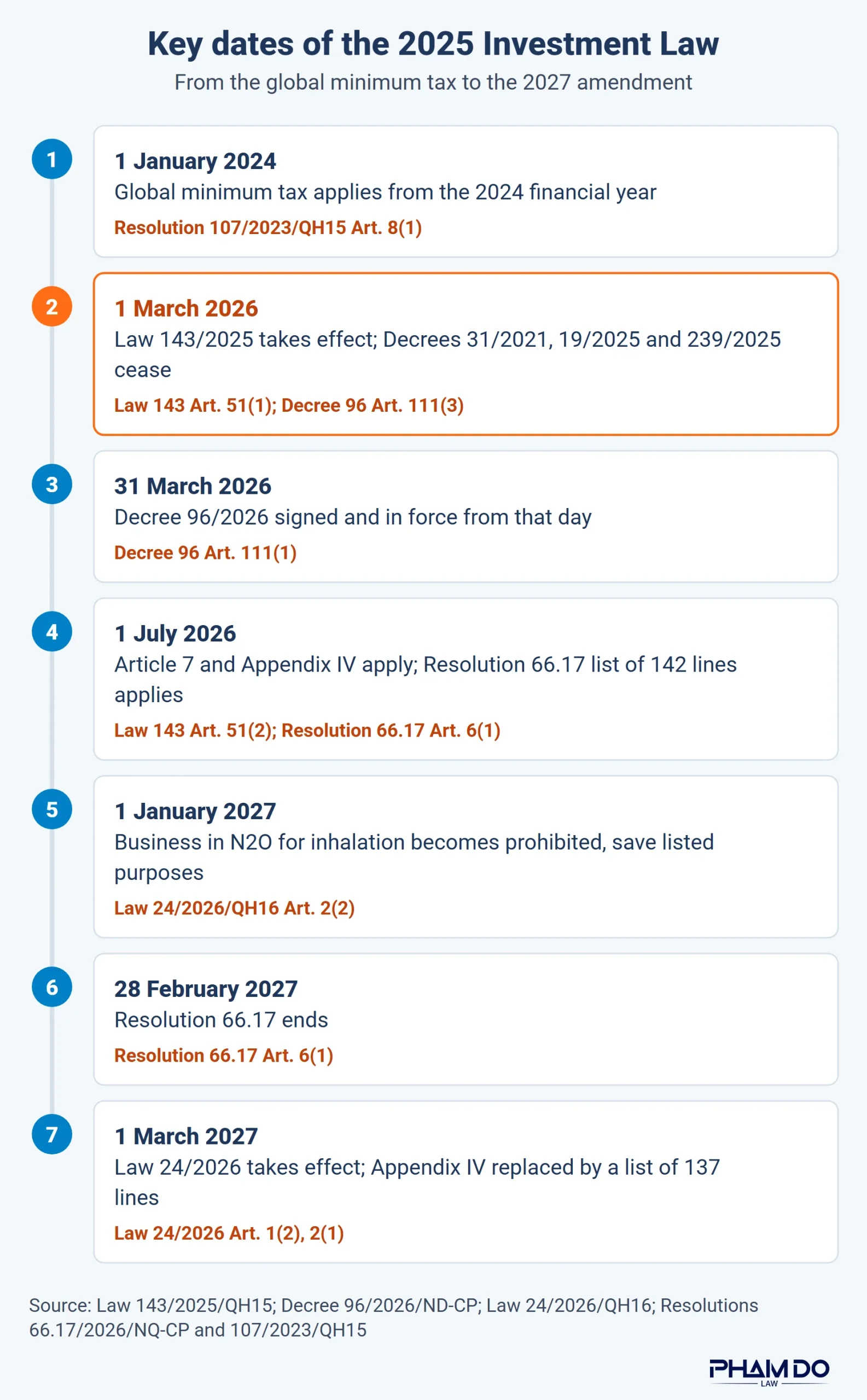
| 1 March 2026 | The 2025 law takes effect. The 2020 law ends, except its Article 7 and Appendix IV. Three earlier decrees end. | Law 143, Article 51(1), (4); Decree 96, Article 111(3) |
| 31 March 2026 | Decree 96/2026/ND-CP is signed and takes effect, except its Articles 11 and 12. | Decree 96, Article 111(1) |
| 1 July 2026 | The new Article 7 and Appendix IV apply. Decree 96 Articles 11 and 12 apply. Resolution 66.17/2026/NQ-CP starts. | Law 143, Article 51(2); Decree 96, Article 111(2); Resolution 66.17, Article 6(1) |
| 1 January 2027 | The ban on trading N2O gas for inhalation takes effect. | Law No. 24/2026/QH16, Article 2(2) |
| 28 February 2027 | Resolution 66.17 ends. | Resolution 66.17, Article 6(1) |
| 1 March 2027 | Law 24/2026 takes effect and replaces Appendix IV with a new list. | Law 24, Articles 1(2) and 2(1) |
Older legal normative documents may still refer to an “investment policy decision”. Under Article 51(6), such a reference is now read as investment policy approval under the 2025 law.
The 2020 law and the earlier laws
Under Article 111(3) of Decree 96/2026/ND-CP, three decrees ceased to have effect on 1 March 2026:
- Decree 31/2021/ND-CP of 26 March 2021.
- Decree 19/2025/ND-CP of 10 February 2025.
- Decree 239/2025/ND-CP of 3 September 2025.
Older papers may also cite the Law on Foreign Investment in Vietnam (No. 04/LCT/HĐNN8), passed by the National Assembly on 29 December 1987.
Where to read the official text
Law No. 143/2025/QH15 was published in the Official Gazette No. 42 of 22 January 2026, and Decree 96/2026/ND-CP in No. 215 of 15 April 2026. The consolidated text with the Law 24/2026 changes is VBHN 142/2026/VBHN-LQ-VPQH.
What the 2025 law says for foreign investors at a glance
The 2025 law gives foreign investors five investment forms and the same market access conditions as domestic investors, except lines on the restricted list.
| Topic | What the 2025 law says | Basis |
|---|---|---|
| Investment forms | Five forms: setting up an economic organization; contributing capital or buying shares; carrying out a project; a business cooperation contract (BCC); other forms set by the Government. | Article 18 |
| Setting up a company | A foreign investor may set up the company before the Investment Registration Certificate (IRC) procedure. It must meet the market access conditions when setting it up. | Article 19(2) |
| Market access | The same conditions as domestic investors, except lines on the restricted list the Government publishes. | Article 8(1), (2) |
| Project transfer | Allowed in whole or in part if the project is not terminated, a foreign transferee meets Article 21(2), and the land, housing and real estate conditions and those in its approval or IRC are met. A project with an IRC is transferred through the project adjustment procedure in Article 33. | Article 34(1), (2) |
| Outbound investment | The Ministry of Finance issues the outbound IRC. Large-scale projects, or projects seeking special support, need the Prime Minister’s approval first. Smaller projects outside the conditional outbound sectors only register the foreign exchange transaction. | Articles 41(1), 42 |
| Incentives when the law changes | A higher new incentive applies for the remaining period, except special incentives for projects under Article 17(5)(a). Where the new incentive is lower, the investor keeps the earlier one, except for changes made for defense, security, public order, morals, public health or the environment. | Article 12(1) to (3) |
The conditional outbound sectors are banking, insurance, securities, press and broadcasting, and real estate business (Article 41(1)).
Where the investor cannot keep the earlier incentive because of the defense, security or other listed exception, it may be considered for one or more measures under Article 12(4). These are deducting the investor’s actual damage from taxable income, adjusting the project’s operating objectives, or supporting the investor to remedy the damage. For these measures, the investor must make a written request within 3 years from the date the new legal normative document takes effect (Article 12(5)). The investment registration authority decides on applying a measure within 30 days from receipt of a valid file (Decree 96 Article 4(4)). The guarantee covers investment incentives, not every change in the law. The other guarantees are covered in our guide to foreign direct investment in Vietnam.
Company first, project later under the 2025 law
A foreign investor may now set up its Vietnamese company before it obtains an IRC.
Before 1 March 2026, Article 22(1)(c) of Law No. 61/2020/QH14 required a foreign investor to have an investment project and complete the IRC procedure before setting up a company. The exceptions were innovative start-ups and start-up investment funds. From 1 July 2025, Law No. 90/2025/QH15 added a second exception: new innovation or R&D centers, big data, cloud, 5G and other digital infrastructure in a strategic technology field, and strategic technology projects, under a Prime Minister decision (Article 22(1)(d)).
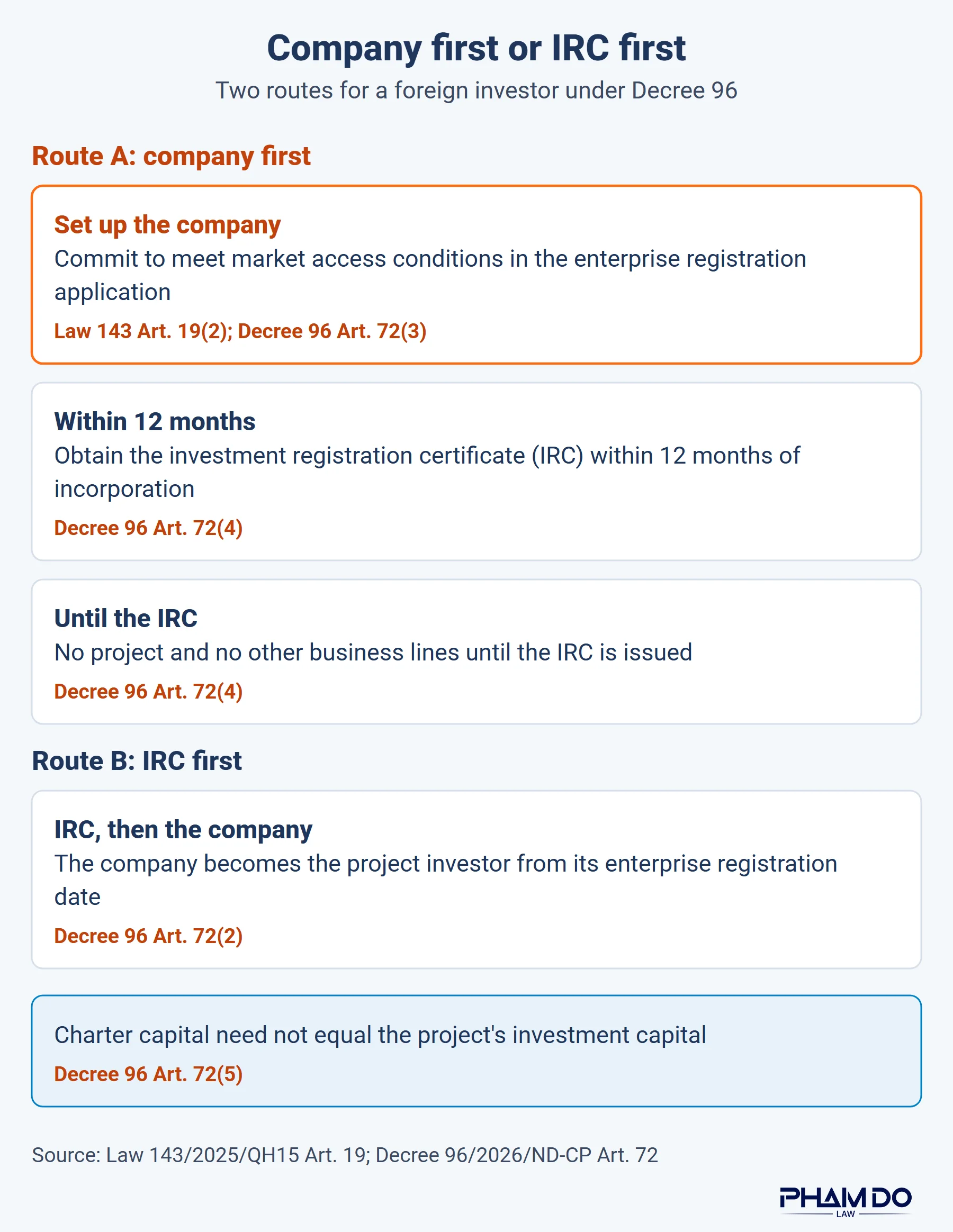
Article 72 of Decree 96/2026/ND-CP sets the rules for the company-first route:
- The enterprise registration application includes a commitment to meet the market access conditions for foreign investors (Article 72(3)).
- Within 12 months from the date the company is set up, it must complete the procedure for an IRC for a project matching its business lines (Article 72(4)).
- Until it has the IRC, the company may not carry out the project or add other business lines to its enterprise registration (Article 72(4)).
- The charter capital need not equal the investment capital of the project (Article 72(5)).
Under Article 72(2), on the IRC-first route the company becomes the investor of the project from the date of its Enterprise Registration Certificate (ERC).
Under Article 26(1) of the 2025 law, a foreign investor’s project needs an IRC. Contributing capital or buying shares in a Vietnamese company does not (Article 26(2)(c)). Zone management boards license projects inside industrial parks, export processing zones, high-tech parks, concentrated digital technology zones and economic zones (Article 27). The Department of Finance licenses projects outside them. Both exclude the cases in Article 27(3).
A foreign-invested company already in Vietnam does not need a new company for a new project (Article 20(3)). Our guides on investment and enterprise registration certificates, on how to set up a company in Vietnam and on choosing an LLC or JSC cover the filings in detail.
What the investment registration certificate file needs
For a project that does not need investment policy approval, the file follows Article 32(1) of Decree 96 (Article 39(1)). Two documents in it take the most preparation:
- A location document. Where the investor does not ask the State for land, this is a copy of its land use papers or another document showing its right to use the site (Article 32(1)(đ)), such as a site lease agreement (Article 39(3)(b)).
- Proof of financial capacity: at least one of its financial statements for the last 2 years, a financial support commitment from its parent company or a financial institution, a financial capacity guarantee, or another document (Article 32(1)(c)).
The financial statements need not be audited, and a commitment or guarantee need not state a term (Article 6(7)). Financial capacity is a file document, not one of the conditions for issuing the IRC in Article 39(3).
In our experience, individual foreign investors often find the proof of business location and the proof of financial capacity a hassle, while large multinational groups want a more formal and safer way to invest.
Buying into a Vietnamese company
Under Article 21(3) of the 2025 law, a foreign investor buying into a Vietnamese company registers with the investment registration authority, before the change of members or shareholders, only where:
- the purchase raises foreign ownership in a company trading in a line open to foreign investors with conditions;
- foreign investors will hold over 50% of charter capital, either rising from 50% or less, or rising further from over 50%;
- the company holds land use right certificates on an island, in a border or coastal commune or ward, or in another area affecting defense and security.
Decree 96 Article 76(4) sets 10 working days from receipt of a valid file for the first two cases. The third case adds consultation steps (Article 76(5)). In every other case, the company goes straight to registering the change of members or shareholders with the business registration authority (Article 76(2)).
Where the Vietnamese company was set up long ago, it often carries legal, tax and financial risks, so a foreign investor needs extra time and cost to review its legal and financial position in full before contributing capital or buying shares.
When a company follows the foreign-investor rules
Under Article 20(1) of the 2025 law, a company in which foreign investors hold over 50% of charter capital follows the foreign-investor conditions and procedures when it invests in another company or carries out another project. The test also counts holdings through such companies. A partnership follows those conditions too when most of its general partners are foreign individuals.
Market access for foreign investors under Decree 96
Under Article 8(1) and (2) of the 2025 law, the restricted list has two groups. Some lines are not yet open to foreign investors and others are open with conditions.
Appendix I to Decree 96/2026/ND-CP is the list:
| Part of Appendix I | Meaning | Number of lines |
|---|---|---|
| Part A | Not yet open to foreign investors | 23 |
| Part B | Open to foreign investors with conditions | 62 |
Under Article 8(3), the conditions in Part B can concern the foreign ownership ratio of charter capital, the investment form, the scope of activities, the capacity of the investor and its partners, and other conditions. Example: line 23 of Part A lists travel services as not yet open to foreign investors, except international travel services for international tourists coming to Vietnam.
A foreign investor should check its intended line against both parts before filing. Until 28 February 2027, Resolution 66.18/2026/NQ-CP removes some maritime business conditions and caps foreign capital at 49% of charter capital for ship agency and towage (Part B, line 51) and domestic sea transport (Part B, line 44). Cargo handling (Part B, line 43) is allowed only through a joint venture within Vietnam’s WTO commitments. Market access is covered in more detail in our guide to foreign direct investment in Vietnam.
Prohibited and conditional business lines in 2026 and 2027
Under Article 6(1)(l) of the Law on Investment 2025, trading in e-cigarettes and heated tobacco products is a prohibited business line. From 1 January 2027, Law No. 24/2026/QH16 will add point (m): trading in N2O gas for human inhalation, except for medical, food technology, testing, research and other purposes set by the Government.
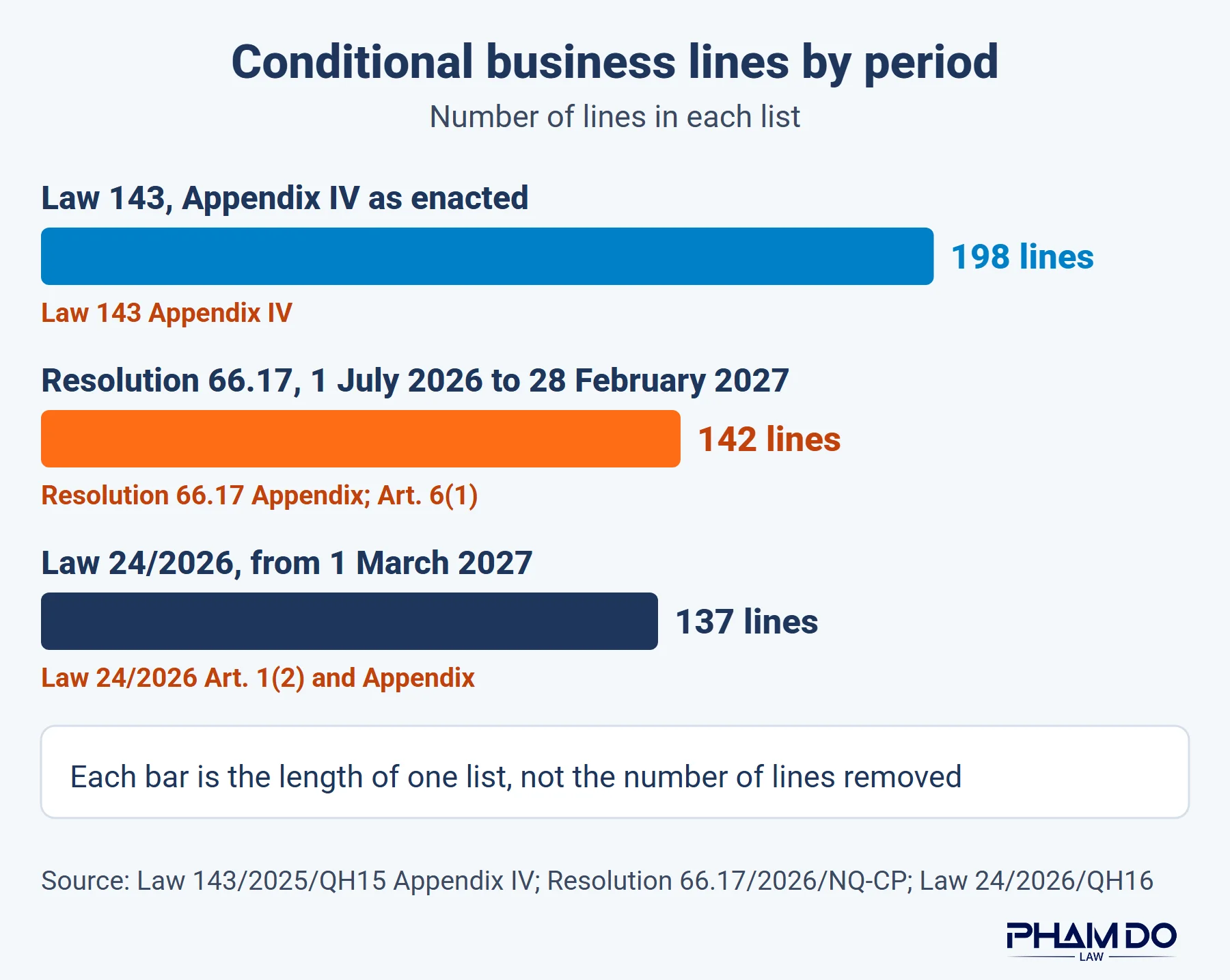
Three lists of conditional business lines apply in turn:
- Appendix IV of the 2025 law, with 198 lines, took effect on 1 July 2026 (Article 51(2)).
- Resolution 66.17/2026/NQ-CP cuts and amends the list, with 142 lines, from 1 July 2026 to 28 February 2027 (Article 6(1)).
- Law No. 24/2026/QH16 will replace Appendix IV with a new list of 137 lines from 1 March 2027 (Articles 1(2) and 2(1)).
Until 28 February 2027, where Resolution 66.17 differs from other legal documents on conditional business lines, the resolution applies (Article 6(3)). If a law on the same lines takes effect during that window, the matching parts of the resolution end from that date (Article 6(2)).
Where a conditional business line requires it, further licences must be obtained after the enterprise registration certificate is issued, so investors should check those conditions with a lawyer before deciding to set up the company. Our guide to business licenses for conditional lines lists the common sector licenses.
Which projects still need investment policy approval?
Investment policy approval is needed for the 20 cases listed in Article 24 of the Law on Investment 2025. Three cases matter most to foreign investors:
- a foreign investor’s project in telecoms services with network infrastructure, afforestation, publishing or press (Article 24(7));
- a project asking the State to allocate or lease land without an auction or tender, or to change the land use purpose (Article 24(8));
- building and operating the infrastructure of an industrial park, export processing zone or concentrated digital technology zone (Article 24(14)).
Under Article 25, the approving body is the National Assembly, the Prime Minister, the chair of the provincial People’s Committee, or the zone management board for listed projects inside zones that match the approved planning. For policy approval given together with investor approval, Decree 96 Article 38(1)(a) sets 5 working days for the IRC, from the day the authority receives the approval decision. For the approval route, see our guide to foreign direct investment in Vietnam.
The special investment procedure
Under Article 28 of the 2025 law, the special investment procedure is optional. It covers projects in industrial parks, export processing zones, high-tech parks, concentrated digital technology zones, free trade zones, international financial centers and functional areas of economic zones. Decree 96 Article 46(1) excludes only projects under Article 24(5), (6), (11), (12), (13), (15), (16), (17), (18) and (20) of the law carried out in economic zones or free trade zones, and projects under Article 24(14) of the law.
A project on this route skips policy approval, technology appraisal, the environmental impact assessment report, detailed planning, the construction permit and the construction and fire safety approvals. Instead, the investor commits in writing to meet the conditions, standards and regulations (Article 28(2)). The zone management board issues the IRC within 15 working days from receipt of the file (Decree 96 Article 47(5)(b)). Before construction starts, the investor sends a notice with an economic and technical report (Article 28(3)).
Changing a licensed project under the 2025 law
An investor must amend its IRC when a change to the project alters the main content of the project stated in the certificate (Article 33(2) of the Law on Investment 2025). Where no approval adjustment is needed, Decree 96 Article 56 sets two time limits:
- 3 working days from receipt of the request, for a change of project or investor name on the IRC (Article 56(1)(b)).
- 7 working days from receipt of a valid file, for other changes (Article 56(2)).
For a project without policy approval, the 3-day limit also applies to progress or operating term after late land allocation or handover (Decree 96 Article 28(5)) or a location update after the reorganization of administrative units. A project approved by the provincial chair or a zone board follows Articles 53(3) and 54(5) instead.
A project that already has investment policy approval needs an approval adjustment in the cases in Article 33(3):
- a change to the contents or objectives that required approval and are stated in the approval;
- a change in land area as set by the Government, or a change of location;
- an extension of progress beyond 24 months;
- a change in the operating term;
- a change of investor of a project approved together with investor approval, made before the project operates, or a change in the conditions on the investor.
For land, Decree 96 Article 51(3)(b) sets the threshold at over 10% or over 30 hectares of land allocated or leased without auction or tender. The 2020 list also covered a capital change of 20% or more that changed the project’s scale, and a change in appraised technology (Article 41(3)(c), (e) of Law No. 61/2020/QH14). Neither is named in the 2025 list. The texts do not settle whether Article 33(3)(a) covers them.
Under Article 33(4), a policy-approved project may not extend its progress by more than 24 months beyond the first approval, except in cases (a) to (g). The 2020 law had the same limit, but it required an approval adjustment for an extension beyond 12 months (Article 41(3)(d) of the 2020 law).
Where a company adds a business line that has to be shown on both its IRC and its ERC, the timing matters. It is best to finish amending both certificates before starting the new business line. Our guide to investment and enterprise registration certificates covers both amendments.
Project term and extension
Under Article 31 of the 2025 law, a project may run for up to 70 years in an economic zone and 50 years elsewhere. Some projects outside economic zones may run up to 70 years, such as those in areas with difficult conditions or with special incentives.
It runs from the first IRC or approval decision, or from the land decision where the State allocates or leases land (Decree 96 Article 28(1)). The investor may lengthen or shorten it within the limit (Article 31(4)). At expiry, it may be considered for extension if the investor wishes to continue and meets the conditions of law, except for projects with outdated, polluting or resource-intensive technology, or whose assets pass to the State without compensation (Article 31(5)). In the 12 months before expiry, a project below the 50 or 70-year maximum may choose adjustment or extension (Decree 96 Article 28(8)); a project already at the maximum must also fit a plan and, where land is involved, meet the conditions for land allocation or lease (Article 28(9)).
What does Decree 96/2026 add to the 2025 law?
Under Article 39(3) of Decree 96, the investment registration authority issues the IRC within 10 working days from receipt of a valid file, where the project meets six conditions:
- it is not in a prohibited business line under Article 6 of the law or a treaty on investment;
- it has a location;
- it fits the planning referred to in Article 32(7) of the decree;
- it meets the provincial rules on investment per area of land and number of workers, if any;
- it meets the market access conditions for foreign investors;
- it meets the technology conditions, where the project needs an opinion on technology.
The same article lets the authority consult local state agencies where needed. Because the licensing authority often consults specialised agencies and the locality to check that the project fits local planning and development, the time to issue an investment registration certificate can run longer than the statutory limit depending on the province.
For a project that does not need policy approval, the investor may file on paper or online through the National Investment Information System, with or without a digital signature (Article 42(1)). On the digital-signature route, a valid online file is decided within 10 working days from receipt (Article 43(1)(đ)). The online declaration lapses unless the authority receives the file within 10 working days of the declaration date (Article 41(1)). Without a digital signature, the online file lapses unless the paper file arrives within 30 days of the notice that it qualifies (Article 43(2)(e)). Our guide to investment and enterprise registration certificates covers the forms.
Investment incentives under the 2025 law
Incentives go to projects in preferential sectors or areas, large-capital or labor-intensive projects, and the other cases in Article 14(1) of the Law on Investment 2025. They are time-limited and based on the project’s results (Article 14(8)).
Under Article 14(2), the incentive forms are:
- corporate income tax incentives;
- import duty exemption for goods imported to form fixed assets;
- exemption from or reduction of land use fees, land rent and land use tax;
- accelerated depreciation and higher deductible expenses.
Support can also cover green transition, emission reduction and climate adaptation (Article 14(3)(h)). Priority sectors in Article 15(1) include science and technology, semiconductors, the green economy, renewable energy, infrastructure, education and health.
The preferential areas in Article 15(2)(b) include zones and parks. Decree 96 Article 22(7) sets the level each one receives:
| Area | Incentives at the level of |
|---|---|
| Industrial parks, industrial clusters, export processing zones | An area with difficult socio-economic conditions |
| Economic zones, high-tech parks, hi-tech agriculture zones, concentrated digital technology zones, free trade zones, international financial centers | An area with especially difficult socio-economic conditions |
Four rules apply to incentives:
- The investor must meet the conditions throughout the incentive period (Article 14(8)), and loses the incentive for any period it does not (Decree 96 Article 23(3)).
- A project that qualifies for several levels receives the highest one (Article 14(9)).
- Area-based incentives do not cover mineral extraction, goods subject to special consumption tax except cars, aircraft and yachts, or commercial housing (Article 14(7)).
- A project without an IRC or approval decision determines its own incentives and applies to the tax, customs or land authority (Decree 96 Article 24(4)).
A project of VND 6,000 billion or more qualifies for incentives if it disburses at least VND 6,000 billion within 3 years from its IRC or approval. It must also reach revenue of VND 10,000 billion a year, or employ 3,000 or more regular workers on average, within 3 years from its first revenue year (Decree 96 Article 19(3)). Incentives by sector, area and investment route are covered in our guide to foreign direct investment in Vietnam.
Special incentives
Article 17 of the 2025 law sets special incentives, and Decree 96 Article 21(1) sets the thresholds:
| Project | Total capital | Disbursement |
|---|---|---|
| Innovation or R&D centers, big data, cloud and 5G infrastructure | VND 3,000 billion or more | VND 1,000 billion within 3 years |
| Semiconductor chips, AI data centers, key digital products | VND 6,000 billion or more | VND 6,000 billion within 5 years |
| Projects in sectors with special investment incentives | VND 30,000 billion or more | VND 10,000 billion within 3 years |
Disbursement runs from the IRC or the approval. Tax and land incentive levels follow the corporate income tax law and the land law (Decree 96 Article 21(2)). Special incentives do not apply to projects that received an investment certificate, IRC or policy decision before 1 March 2026 (Article 17(5)(a)).
Global minimum tax under Resolution 107
Vietnam has applied a global minimum tax since 1 January 2024 under Resolution 107/2023/QH15. It covers constituent entities of multinational groups with consolidated revenue of EUR 750 million or more in at least 2 of the 4 years before the fiscal year, subject to listed exceptions (Article 2(1)). The minimum rate is 15%.
Decree 236/2025/ND-CP guides the resolution. It took effect on 15 October 2025 and applies from fiscal year 2024. The Law on Investment 2025 itself does not use the term global minimum tax.
The Investment Support Fund
Under Article 16 of the 2025 law, the Government sets up an Investment Support Fund. Its purpose is to stabilize the investment environment, attract strategic investors and multinational groups, and support domestic businesses.
When it was issued on 31 December 2024 under the 2020 law, Decree 182/2024/ND-CP set the Fund’s source as an amount matching the full additional corporate income tax collected under the global anti-base erosion rules (Article 35(1)(a)).
What happens to projects licensed before 1 March 2026, and what changes on 1 March 2027?
A project licensed before 1 March 2026 continues under the license, certificate or approval it already holds (Article 52(1) of the Law on Investment 2025). The transition rules are:
- No new policy approval for a project approved, lawfully under way, won at auction or tender, or licensed before that date (Article 52(2)).
- If a later change needs policy approval under the 2025 law, the investor follows the 2025 law. If the project no longer needs approval, no approval adjustment is needed unless the investor wants one (Article 52(3)).
- A foreign-invested company with better market access than the restricted list keeps the conditions in its IRC (Article 52(9)).
- Old investment licenses and certificates have the same legal value as an IRC (Decree 96 Article 101(2)).
- An investor may exchange an old license for an IRC. The authority issues it within 3 working days from receipt of the file (Decree 96 Article 109(1)).
- A company whose investment license also served as its business registration need not switch to an ERC (Decree 96 Article 109(2)).
Our guide to investment and enterprise registration certificates covers exchanging an old license for an IRC.
To update the project location after the reorganization of administrative units and two-tier local government, the investor files a written request with an explanation (Decree 96 Articles 53(3)(a), 54(5)(a) and 56(1)(a)). The update is not a change of location (Decree 96 Article 51(3)(c)). For a project approved by the provincial chair, the authority reports to the chair within 2 working days of a valid file, and the chair decides without the steps in Article 53(2) (Article 53(3)). For a zone board approval, the board decides within 5 working days (Article 54(5)).
From 1 March 2027, for lines removed from the conditional business list, Article 3(3) of Law No. 24/2026/QH16 provides that:
- companies and individuals may trade in them without meeting business conditions;
- if they wish, they may keep using existing licenses until these expire, without renewal or amendment;
- pending applications validly received before 1 March 2027 will be stopped and returned to the applicant.
Legal basis for the Vietnam Investment Law 2025
- Law on Investment No. 143/2025/QH15, in force from 1 March 2026.
- Law No. 24/2026/QH16 amending the Law on Investment, in force from 1 March 2027, except its N2O provision, which applies from 1 January 2027.
- VBHN 142/2026/VBHN-LQ-VPQH, the consolidated Law on Investment with the Law 24/2026 changes, Official Gazette No. 527-VBHN of 25 September 2026.
- Decree 96/2026/ND-CP guiding the Law on Investment, in force from 31 March 2026.
- Decree 19/2026/ND-CP on investment supervision and evaluation.
- Decree 31/2021/ND-CP, Decree 19/2025/ND-CP and Decree 239/2025/ND-CP, which ceased to have effect on 1 March 2026 (Decree 96 Article 111(3)).
- Resolution 66.17/2026/NQ-CP on conditional business lines, from 1 July 2026 to 28 February 2027.
- Resolution 66.18/2026/NQ-CP on business conditions, until 28 February 2027.
- Resolution 107/2023/QH15 on the global minimum tax, in force from 1 January 2024, and Decree 236/2025/ND-CP guiding it.
- Decree 182/2024/ND-CP on the Investment Support Fund, issued under the 2020 law.
- Law on Investment No. 61/2020/QH14, which ceased to have effect on 1 March 2026, cited for comparison only.
- Law No. 90/2025/QH15, which added Article 22(1)(d) to the 2020 law from 1 July 2025.
- Law on Foreign Investment in Vietnam No. 04/LCT/HĐNN8 of 29 December 1987, cited as history only.
Frequently asked questions on the Vietnam Investment Law 2025
What are foreign investment restrictions in Vietnam?
Pham Do Law Firm’s answer: They are the lines in Appendix I to Decree 96/2026/ND-CP: 23 not yet open to foreign investors and 62 open with conditions. The conditions can cover ownership ratio, investment form, scope, and investor capacity (Article 8(3) of the Law on Investment 2025).
Who is subject to global minimum tax in Vietnam?
Pham Do Law Firm’s answer: Constituent entities of multinational groups with consolidated revenue of EUR 750 million or more in at least 2 of the 4 years before the fiscal year, with listed exceptions. The minimum rate is 15% (Resolution 107/2023/QH15).
Pham Do Law Firm’s answer: Yes, quarterly and yearly, to the investment registration authority and the statistics agency, through the National Investment Information System (Article 47 of the 2025 law). Quarterly reports are due before the 10th of the first month of the next quarter, annual reports before 31 March (Decree 96 Article 94). Investors in projects using no state capital also file supervision and evaluation reports under Decree 19/2026/ND-CP Article 94(8), with deadlines in Article 94(11)(a) as amended by Decree 96 Article 99(6).
Where can I find the Vietnam Investment Law 2025 PDF?
Pham Do Law Firm’s answer: The Vietnamese text of Law No. 143/2025/QH15 is on thuvienphapluat.vn. It was published in Official Gazette No. 42 of 22 January 2026. The consolidated text with the Law 24/2026 changes, VBHN 142/2026/VBHN-LQ-VPQH, is also on thuvienphapluat.vn.
What is Decree 96/2026/ND-CP?
Pham Do Law Firm’s answer: It is the Government decree guiding the Law on Investment 2025, in effect since 31 March 2026.
How long does a company set up before its IRC have to obtain one?
Pham Do Law Firm’s answer: 12 months from the date it is set up (Decree 96 Article 72(4)).
Investment advice from Pham Do Law Firm
Pham Do Law Firm offers a company incorporation service for foreign investors who want to set up a company in Vietnam under the 2025 law. Investors weighing the wider options can read our guide to foreign direct investment in Vietnam or contact our lawyers. The licensing authority decides each file, and no outcome is guaranteed.
This is Pham Do Law Firm’s advice on the Vietnam Investment Law 2025 as of 18 November 2026. Contact Pham Do Law Firm for advice on your specific situation.