
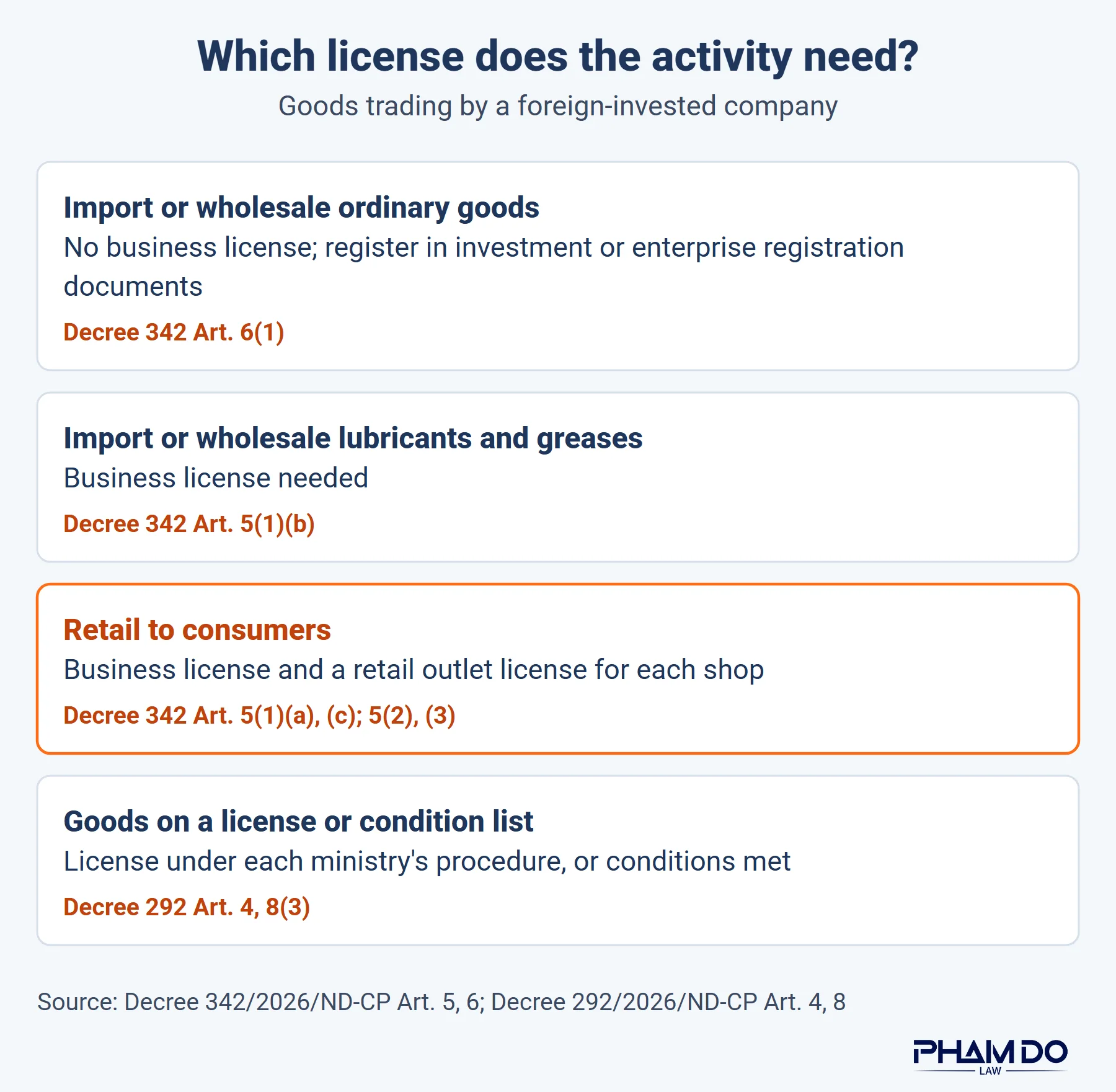
A foreign-invested company in Vietnam needs no business license to import or wholesale ordinary goods. Decree 342/2026/ND-CP replaced Decree 09/2018/ND-CP on 18 October 2026. Under Decree 342 Article 6(1), the company registers those activities in documents under the Investment Law or Law on Enterprises. Retail needs a business license and an outlet license per shop, and listed goods need import licenses or must meet conditions.
Trading rights of foreign-invested companies in Vietnam
A foreign-invested trading company trades goods in Vietnam by exercising three rights: the export right, the import right and the distribution right (Decree 342 Article 3(2)). Wholesale of ordinary goods only needs registration, while retail needs a business license and an outlet license.
Under Article 8(1) of the Investment Law 2025 (Law No. 143/2025/QH15), foreign investors get the market-access conditions of domestic investors, except in the sectors on the Government’s restricted list.
Decree 96/2026/ND-CP puts goods trading by foreign service suppliers on that list as a sector with conditional market access (Annex I, Part B, item 23). It closes to foreign investors the export, import and distribution of goods on the list that foreign-invested companies may not trade (Annex I, Part A, item 15).
Goods trading by foreign service suppliers is also on the conditional business list of Law 143 until 28 February 2027. The replacement list in Law No. 24/2026/QH16, which applies from 1 March 2027, no longer includes it.
Law 24 Article 3(3)(a) then lets businesses trade in lines dropped from the list without meeting investment business conditions. Point (b) keeps licenses already issued usable until they expire. Under point (c), permit files in those lines that were validly received before 1 March 2027 and are still pending are returned. Whether these points cover Decree 342 licenses is open.
Under Law 24 Article 2(3), ministries set replacement measures where necessary before 1 March 2027.
| Right | What Decree 342 says | Basis |
|---|---|---|
| Export right | Buy goods in Vietnam to export, and stand as declarant on the export declaration. It does not cover buying from non-traders. | Article 3(4) |
| Import right | Import goods to sell to traders that hold the distribution right. On its own, it does not let the company organize or join a distribution system. | Article 3(5); Law on Foreign Trade Management (Law 05/2017) Article 5(2)(c) |
| Distribution right | Wholesale, retail, sales agency and franchising in the distribution field. | Article 3(6), (7) |
Under Decree 342, these limits apply unless Vietnamese law or a treaty provides otherwise.
Import and export rights
Under Article 3(2) of Decree 292/2026/ND-CP, a foreign-invested company may directly import machinery, materials and other goods for the project in its investment registration certificate (IRC), and export its own products.
Decree 342 lets a company holding the export or import right trade only goods outside the prohibited, suspended and treaty-excluded lists. Within those limits, an export rests on the registered export right. Goods on the export-by-license or by-condition lists also need the license or must meet the conditions (Article 7(1), (2)). The ministry or ministry-level agency in charge issues those licenses under its procedure (Decree 292 Article 8(3)).
Distribution, wholesale and retail rights
Wholesale sells goods to wholesalers, retailers and other traders or organizations, including wholesale agency. Retail sells goods to individuals, households and other organizations for consumption, including retail agency. A retail outlet is a place where retail happens. Vending machines and mobile sales vehicles are not outlets.
A company with the wholesale or retail distribution right may sell goods made or processed in Vietnam and goods lawfully imported (Decree 342 Articles 3(8) to (10) and 7(4)).
When does a foreign-invested company need a business license?
Under Decree 342/2026/ND-CP, a foreign-invested company in Vietnam needs a business license, or trading license, for retail, and for importing or wholesaling petroleum-based lubricants and greases.
Export, import and wholesale of other goods need no business license: the company may carry them out once registered in its investment or enterprise registration documents, within the limits above. For rice, sugar, recorded items, and books, newspapers and magazines, Decree 342 provides only for a retail distribution license, covered under goods outside Vietnam’s commitments.
For example: if a foreign-invested company imports petroleum-based engine oil to sell to local distributors, it needs a business license; for machine parts sold the same way, registration is enough.
The enterprise registration certificate (ERC) lists no business lines under the Law on Enterprises (consolidated No. 67/VBHN-VPQH), so business-line changes are notified.
The business license also covers logistics sub-sectors outside Vietnam’s commitments, leasing goods (not finance leasing, and except construction equipment with an operator), trade promotion (not advertising), commercial intermediary services (not wholesale or retail agency), e-commerce platforms and tender services.
Both licenses are issued to foreign-invested economic organizations, meaning those with a foreign investor as a member or shareholder.
A company must also meet the conditions and follow the same procedures if over 50% of its charter capital is held by foreign investors, by a company that is itself over 50% foreign-held, or by the two together. The same applies to a partnership whose general partners are mostly foreign individuals.
| Rule | Basis |
|---|---|
| Retail, lubricants, greases and other licensed activities | Decree 342 Articles 5(1)(a) to (i), 9(4)(c) |
| The ERC lists no business lines | Law on Enterprises Articles 28, 31(1)(a) |
| Who receives both licenses | Law 143 Articles 3(22), 20(1)(a) to (c); Decree 342 Article 5(1), (2), (5) |
Treaty and non-treaty investors
Under Article 9(1) of Decree 342, an investor from a country in a treaty under which Vietnam opened its market must meet that treaty’s market-access conditions throughout operation. The company must also have no overdue tax if it has existed for one year or more. The Ministry of Industry and Trade publishes Vietnam’s treaty commitments on trading where they can be made public.
Non-treaty investors, and goods or services Vietnam has not committed to open, face extra criteria: whether the activity fits the sector law, and how much domestic competition there was in the same field in the year before filing.
In those cases the authority also weighs fit with local, regional and national sector development strategies and Vietnam’s progress in market negotiations and opening. For non-treaty investors, it also weighs foreign relations and national security, order and social safety.
Where a non-treaty investor registers export, import or wholesale activities, the authority consults the provincial People’s Committee before registering them.
| Rule | Basis |
|---|---|
| Extra criteria and consultation | Decree 342 Articles 9(2) to (4), 9(5)(a), (b), 6(2) |
| Treaty commitments published | Decree 342 Article 43(1)(a) |
Before quoting a fee, Pham Do Law Firm always checks whether the client meets the conditions for the license. If the conditions are not met, Pham Do Law Firm declines the work so that the client does not lose time and money. If a condition is not yet met but can be fixed, we advise the client so they can choose whether to fix it and apply for the license.
Goods outside Vietnam’s commitments
Decree 342 names the goods not yet opened under Vietnam’s treaties: petroleum-based lubricants and greases, rice, sugar, recorded items, and books, newspapers and magazines.
For lubricants, the company needs an IRC for a project producing them or producing machinery, equipment or goods that use them, or permission to distribute such machinery, equipment or goods in Vietnam.
For rice, sugar, recorded items, and books, newspapers and magazines, the authority considers a retail license only for a company already licensed to run convenience stores, mini-marts or supermarkets, to sell at those outlets. On the outlet license, the term for trading these goods is 5 years, but no longer than the term for the same goods on the business license (Article 24(2)).
Licenses issued under the old decree
A company holding business or outlet licenses issued before 18 October 2026 keeps carrying out the licensed activities. A later amendment of their content follows the new procedure. The new procedure also applies when a company without a license amends licensable trading or outlets recorded in certificates issued before 15 January 2018.
Files received before 18 October 2026 are handled under Decree 09/2018 and Article 36 of Decree 146/2025/ND-CP. If the authority asks for a supplement on such a file, the company has 6 months from the request to provide it, or Decree 342 applies.
Under Decree 09, the provincial Department of Industry and Trade issued the licenses, consulting the Ministry of Industry and Trade or the sector ministry in some cases. From 1 July 2025, the provincial People’s Committee took over that review.
| Rule | Basis |
|---|---|
| Old licenses and Decree 09 | Decree 342 Article 44(1), (2), (4), (5); Decree 09 Article 8; Decree 146 Articles 36(2), 60(1) |
Buying into a Vietnamese company that already retails
Under Article 5(6) of Decree 342, a Vietnamese company with retail outlets that becomes foreign-invested after receiving capital must obtain the business license and the outlet licenses.
Within 30 days of the document confirming that the foreign investor met the conditions to contribute capital, buy shares or buy capital contributions, it files for the outlet licenses that let its outlets keep trading. That file lists a business license copy only if the company has one.
While that procedure runs, it may keep retailing at its existing outlets until the licenses are issued, for up to 12 months from the same document. For example: if the confirmation document is dated 1 December 2026, retailing at those outlets may continue at most until 1 December 2027. Whether Law 24 (above) changes this from 1 March 2027 is open.
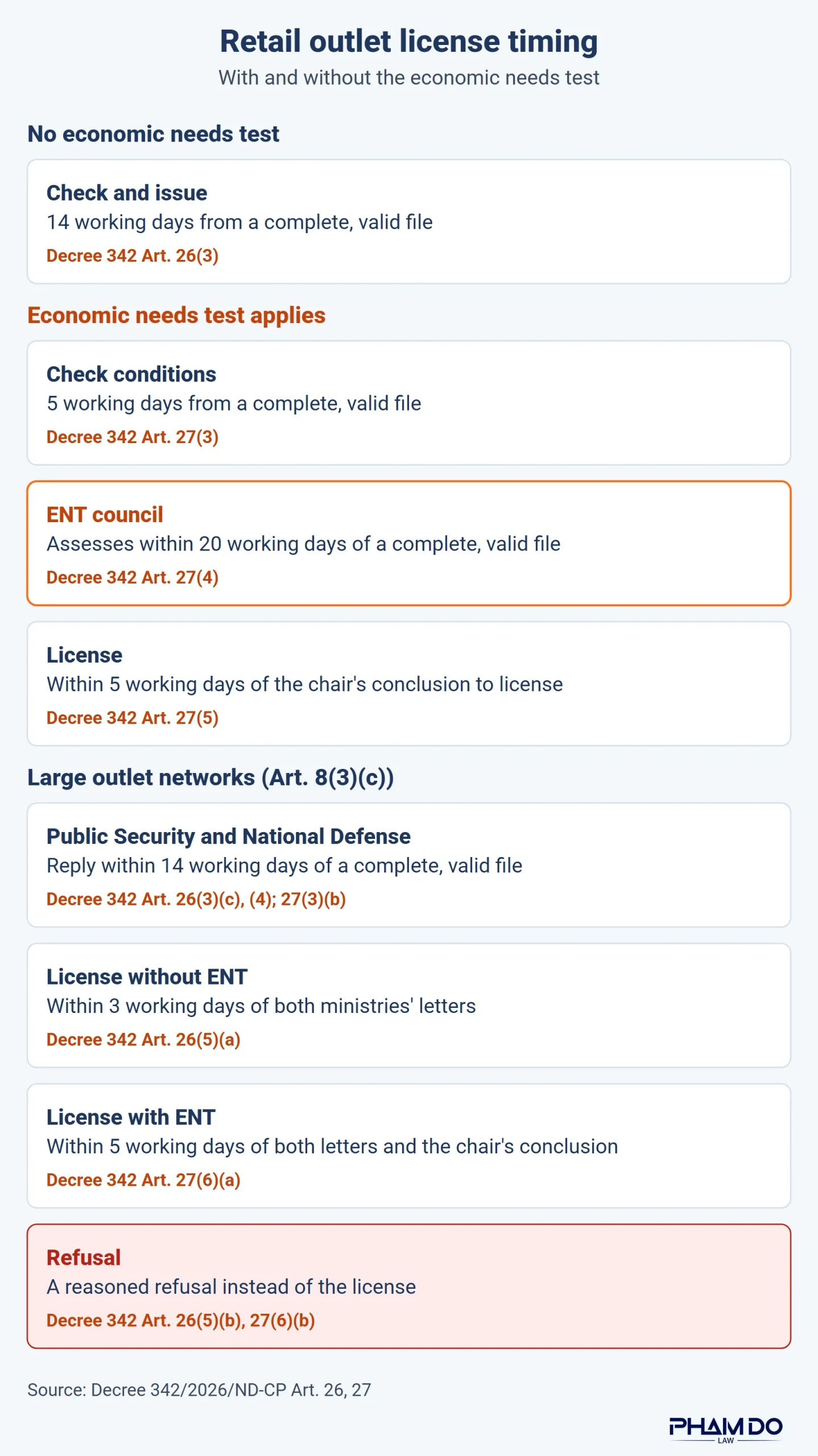
The file includes the outlet’s results and a summary of the company’s results, both based on the audited financial statements of the latest year. The authority decides on these outlet licenses within 14 working days of a complete, valid file.
Large networks have 100 outlets under 500 m², and/or 50 of 500 m² to under 3,000 m², and/or 30 of 3,000 m² or more. For such a network, the authority asks the Ministries of Public Security and National Defense about national security. In that review, both ministries look at a foreign investor buying into such a network or growing one.
That security review adds time: the authority forwards a complete, valid file within 3 working days of receipt. The ministries reply within 14 working days of receipt. The decision follows within 3 working days of both letters.
| Rule | Basis |
|---|---|
| Conversion: file, timing and ministries | Decree 342 Articles 5(6)(c), 8(3)(c), 36(1)(b), (c), (đ), 36(2)(a), (c), (d), (đ) |
Can a foreign-owned company open a shop in Vietnam?
A foreign-invested company, even 100% foreign-owned, can open shops in Vietnam once it holds a business license for retail and a retail outlet establishment license per outlet (Decree 342/2026/ND-CP).
One outlet license per shop
Under Article 8(2) of Decree 342, the provincial People’s Committee where the outlet is issues the outlet license. The company may apply for it only after it holds the business license and the documents for the outlet site. Where the first outlet is in the same province as the head office, it may apply for the business license and the first outlet license together, on Form 02.
Decree 342 lists the shopping mall and three store types by sales area, storage included: a convenience store under 300 m², a mini-mart of up to 500 m² and a supermarket over 500 m².
The outlet license requires no overdue tax, for a company at least one year old, and a site that meets the rules on land, planning, investment, construction, fire safety, traffic safety and environmental hygiene.
The authority also weighs whether the outlet fits sector plans. For non-treaty investors, it adds market opening, foreign relations and security. Before signing the lease, check that the site has the documents the outlet file needs to prove it meets the Article 21(1)(b) rules.
The outlet file includes:
- the application on Form 05;
- the site explanation and site documents, and a 5-year outlet business plan;
- the no-overdue-tax confirmation;
- copies of the ERC and business license, plus a branch or business-location certificate under 500 m², or a branch certificate and the outlet project IRC from 500 m²;
- an explanation of the market-effect and area-contribution criteria, in a case under the economic needs test (ENT).
Decree 342 sets these outlet license time limits without the ENT:
- the authority asks for corrections within 3 working days of receipt and decides within 14 working days of a complete, valid file;
- the authority, within the same 14 working days, sends qualifying files to the Ministries of Public Security and National Defense where the investor owns or co-owns at least a large network;
- the ministries reply within 14 working days of receiving a complete, valid file, and the license or a reasoned refusal follows within 3 working days of both letters.
The outlet license runs for the remaining term of the outlet project’s IRC or of the site lease, whichever is shorter. An extension is filed no earlier than 3 months before expiry and is decided within 10 working days once the file is complete.
| Rule | Basis |
|---|---|
| Outlet license order and store types | Decree 342 Articles 5(3), (4), 19(1), 3(12), (13) |
| Outlet conditions | Decree 342 Article 21(1), (3) |
| Outlet file and ENT explanation | Decree 342 Article 25(1) to (6) |
| Timing without the ENT | Decree 342 Articles 8(3)(c), 26(2) to (5) |
| Outlet license term and extension | Decree 342 Articles 24(3)(a), 35 |
The economic needs test
The ENT applies only to an investor from a country not party to a treaty under which Vietnam committed to abolish it, and only after the investor’s or brand’s first outlet (Decree 342).
Outlets under 500 m² inside a shopping mall are exempt unless they are convenience stores, mini-marts or supermarkets. For example: if such an investor opens a second outlet that is a 400 m² mini-mart inside a shopping mall, the exemption does not cover it, so the ENT applies.
The ENT looks at the market area (commune or ward level under 5,000 m², province level from 5,000 m²), the effect on existing shops and traditional markets, the outlet’s contribution to the area, and security, order and social safety.
With an ENT, the authority checks the conditions within 5 working days. The ENT council assesses the criteria within 20 working days. Both periods run from a complete, valid file. The council chair then concludes for or against licensing, and if the conclusion is to license, the license follows within 5 working days. For a large network, the license or a reasoned refusal follows within 5 working days of both ministry letters and the chair’s conclusion.
| Rule | Basis |
|---|---|
| ENT scope, criteria, timing | Decree 342 Articles 3(11), 22(1), (2), 27(3) to (6) |
Adding import or trading lines to an existing company in Vietnam
A foreign-invested company in Vietnam may add export, import or wholesale activities in ordinary goods only after registering them in its investment or enterprise registration documents, as Decree 342 requires. On the enterprise registration route, this is the business-line change notice to the business registration office, filed within 10 days of the change. Ask the office to confirm the change in writing.
Under Decree 168/2025/ND-CP, the file is the change notice and the decision of the owner, members’ council or shareholders. Within 3 working days of receipt, the provincial office checks the file and, for lines restricted for foreign investors, whether the market-access conditions are met.
Under Law 143, if the new trading objective changes the main content of the project in the IRC, the investor also adjusts the IRC.
The management board of the industrial, export processing, high-tech or economic zone adjusts the IRC for projects inside those zones or a concentrated digital technology zone. The provincial Department of Finance adjusts it for projects outside them.
A project in two or more provinces, both inside and outside such zones, or in a zone with no management board yet goes to the investment registration office. It is the one where the investor sets or plans to set its operating office.
The registering authority adjusts the IRC within 7 working days of a valid file where the change needs no investment policy approval and is outside Decree 96 Article 56(1).
Where the company holds one, a business license states the goods it may trade, so changing them means amending the license.
An amendment is filed within 10 working days of the ERC recording a new name, code, head office, legal representative or owners. For the name, code, address, legal representative or treaty-country owners, the authority decides within 5 working days of a complete, valid file (Decree 342 Article 15(2)(b)). An address changed by the reorganization of provinces needs no amendment of either license (Decree 342 Article 44(3)).
Under Decree 342 Article 15(3) as written, other changes follow the issuing procedure, with the Ministries of Public Security and National Defense consulted. A head office move to another province is the exception: the license is re-issued, as it is when lost or damaged.
Pham Do Law Firm gave this advice for files under Decree 09, when the license required a financial plan. “If the company’s capital is not high and it wants to retail, it has to cut down the number of goods it applies to retail, and apply to add more later when the need is real.”
Decree 342 sets no capital condition for the business license.
| Rule | Basis |
|---|---|
| Business-line change | Decree 342 Article 6(1); Law on Enterprises Article 31(1)(a), (2); Decree 168 Article 49 |
| Authority that adjusts the IRC | Law 143 Article 27(1) to (3)(c) |
| IRC adjusted for main changes | Law 143 Article 33(2) |
| IRC adjusted within 7 working days, no policy approval needed, outside Article 56(1) | Decree 96 Article 56(2) |
| Financial plan required under Decree 09 | Decree 09 Article 9(1)(b) |
| Goods on the business license | Decree 342 Articles 10(1)(d), 13 |
| Business license amendment | Decree 342 Articles 15(1), (2), (3), 12(3)(b), 16, 44(3) |
Selling in Vietnam without your own trading company
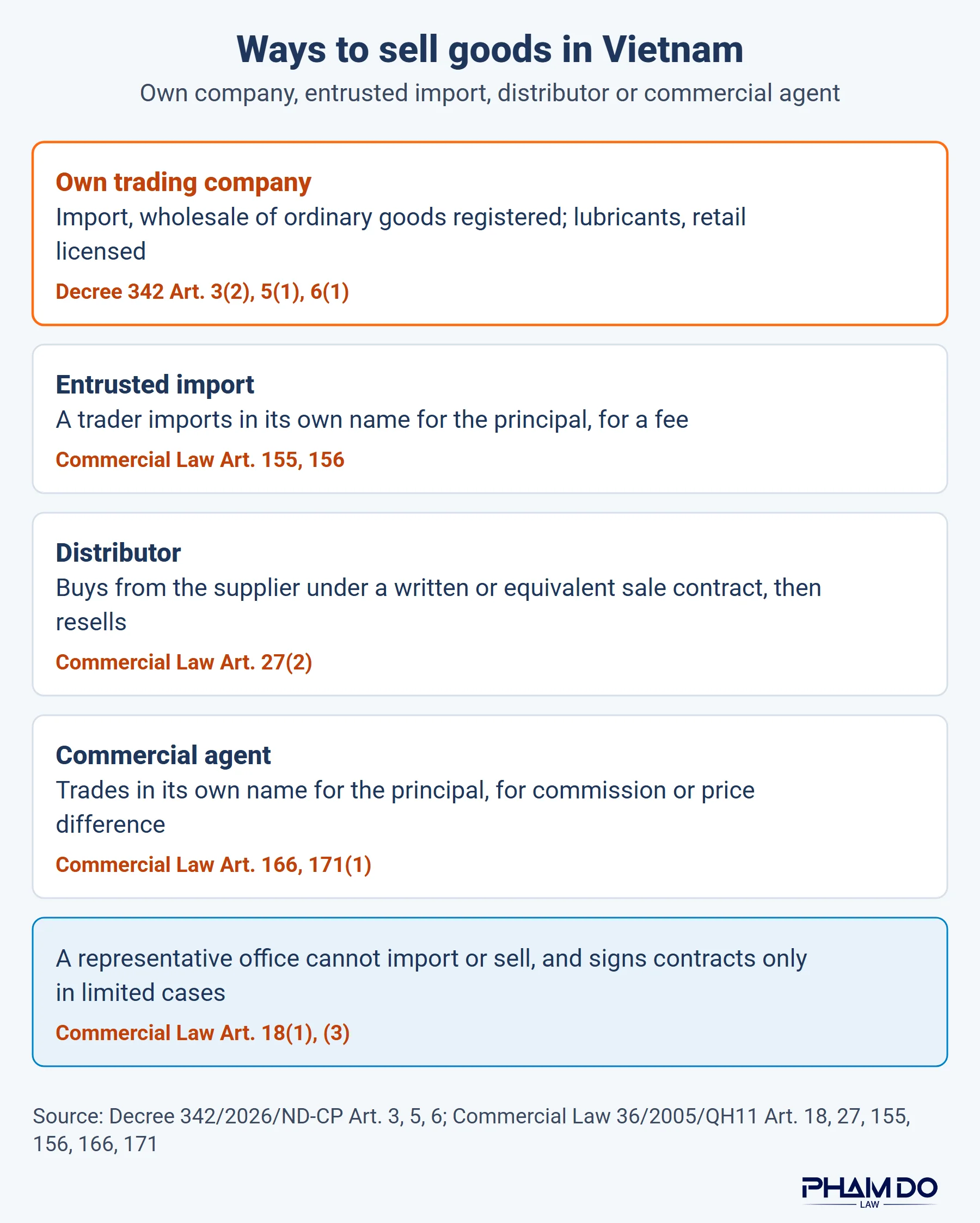
A foreign supplier can sell into Vietnam without its own distribution company. It can use a local importer under entrusted import, a distributor that buys and resells, or a commercial agent.
A foreign trader without presence in Vietnam may trade goods here only within export and import rights the Government sets (Decree 292 Article 3(3)). Decree 90/2007/ND-CP ties those rights to a registration certificate from the provincial People’s Committee (Decree 146 Article 33(1)). Breaches tied to that certificate are fined under Decree 98/2020/ND-CP Article 71. Whether a supplier selling only to a local importer needs one is open.
To distribute itself, a foreign supplier sets up a company in Vietnam that registers its trading activities and, to retail, obtains the business license and an outlet license for each shop.
A representative office cannot fill that role. Under Article 18(1) and (3) of the Commercial Law (consolidated No. 113/VBHN-VPQH), it may not carry out directly profit-generating activities in Vietnam or, except in limited cases, sign contracts. Therefore, it cannot import or sell goods.
Entrusted import and local distributors
Under Articles 155, 156 and 159 of the Commercial Law, in entrusted import a trader buys the goods in its own name on the terms agreed with the principal and earns a fee. The trader must deal in goods that match those entrusted, and the contract must be in writing or an equivalent form.
The Commercial Law does not name a separate distribution contract. A distributor that buys from the foreign supplier and resells signs an international sale contract, which Article 27(2) of the Commercial Law requires in writing or an equivalent form. The supplier should put territory, exclusivity and termination terms in writing.
Before appointing a distributor, check the business lines it has published on the National Business Registration Portal. Register the trademark in Vietnam before the first goods are handed over.
Commercial agents
Under Articles 166 and 171 of the Commercial Law, a commercial agent buys or sells goods in its own name for the principal and, unless agreed otherwise, is paid a commission or a price difference. The agency contract must be in writing or an equivalent form, and the principal keeps ownership of the goods given to the agent.
Agency forms include exclusive agency, with one agent in a given area, and general agency, with the agent running sub-agents.
Unless agreed otherwise, the agency ends no earlier than 60 days after written notice. An agent whose contract the principal ends may, unless agreed otherwise, claim one month’s average remuneration for each year it acted as agent, or one month’s average for an agency under a year. An agent whose contract ends at its request gets no compensation.
| Rule | Basis |
|---|---|
| Agency contract | Commercial Law Articles 168, 169, 170, 177 |
These terms decide what leaving the market costs, so have the distribution or agency contract reviewed before signing.
Import permits for restricted goods in Vietnam
Goods on the import-license list of Decree 292/2026/ND-CP need a Vietnam import license (import permit) from the ministry or agency in charge. Each ministry issues its licenses under its own procedure. Goods on the decree’s conditional list must meet the conditions, and goods subject to inspection must undergo it.
Licenses issued under Decree 69/2018/ND-CP stay valid for their content and term, and ministry circulars guiding Decree 69 apply until 31 December 2026. Amendments to those licenses follow Decree 292. Complete files received before 5 September 2026 follow the old rules (Article 64(5)).
The Law on Foreign Trade Management No. 05/2017/QH14 (Law 05/2017) gives the lists to the Government. Prohibited goods are in Annex I of Decree 292, and licensed and conditional goods in Annex III. Each ministry or ministry-level agency publishes the prohibited goods with Harmonized System (HS) codes, unless existing law already sets those codes.
| Group | Examples in Decree 292 | Basis |
|---|---|---|
| Banned from import | Weapons and military equipment; e-cigarettes and heated tobacco; used consumer goods such as textiles, footwear, electronics and household appliances; used bicycles and motorbikes; used medical equipment | Annex I, Part II |
| Imported under license | Specially controlled chemicals; precursors; goods under automatic import licensing; tobacco materials; civil cryptographic products; drones | Annex III, Part II |
| Imported under conditions | Conditional chemicals; petroleum; tobacco materials; alcohol; liquefied petroleum gas, liquefied and compressed natural gas; cars | Annex III, Part IV |
Cigarettes and cigars are imported only by designated traders (Decree 292 Article 7, Annex II). The Minister of Industry and Trade decides from time to time which goods need an automatic import license. Tariff-rate quota goods are listed in an annex to Circular 48/2026/TT-BCT, and allocation methods include auction, file review, first-come registration and a designated importer.
Under Article 14(2) of Decree 292, a foreign-invested company may not run a temporary import for re-export business. It may use only the other forms in the decree, such as temporary import of goods for warranty, maintenance, lease or borrowing, then re-export of the same goods.
Under Article 14(1) of Law 05/2017, goods under an import or export suspension may, as an exception, be imported or exported for purposes such as research, medical use, or defense and security. Veterinary or plant protection and quarantine law may provide otherwise.
Law 05/2017 gives the Prime Minister the power to allow banned goods to be exported or imported for the same purposes. Under Decree 146, the ministry managing the goods exercises it, except weapons and technical equipment of strategic significance and special professional technical means, which stay with the Prime Minister.
Decree 146 ends on 1 March 2027 unless the National Assembly extends it in whole or in part, and a provision ends earlier if a later act on the same power takes effect before that date. Who exercises this power from 1 March 2027, if Decree 146 is not extended and no later act takes it over, is open.
For banned goods, the trader files with the licensing authority under Decree 292. Decree 342 keeps prohibited and suspended goods outside a foreign-invested company’s export and import rights, so whether these exceptions are open to such a company is unsettled.
For suspended goods, Law 05/2017 has the Minister of Industry and Trade decide the exception. Resolution 66.18/2026/NQ-CP moved that decision to the provincial People’s Committee. Decree 292 cites that resolution point but also repeals it (Article 65(2)(c)), so it is open who licenses these goods.
Before ordering, check each product against the banned list and against any suspension decision. The Minister of Industry and Trade decides suspensions, unless veterinary or plant protection and quarantine law provides otherwise. Without an exception license, a banned or suspended item stays barred.
Decree 292 binds foreign-invested importers and exporters to the Ministry of Industry and Trade’s published goods list and roadmap. The Ministry set its World Trade Organization exclusion list in Circular 34/2013/TT-BCT, consolidated as No. 13/VBHN-BCT.
Circular 34’s Annexes 02 (import right) and 03 (distribution right) listed cigarettes and cigars. Annex 03 included pharmaceuticals and the goods Decree 342 Article 9(4)(d) lets the authority license for retail: rice, sugar, recorded items, books, newspapers and magazines. Whether the annexes still apply is open.
| Rule | Basis |
|---|---|
| Decree 292 transition | Decree 292 Articles 65(1), 64(1), (4), (5) |
| Goods lists and licensing procedure | Law 05/2017 Articles 10(1), 13(1), 31(1); Decree 292 Articles 3(2), 4, 5(1), (2), 8(1) to (4) |
| Tariff-rate quota allocation | Circular 48/2026 Articles 7, 10 |
| Other temporary import and re-export forms | Decree 292 Article 16(1) |
| Banned goods exceptions: license within 5 working days of a complete, valid file, or a written refusal with reasons; banned imports kept or used as registered for at most 2 years; Form BC01 by 31 December each year | Law 05/2017 Article 10(2); Decree 146 Articles 28(1), 60(2); Decree 292 Article 5(3) to (7) |
| Suspended goods licenses: corrections within 3 working days of receipt; file sent to the ministry concerned within 2 working days of a complete, valid file; its reply within 5 working days of the request; decision within 3 working days of the reply. The 2-year limit and Form BC01 also apply. | Decree 292 Article 6(1), (2), (4), (5) |
Rules of origin for goods in Vietnam
Under Law 05/2017 on foreign trade management, Vietnam’s exports and imports need proof of origin when a trader claims treaty tariff preferences or the law requires it. Proof is a certificate of origin (C/O) from an authorized body or, for approved exporters, the trader’s self-certification.
Under Decree 31/2018/ND-CP on the origin of goods, goods have non-preferential origin where they are wholly obtained, or where they meet the product-specific rules set by the Ministry of Industry and Trade. Preservation, sorting, repackaging, labeling, simple mixing and simple assembly are simple processing and are not counted.
Under that decree, the C/O issuer suspends C/O issuance for 6 months where a trader uses forged documents or false declarations.
For goods imported into Vietnam, Law 05/2017 treats evading all or part of a trade remedy measure in force as circumvention. Where the investigating authority finds circumvention, the measure can be widened to goods or components imported from the countries investigated.
Under the Law on Export and Import Duties, origin also decides whether goods get the special preferential import duty rate.
| Rule | Basis |
|---|---|
| Origin rules and C/O suspension | Law 05/2017 Articles 32(1), 33, 34(2); Decree 31 Articles 6, 8, 9, 29(1)(b) |
| Circumvention | Law 05/2017 Article 72(1), (2), (4) |
Tax points for trading companies in Vietnam
A foreign-invested trading company in Vietnam pays import duty and VAT on imports.
Under the Law on Export and Import Duties, import duty applies to goods imported through Vietnam’s border gates and borders, including goods imported by companies exercising trading rights. The owner of the goods, or the import trustee, pays it. The rate is preferential, special preferential or ordinary, depending on the goods’ origin.
Under Article 4(2) of the VAT Law, the importer pays VAT on imported goods. The VAT base is the customs value plus import duty, plus any additional import duty, special consumption tax and environmental protection tax. Exported goods carry VAT at 0%, except some goods such as imported tobacco, alcohol and beer later exported.
| Rule | Basis |
|---|---|
| Import duty and VAT | Law on Export and Import Duties Articles 2(1), (3), 3, 5(3); VAT Law Articles 4(2), 7(1)(b), 9(1)(a), (d) |
How do you apply for a business license in Vietnam?
A foreign-invested company applies to the provincial People’s Committee of its head office for a Vietnam business license once set up and holding any required investment registration certificate (Decree 342 Articles 8(1), 11, 12).
Investment registration
Law 143 lets a foreign investor set up the company before the IRC procedure. At set-up the investor must meet the market-access conditions for foreign investors.
Under Articles 26(1) and 20(1) of Law 143, a project of a foreign investor or of a company caught by the tests above needs an IRC. A foreign-invested company with a new project carries out the investment procedure for it and need not set up a new company. Buying into a retailer follows its own route.
Choose between a limited liability company and a joint stock company (LLC or JSC), then set up a company in Vietnam.
| Rule | Basis |
|---|---|
| Company before IRC; new project | Law 143 Articles 19(2), 20(3) |
Business license file, timing and fees in Vietnam
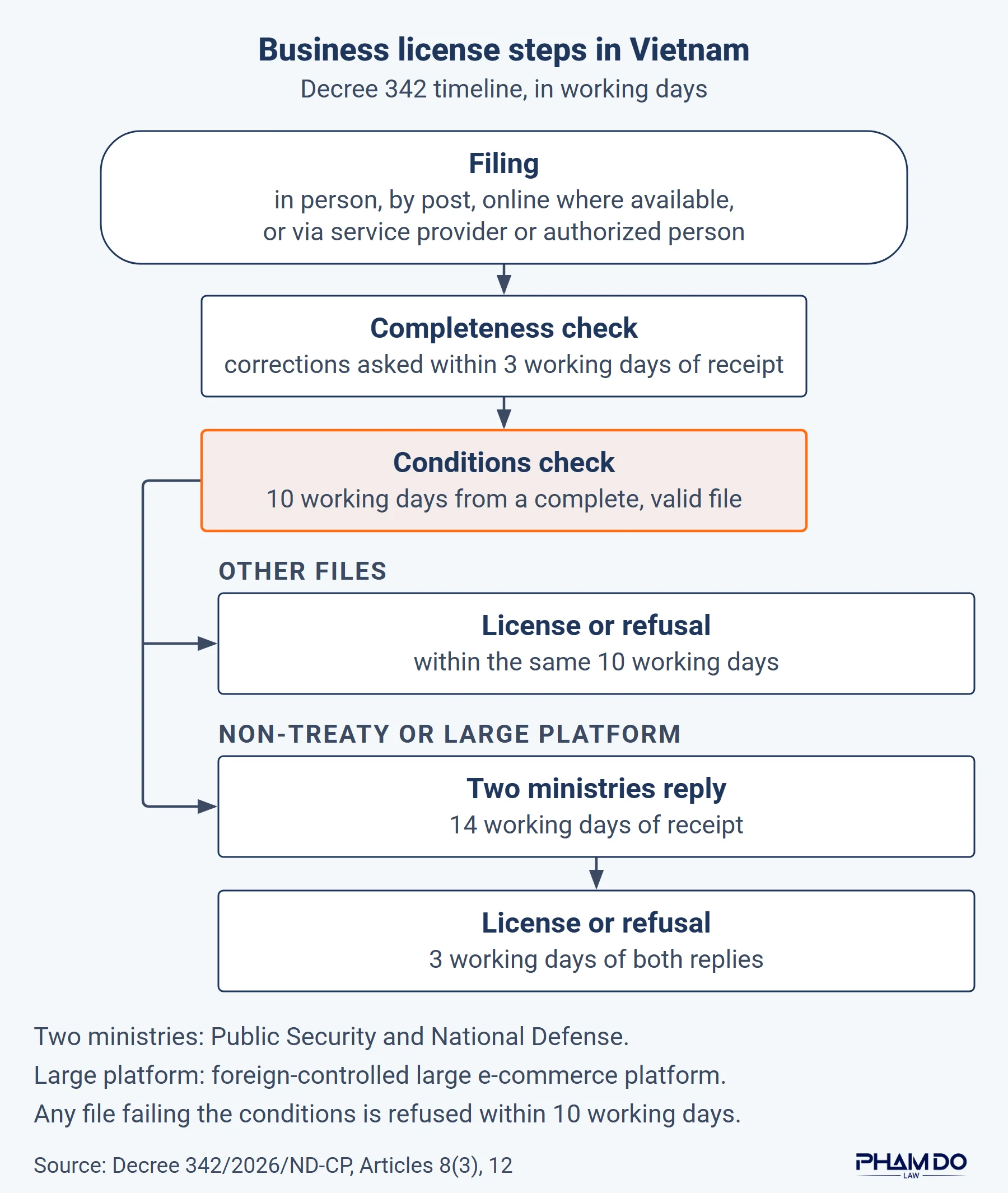
The authority asks for corrections within 3 working days of receiving the file. Within 10 working days of a complete, valid business license file, Vietnam’s provincial People’s Committee decides or, for non-treaty investors and foreign-controlled large e-commerce platforms, consults the Ministries of Public Security and National Defense. If the conditions are not met, the authority refuses in writing, with reasons, within those 10 working days.
The ministries reply within 14 working days of receipt, and the authority decides within 3 working days of both replies.
The Decree 342 business license file contains:
- the application on Form 01;
- an explanation of how the company meets the conditions in Article 9, a 5-year business plan from the year of filing, and, in the Article 5(5) and 5(6) cases, a report on current trading;
- the tax authority’s confirmation of no overdue tax, issued no more than 6 months before filing;
- copies of the ERC and of the IRC for the trading project, if any;
- a copy of the IRC for the project concerned, in lubricant cases (Article 11(5));
- a copy of the convenience store, mini-mart or supermarket outlet license, for the Article 9(4)(d) goods (Article 11(6)).
For both licenses, the tax confirmation and the copies are needed only where the authority cannot pull them from the national and specialized databases.
Under Decree 09, the file had to include a financial plan. Pham Do Law Firm on preparing such files: “The file must explain many points, such as the conditions, the business plan and the financial plan, and this requires additional documents proving that those plans are feasible and reliable.”
Decree 342 asks for an explanation of the conditions and a 5-year business plan, naming no financial plan.
The company files one set in person, by post, through a service provider or authorized person, or online where available. In Nghệ An, the published procedure (Decision 4488/QD-UBND) shows the provincial Department of Industry and Trade advising the People’s Committee.
Files from non-treaty investors, or for goods and services outside Vietnam’s commitments, are also weighed on the extra criteria (Decree 342). The firm’s view of license files in general, from its Decree 09 work: “The file is one of explanation and persuasion, so each official’s view will differ.”
Decree 342 sets no fee for either license, and Nghệ An’s published procedure lists no state fee.
| Rule | Basis |
|---|---|
| Business license file | Decree 342 Articles 8(1), 11(1) to (4), (7), 25(6); Decree 09 Article 12(2)(c) |
| Filing channels | Decree 342 Article 12(1) |
| Timing and ministries | Decree 342 Articles 8(3)(a), (b), 12(2) to (5) |
Keeping a business license valid in Vietnam
A foreign-invested company’s business license runs for the term of its enterprise registration certificate, if any, or 5 years for investors, goods or services outside Vietnam’s treaty commitments (Decree 342 Article 10(2)).
Unlike the outlet license, Decree 342 lists no extension for the business license. If the company does not apply for a new grant, or it is not approved, trading ends on the day the term expires.
Decree 342 sets no separate file or lead time for the new grant, so apply well before that date. A company that will not apply sends the Form 17 notice within 14 working days before expiry.
Every trading foreign-invested company reports on its trading twice a year, before 15 January and 15 July, on Form 14. Reports go in person, by post, through a service provider or authorized person, or online where available (Decree 342 Article 38(1)(a), (c)).
The authority revokes the business license if the company, among other cases, stops trading for over 12 months without reporting, skips the periodic reports for 24 consecutive months, or is fined three times in a row within 12 months for breaching the license (Decree 342).
A company that no longer meets the licensing conditions must pause the licensed trading on the competent authority’s decision. It then has 12 months from the day the authority’s notice takes effect to meet them again. Otherwise the authority ends that trading.
Under Decree 342, the outlet license is revoked if, among other cases, the company still lacks a required IRC 12 months after the license was issued and has not reported, or still lacks it 24 months after issue. After any revocation, the authority refuses that license to the same company if it applies within 2 years.
Under Article 70 of Decree 98/2020/ND-CP, trading outside the business license or outlet license, setting up an unlicensed outlet, or organizing or joining a distribution system against the law is fined VND 30,000,000 to VND 40,000,000.
Trading after either license is revoked, or after it expires without being extended, is fined VND 40,000,000 to VND 50,000,000. At both fine levels illegal profits are surrendered. Decree 98 predates Decree 342 and, for expiry, speaks only of extension.
At the VND 30,000,000 to VND 40,000,000 level, the right to use the license, or the activity itself, can also be suspended for 1 to 3 months. Not amending a license when its content changes is fined VND 20,000,000 to VND 30,000,000. Not reporting to the authority is fined VND 10,000,000 to VND 20,000,000.
| Rule | Basis |
|---|---|
| Business license term; no extension, a new grant at expiry | Decree 342 Articles 8(1), 9(1) to (4), 10(2), 41(1)(b), (c), (2)(b), (c) |
| Lapsed conditions, revocation and the 2-year bar | Decree 342 Articles 40(1)(c), (3), 41(1)(d), 42(1), 42(2)(c), (d), 20(3), 37(2) |
| Fines, suspension and profits | Decree 98 Article 70(1)(c), (2)(a), (3) to (6) |
Legal basis for trading in Vietnam
- Decree 342/2026/ND-CP on trading activities of foreign-invested companies, in force from 18 October 2026.
- Decree 09/2018/ND-CP, replaced by Decree 342 from 18 October 2026 (Article 45(2)).
- Decree 146/2025/ND-CP on decentralization in industry and trade; Decree 342 Article 45(2) repeals its Article 36, and Decree 292 Article 65(2)(a) repeals its Article 31 and Annex X.
- Law on Foreign Trade Management No. 05/2017/QH14 (Law 05/2017).
- Resolution 66.18/2026/NQ-CP on decentralizing and simplifying procedures.
- Decree 292/2026/ND-CP detailing the Law on Foreign Trade Management, in force from 5 September 2026 and replacing Decree 69/2018/ND-CP.
- Circular 48/2026/TT-BCT guiding Decree 292.
- Circular 34/2013/TT-BCT, which set the goods that foreign suppliers may not trade, as amended by Circular 03/2024/TT-BCT and consolidated as No. 13/VBHN-BCT.
- Investment Law No. 143/2025/QH15, in force from 1 March 2026, amended by Law No. 24/2026/QH16 mainly from 1 March 2027 (its Articles 1(1) and 3(1) from 1 January 2027).
- Decree 96/2026/ND-CP detailing the Investment Law.
- Law on Enterprises No. 59/2020/QH14, consolidated as No. 67/VBHN-VPQH.
- Decree 168/2025/ND-CP on enterprise registration, amended by Decree 296/2026/ND-CP.
- Commercial Law No. 36/2005/QH11, consolidated as No. 113/VBHN-VPQH.
- Decree 31/2018/ND-CP on the origin of goods.
- Value-Added Tax (VAT) Law No. 48/2024/QH15, as amended.
- Law on Export and Import Duties No. 107/2016/QH13, as amended.
- Decree 90/2007/ND-CP on export and import rights of foreign traders without presence.
- Decree 98/2020/ND-CP on penalties in trade, as amended.
- Decision 4488/QD-UBND of Nghệ An province (15 October 2026) on that province’s trade procedures.
A National Assembly law amending the Commercial Law and Law on Foreign Trade Management, passed 13 November 2026, takes general effect on 1 July 2027, VietnamPlus reports. No signed text was public on 19 November 2026.
Frequently asked questions about import licenses in Vietnam
Do I need two licenses to trade in Vietnam?
Pham Do Law Firm’s answer: Only if you retail, which needs a business license and an outlet license for each shop. Import and wholesale of most goods need registration, not a business license. Imports must stay off the prohibited, suspended and treaty-excluded lists, and goods on the import-by-license or by-condition lists need a goods license or must meet the conditions (Decree 342 Articles 5, 6(1) and 7(2)).
Can a foreign-owned company open a shop?
Pham Do Law Firm’s answer: Yes, with a business license for retail and a retail outlet license for each outlet. An investor from outside the treaties that abolish the economic needs test may have to pass it after the investor’s or brand’s first outlet.
Can one business license cover many product lines?
Pham Do Law Firm’s answer: Yes. The business license for retail or for lubricants lists the goods, and adding goods later means amending it.
Does a business license need a minimum capital?
Pham Do Law Firm’s answer: Decree 342 does not set one for the business license. Its conditions include market access and no overdue tax, plus sector law, domestic competition and goods-specific conditions in some cases.
Can a representative office import?
Pham Do Law Firm’s answer: No. Under the Commercial Law, a representative office may not carry out directly profit-generating activities in Vietnam, so it cannot import or sell goods.
Does a foreign-invested franchisee that retails need a retail license?
Pham Do Law Firm’s answer: Decree 342 does not answer this directly. It has no separate franchising rule and lists franchising in the distribution field as part of distribution. For a foreign-invested company that retails, it requires the business license for retail and an outlet license for each shop; it does not say how this applies to a franchisee.
Trading license advice from Pham Do Law Firm
Pham Do Law Firm handles licensing steps for foreign-invested trading companies in Vietnam.
What the client provides
- The ERC and, where issued, the IRC;
- The goods to be traded and the address of each planned outlet.
Scope of work
- Checking the Decree 342 conditions;
- Registering the trading activities;
- Preparing and filing the business license and outlet license applications.
Investors who still need a company can use our company incorporation service. To discuss a file, contact our lawyers.
This is Pham Do Law Firm’s advice on import and trading licenses in Vietnam as of 19 November 2026. Contact Pham Do Law Firm for advice on your specific situation.